(Texts: All Artifacts, Color Coding, & Writings in Bold Type With Italics Inside Parenthesis, are Added by Editor R. Brown, not the Authors, Translators, or Publishers!)
(gods in blue …mixed-breed demigods in teal...)
The following, very fragmentary text from Uruk, is a chronographic document dealing with the history of Babylonia in the eighth century BCE, and especially the demise of king Nabû-šuma-iškun, who died in 748, after he had broken all written and unwritten laws of his civilization. The text was already damaged in Antiquity: the scribe notes several breaks in the original he was copying.
Translation
Column iMarduk-apla-usur […] the Chaldaean. |
|
[…] the Tigris […] |
|
[…] a messenger […] he killed and […]. |
|
[…] |
|
Forced labor and corvée were imposed and […] slave. |
|
and bread, the food offering for the fifth day that he had seized, he used up and […]. |
|
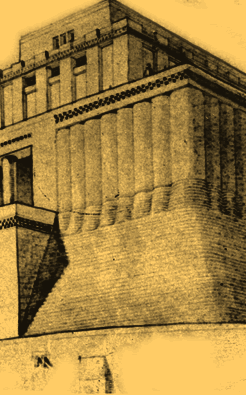
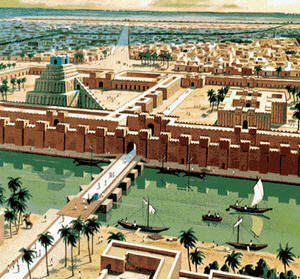
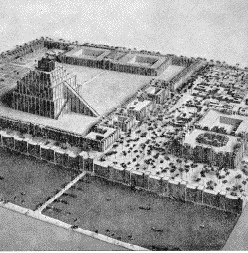
the boat Idhedu […] for the Esagila (Marduk’s ziggurat / temple / residence in Babylon). |
Column ii(…) |
|
on the order of the BREAK lords Nabû and (father) Marduk, he went into the […] inside the house and |
|
no longer went into battle nor started into the field. |
|
In the third year, again, he brought the statue of Nanaya (Nabu’s spouse), the goddess of the Ezida (residence of Nabu & Nanaya in Borsippa), the beloved of Nabû, into the Bit mummi but |
|
kept Nabû in Babylon and had the ceremonies of the evening before and those of the day if the eššešu-festival celebrated in only one day. |
|
He covered the fine garment of Nabû with the fine garment of Bêl (Marduk) of the month Šabatu. |
|
Dressed as the latter, he proposed Bêl’s marriage to Tašmetu (Nabu’s spouse). |
|
Unshaven, he mutilated the fingers of his apprentice scribe, and, wearing fine gold, he entered into Bêl’s cella of offering […]. |
|
A leek, a thing forbidden in the Ezida, he brought to the temple of Nabû and gave to eat to the one “entering the temple” (i.e., the priest). |
|
Ea (Enki), the lord of wisdom, whose dwelling place was founded with pure heaven and earth, |
|
he made him get up from the dwelling place, which befitted his great divinity, and made him sit in the exalted gateway of Bêl. |
|
He removed Madanu, “Bêl of Babylon” (Marduk), his favorite god, from his seat and made him leave. |
|
Without the authority of […] this city, he did as he pleased, |
|
of […]ri, son of […], who |
|
He […] BREAK […] |
|
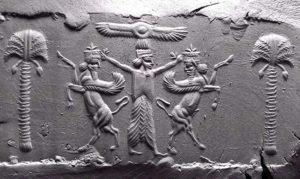
[…] she who sits on the throne […] seven lions. |
|
[…] he unleashed and […] allowed to roam freely. |
|
He had her grasp […] he had her leashed. |
|
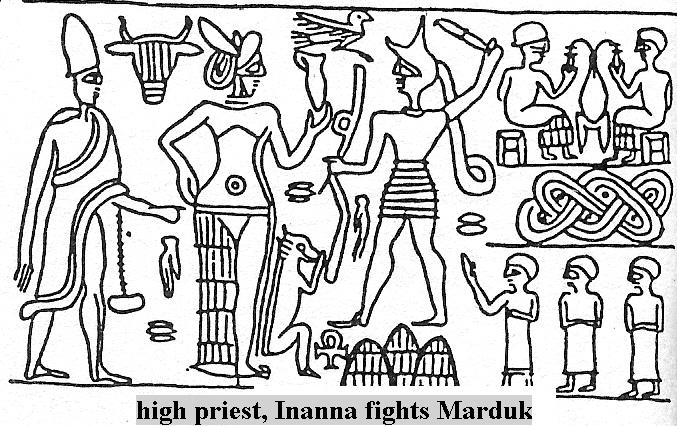
He had […] of Ištar (Inanna) […] disconnected. |
|
[…] to the granary of the verdant countryside he offered […] a dust storm […]. |
|
He presented […] Belet-duri […]. |
|
[…] Nabû, detained several nights in Babylon and […] seated among […] without destinies. |
|
[..] Babylon […] which he destroyed by fire. |
|
[…] the great lord Marduk […] he went to Marduk in place of the king and |
|
[…] he spoke […] was placed. |
|
[…] kept in order […]. |
|
[…] the kneeling lord […] he made sing. |
Column iii[…] Nin […] |
|
When the proud lord, the freedom of Babylon, Borsippa, and Cutha |
|
and the sworn agreements of Enlil-ina-mati, the son of KU[…] BREAK, the governor of Larak, in their time had established |
|
and when he had offered sacrifices at Babylon, Borsippa, and Cutha before Bêl, Nabû, and Nergal. |
|
Year after year, he made unbearable their burden of slaughter, robbery, murder, corvée, and forced labor. |
|
In only one day, he burned alive sixteen Cutheans at Zababa’s (Ninurta) gate in the heart of Babylon. |
|
He delivered inhabitants of Babylon to Hatti and Elam as a token of respect. |
|
He made the inhabitants of Babylon with woman, children, and servants go out and settled them into the countryside. |
|
He heaped up the houses of Babylon’s inhabitants BREAK BREAK into piles of rubble, and he turned them into royal property. |
|
The main street, the avenue of Šarur, his lord’s beloved, who passes through the streets of his city in the month of Ululu, |
|
its passage he blocked off and turned into royal property, making him pass into a cul-de-sac. |
|
He seized Mudammiq-Adad, son of Adad-šuma-ereš, his court opponent, without having committed either a crime or a rebellion, and |
|
his people, as many as there were, he carried off to the Chaldaeans and the Aramaeans, as a sign of respect. |
|
His towns, his fields, his houses, his gardens, and everything that belonged to him, as many as there were, he appropriated for himself. |
|
The man Iltagal-il of the town Dur-ša-Karbi, which is on the bank of the Euphrates, came to his presence and swore agreements and oaths, but |
|
he committed insult and unspeakable slander, that are forbidden of princes, against him and counted his town as booty. |
|
In the sixth year, he turned his attention toward the Esagila, the palace of the Enlil (Earth Colony Commander) of the gods (i.e., Marduk), with a view to restoring it, but |
|
the possessions of the Esagila, as much as was there, what earlier kings had brought there, |
|
he took out, gathered them into his own palace, and made them his own: |
|
silver, gold, choice and priceless stones, and everything that befits a deity, as much as was there. |
|
According to his good pleasure, he made offerings of them to the gods of the Sealand, of the Chaldeans, and of the Aramaeans. |
|
He would adorn the women of his palace with them, and would give them to Hatti and Elam as signs of respect. |
|
At the beginning of the seventh year, he marched on the Bit-Dakkuri for evil. |
|
Afterward, Nabû-šuma-iškun, the Dakkurean, in violation of the sworn agreements and the oath taken by the great gods, |
|
ordered out horses, troops, and chariots and sent them to go on campaign with him. |
|
He distributed bread, beer of the first quality, and flour to all his camp. |
|
In the month of Addaru, the twentieth day, the days of games in honor of Šamaš (Shamash / Utu) and Marduk, he felt no fear with regard to the sworn agreements and oaths. |
|
The people, as many as were lying like cattle in a meadow, made merry and celebrated. |
Column iv(…) |
|
[…] Bêl (Enlil in some texts, Marduk in some texts) […] |
|
[…] Sin (Nannar / Suen) […] he made get up. |
|
[…] in the room […]. |
|
[…] |
|
[…] Babylon […] he […] them. |
|
[…] Babylon. |
|
[…] he […] and […] they knelt. |
|
[…] they made go up […]. “I want to send […]”. |
|
[…] the great lord Marduk […] looked angrily at […] Ezida and |
|
[…] they made […] attack him and he plundered its […]. |
|
[…] his survivors […] confined and |
|
[…] the fugitives […] he returned and |
|
[…] Akkad […] he burned. |
|
[…] Borsippa, […], Dilbat, and Cutha. |
|
[…] toward those who are in the vanguard, […] he stole their goods. |
|
[…] he marched to Larak and […] the governor of Larak. |
|
[…] sworn agreements and oaths before the great gods, seven times, […] entered into with him. |
|
[…] those people, without having committed any crime […] he seized and |
|
[…] he took them away and […] made them live on the steppe. |
|
[…] toward the Bitter Waters […] them. |
|
[…] he reached […] and Nabû who, before […] kept hold of Babylon. |
|
[…] he caused to be done […] Ekur not […] he made him do but |
|
Marduk, the great lord, and Nabû, the exalted crown-prince (Marduk’s 3rd son), commanded his scattering […]. |
|
[…] |
|
[…] |
|
[…] BREAK […] |
|
—————————————— |
Upper edge[Remains of a colophon] |