Author Archives: nibirudb

Eclectic Chronicle (ABC 24)

The translation on this web page was adapted from A.K. Grayson, Assyrian and Babylonian Chronicles (1975) and Jean-Jacques Glassner, Mesopotamian Chronicles (Atlanta, 2004).


(Texts: All Artifacts, Color Coding, & Writings in Bold Type With Italics Inside Parenthesis, are Added by Editor R. Brown, not the Authors, Translators, or Publishers!)

(gods in blue)


The Eclectic Chronicle (ABC 24) is one of the historiographical texts from ancient Babylonia. It deals with events between 1080 and 822 that were important from a Babylonian point of view, but the exact purpose of this text is unclear. Some lines are duplicates of the Walker Chronicle.

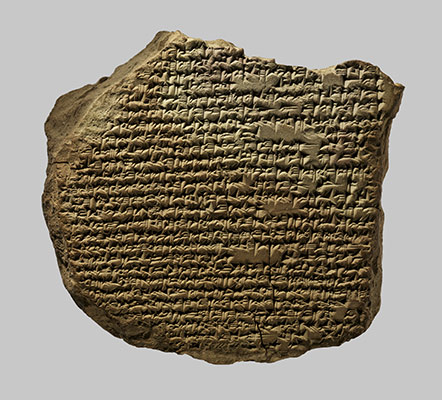
The text of this chronicle is inscribed on a tablet, BM 27859 (98-7-11, 124), the top of which is missing. There is also a large piece missing from the lower left-hand corner. The preserved portion, about two thirds of the text, measures 45 mm wide and 60 mm long.

Translation of obverse

Lacuna

1′ […]

2′ […]

3′ he carried off a great booty.

——————————————

4′ Marduk-šapik-zeri [1], the son of Marduk-nadin-ahhe, rebuilt the wall of Babylon. He conquered the

5′ kings of the lands. During his reign, the people of the land enjoyed prosperity.

6′ He made an entente cordiale with Aššur-bêl-kala, king of Assyria.[2]

7′ At that time, the king went from Assyria to Sippar.

——————————————

8′ Adad-apla-iddina,[3] descendant of Itti-Marduk-balatu, the Arameans and an usurper king rebelled against him

9′ and desecrated all the sanctuaries centers of the land. Der, Dur-Anki (Nippur).

10′ Sippar, Parsa (Dur-Kurigalzu) they demolished. The Suteans attacked and the booty of Sumer and Akkad

11′ they took home. He made frequent visits to the shrines of Marduk and appeased his heart. He totally restored his cult

——————————————

12′ Simbar-šihu, son of Eriba-Sin, knight of the Sealand,

13′ made the throne of Enlil at Ekur-igigal.

——————————————

14′ In the month of Nisannu of the fifth year of Eulmaš-šakin-šumi, the king.[4]

——————————————

15′ The fourteenth year [5]

——————————————

16′ The fourth year of Mar-biti-apla-usur [6]

——————————————

17′ The first year of Nabû-mukin-apli, the king [7]

——————————————

18′ The Nth year

Edge

Lacuna

Translation of reverse

1′ The Nth year of Mar-biti-ahhe-iddina [8]

——————————————

2′ Adad-nirari was the king of Assyria at the time of Šamaš-mudammiq.[9]

——————————————

3′ At the time of Nabû-šuma-ukin, Tukulti-Ninurta was the king of Assyria.[10]

——————————————

4′ At the time of Nabû-apla-iddina, son of Nabû-šuma-ukin, Aššur-nasir-apli was the king of Assyria.[11]

——————————————

5′ At the time of Marduk-zakir-šumi, son of Nabû-apla-iddina, and

6′ Marduk-bêl-usate, Šalmaneser was the king of Assyria.[12]

——————————————

7′ At the time of Marduk-balassu-iqbi and Marduk-zakir-šumi

——————————————

8′ For N years there was no king in the land.[13]

——————————————

9′ Eriba-Marduk, descendant of Marduk-šakin-šumi,

10′ took the hand of Bêl (Marduk) and the son of Bêl (Nabû) in his second year.

11′ The Aramaeans who had taken by murder and insurrection the fields of the inhabitants of Babylon and Borsippa,

12′ Eriba-Marduk slew by the sword, and he brought about their defeat.

13′ He took the fields and orchards away from the and gave them to the [Arameans?] and Borsippeans.

14′ In that same year, he set of the throne of Bêl in Esagila (Marduk’s temple – residence in Babylon) and Ezida (Nabu’s temple – residence in Borsippa) […]

15′ […] Eriba-Marduk […] to Babylon.

——————————————

16′ […] Eriba-Marduk went out from […]

——————————————

17′ […] Nabû-Nasir.[14]

——————————————

18′ […]

——————————————

19′ […] Tiglath-pileser III, king of Assyria, ascended the throne.[15]

——————————————

20′ Šalmaneser, king of Assyria, ascended the throne.”[16]

——————————————

Lacuna

Note 1:
King of Babylonia between 1081 and 1069.

Note 2:
Ruled 1073-1056.

Note 3:
Adad-apla-iddina was king of Babylonia from 1068 to 1047; Itti-Marduk-balatu from 1139 to 1132. The section is identical to several lines from the Walker Chronicle.

Note 4:
This king ruled from 1004 to 988; his fifth year is 1000 BCE.

Note 5:
In this period, only Eulmaš-šakin-šumi had more than thirteen regnal years, so his fourteenth year, 991 BCE) can be meant.

Note 6:
Mar-biti-apla-usur was king of Babylonia from 984 to 979; his fourth year is 981.

Note 7:
This king ruled from 978 to 943.

Note 8:
Became king of Babylonia in 942.

Note 9:
Adad-nirari II ruled from 911 to 891.

Note 10:
Tukulti-Ninurta II was king of Assyria in 890-884.

Note 11:
Aššur-nasir-apli II of Assyria reigned from 883 to 859.

Note 12:
Šalmaneser III of Assyria was king from 858 to 824. His contemporaries can not be dated more accurately.

Note 13:
In fact, an Assyrian king must have ruled over the country The events mentioned in the next section can not be dated exactly.

Note 14:
King of Babylonia, 747-734.

Note 15:
The first full regnal year of Tiglath-pileser III of Assyria is 744; he must have ascended in 745.

Note 16:
The first full regnal year of Šalmaneser V of Assyria is 726; he must have ascended in 727.

Chronicle of the Market Prices (ABC 23)

The translation on this webpage was adapted from A.K. Grayson, Assyrian and Babylonian Chronicles (1975) and Jean-Jacques Glassner, Mesopotamian Chronicles (Atlanta, 2004)


(Texts: All Artifacts, Color Coding, & Writings in Bold Type With Italics Inside Parenthesis, are Added by Editor R. Brown, not the Authors, Translators, or Publishers!)

(mixed-breed demigods in teal…)


The Chronicle of the Market Prices (ABC 23) is a historiographical text from ancient Babylonia. It deals with the prices of commodities and reminds one of similar information in theAstronomical Diaries. The tablet was written in the Seleucid age.

This text is preserved on a broken tablet, BM 48498 (81-11-3, 1209), which measures 30 mm wide and 65 mm long. It is the left-hand side of a medium size tablet. Both surfaces and particularly the reverse are badly marred. A small portion is missing from the bottom of the tablet.

One kor is 180 liter.
A mina is 500 gr.
A is 0.84 or 0.97 liter.
A shekel is 8.33 gr silver.
A sûtu is 6 liter.

Translation Obverse

Obverse

1 In the time of […]

2 N kor of […], wool […]

3 the market prince of his land to […]

——————————————

4 In the time of […]

5 used to be purchased […]

6 10 minas of copper, the market price of his land […]

——————————————

7 In the time of Hammurabi […] [1]

——————————————

8 In the time of Kurigalzu […] [2]

9 3 PI of sesame, 3 minas of wool […]

——————————————

10 The twenty-first year of Merodach-Baladan: […] [3]

11 1 kor of barley, 1 kor of dates […]

——————————————

12 The thirteenth year of […]

——————————————

13 The ninth year of Nebuchadnezzar: […] [4]

——————————————

14 The second[?] year of Marduk-[…] [5]

15 1 sûtu, 3 qû […]

Lacuna

Translation Reverse

Lacuna?

1′ […]

2′ 1 sûtu, N qû […]

——————————————

3′ Year ten, eleven, twelve, thirteen [of …]

4′ one kor of barley […]

5′ for four shekels […]

——————————————

6′ Year five, year six, [of Nabû-šuma-iškun?] [6]

7′ 1 sûtu, 4 qû, […”]

——————————————

Note 1:
Hammurabi
was king of Babylonia from 1792 to 1750 according to the Middle chronology.

Note 2:
Kurigalzu I was king in c.1400, Kurigalzu II in 1332-1308.

Note 3:
Merodach-Baladan (Marduk-apla-iddina) was king from 1171 to 1159.

Note 4:
Nebuchadnezzar I was king from 1125 to 1104.

Note 5:
Several kings are possible: Marduk-nadin-ahhe (1099-1082), Mardik-šapik-zeri (1081-1069), Marduk-ahhe-eriba (1046), and Marduk-zer-xxx (1045-1034).

Note 6:
Nabû-šuma-iškun died in 748 after a reign of at least thirteen years.

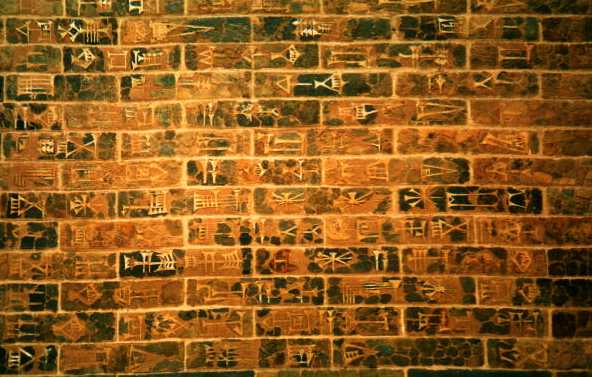
Dedicatory Inscription on the Ishtar Gate, Babylon

(Texts: All Artifacts, Color Coding, & Writings in Bold Type With Italics Inside Parenthesis, are Added by Editor R. Brown, not the Authors, Translators, or Publishers!)

(gods in blue)


TRANSLATION
(Adapted from Marzahn 1995:29-30)


Nebuchadnezzar, King of Babylon, the faithful prince

appointed by the will of Marduk, the highest of princely princes,

beloved of Nabu, of prudent counsel,

who has learned to embrace wisdom,

who fathomed their divine being and reveres their majesty,

the untiring governor, who always takes to heart the care of the cult

of Esagila (Marduk’s temple – residence in Babylon) and Ezida (Nabu’s temple – residence in Borsippa) and is constantly concerned

with the well-being of Babylon and Borsippa,

the wise, the humble, the caretaker of Esagila and Ezida,

the firstborn son of Nabopolassar, the King of Babylon.

Both gate entrances of Imgur-Ellil and Nemetti-Ellil —

following the filling of the street from Babylon—

had become increasingly lower.

Therefore, I pulled down these gates and laid their foundations

at the water-table with asphalt and bricks

and had them made of bricks with blue stone

on which wonderful bulls and dragons were depicted.

I covered their roofs by laying majestic cedars length-wise over them.

I hung doors of cedar adorned with bronze at all the gate openings.

I placed wild bulls and ferocious dragons in the gateways

and thus adorned them with luxurious splendor

so that people might gaze on them in wonder

I let the temple of Esiskursiskur (the highest festival house of Markduk,

the Lord of the Gods—a place of joy and celebration

for the major and minor gods)

be built firm like a mountain in the precinct of Babylon

of asphalt and fired bricks.


DESCRIPTION

Language: Akkadian
Medium: glazed brick
Size: c. 15 meters high
c. 10 meters wide
Length: 60 lines of writing
Genre: Dedication Inscription
Dedicator: Nebuchadnezzar
King of Babylonia
(reigned 605—562 BCE)
Approximate Date: 600 BCE
Place of Discovery: Babylon
(near modern Baghdad, Iraq)
Date of Excavation: 1899—1914
Current Location: Pergamon Museen
(Berlin, Germany)


Poem of the Righteous Sufferer

Source: Foster, Benjamin R. (1995) Before the Muses: myths, tales and poetry of Ancient Mesopotamia, CDL Press, Bethesda, Maryland.

(Texts: All Artifacts, Color Coding, & Writings in Bold Type With Italics Inside Parenthesis, are Added by Editor R. Brown, not the Authors, Translators, or Publishers!)

(gods in blue)

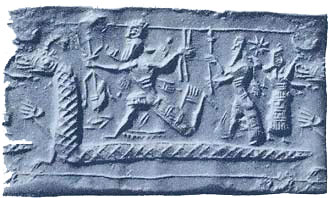
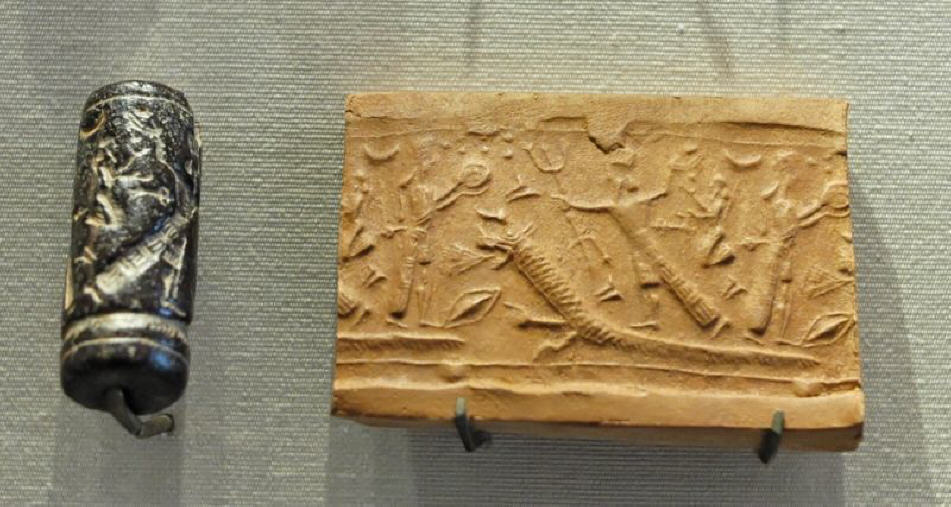
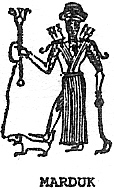
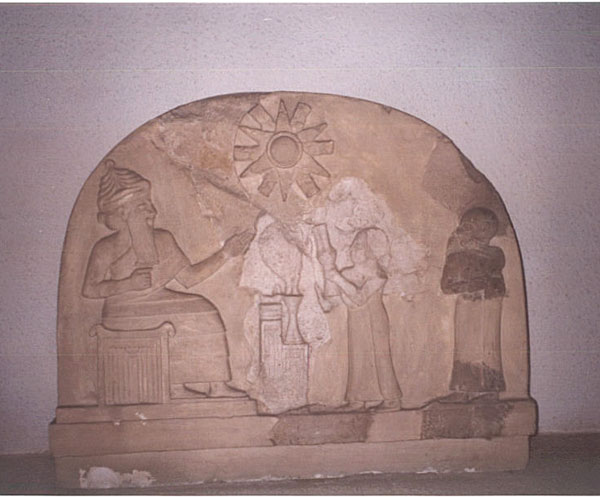
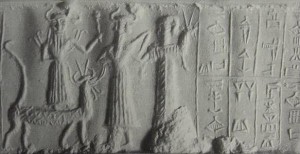
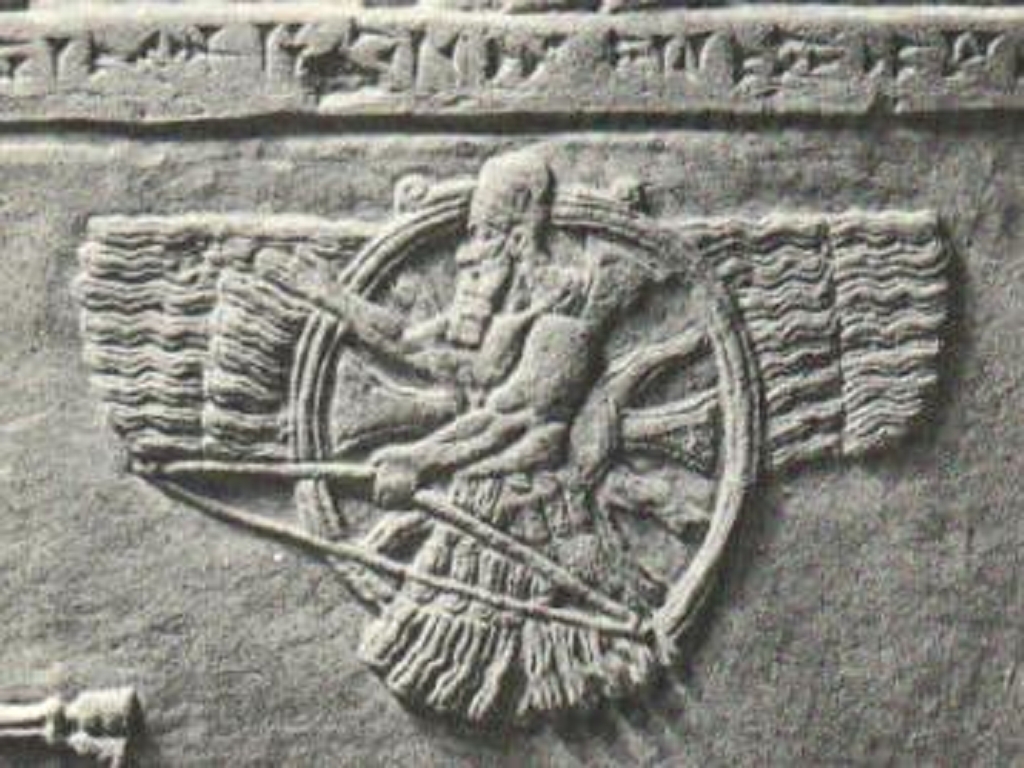
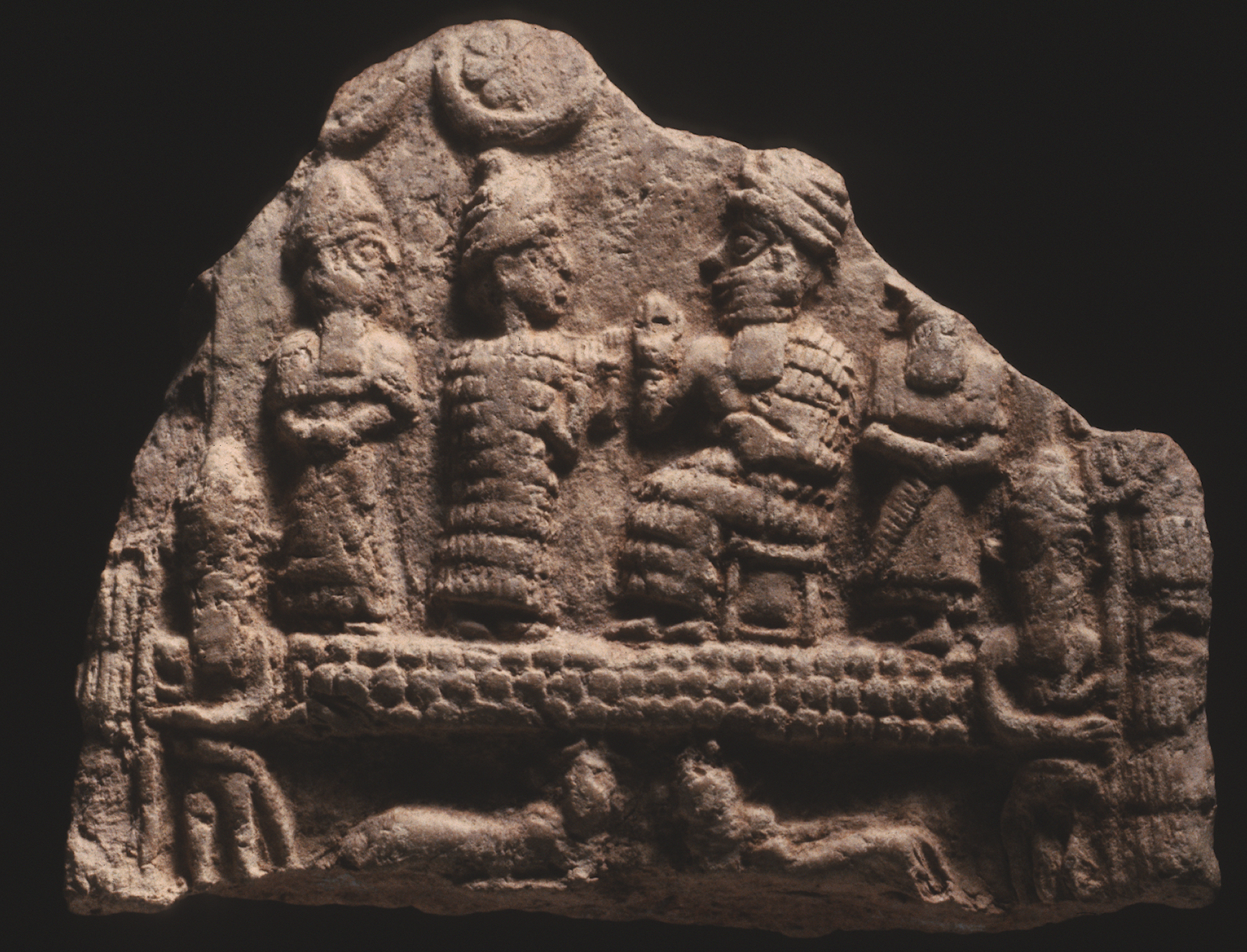
3bb - Marduk in battle riding reptilian symbol

       (Marduk & son Nabu battle cousin alien gods for dominance over gods & earthlings)

   TABLET 1

  1.         I will praise the lord of Wisdom, solicitous god,

  2.         Furious in the night, calming in the daylight;

  3.         Marduk! lord of wisdom, solicitous god,

  4.         Furious in the night, claiming in the daylight;

  5.         Whose anger engulfs like a tempest,

  6.         Whose breeze is sweet as the breath of morn

  7.         In his fury not to be withstood, his rage the deluge,

  8.         Merciful in his feelings, his emotions relenting.

  9.         The skies cannot sustain the weight of his hand,

  10.         His gentle palm rescues the moribund.


                   (Marduk, patron god of Babylon, demanded he become the supreme god over gods & all)

  1.         Marduk! The skies cannot sustain the weight of his hand,

  2.         His gentle palm rescues the moribund.

  3.         When he is angry, graves are dug,

  4.         His mercy raised the fallen from disaster.

  5.         When he glowers, protective spirits take flight,

  6.         He has regard for and turns to the one whose god has forsaken him.

  7.         Harsh is his punishments, he…. in battles (?)

  8.         When moved to mercy, he quickly feels pain like a mother in labor.

  9.         He is bull-headed in love of mercy

  10.         Like a cow with a calf, he keeps turning around watchfully.

  11.         His scourge is barbed and punctures the body,

  12.         His bandages are soothing, they heal the doomed.

  13.         He speaks and makes one incur many sins,

  14.         On the day of his justice sin and guilt are dispelled.

  15.         He is the one who makes shivering and trembling,

  16.         Through his sacral spell chills and shivering are relieved.

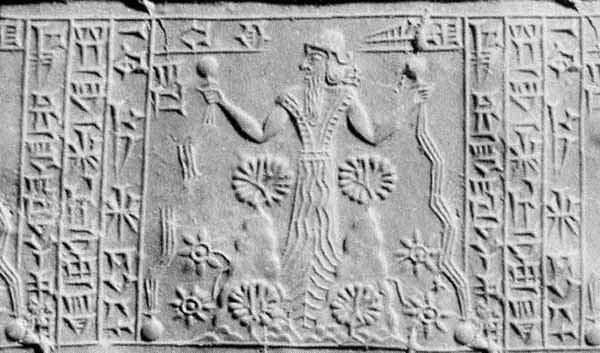
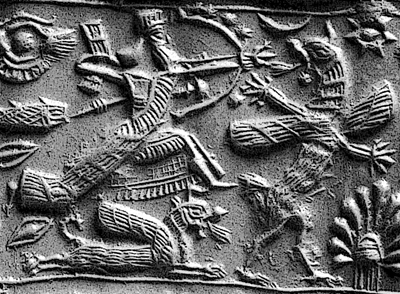
           OLYMPUS DIGITAL CAMERA2b - Nergal, god of the Underworld (warriors Adad & Nergal with alien weaponry)

  1.         Who raises the flood of Adad, the blow of Erra (Nergal),

  2.         Who reconciles the warthful god and goddess

  3.         The Lord divines the gods´ inmost thoughts

  4.         But no god understand his behavior,

  5.         Marduk divines the gods´s inmost thoughts

  6.         But no god understand his behavior!

  7.         As heavy his hand, so compassionate his heart

  8.         As brutal his weapons, no life-sustaining his feelings,

  9.         Without his consent, who could cure his blow?

  10.         Against his will, who could sin and escape?

  11.         I will proclaim his anger, which runs deep, like a fish,

  12.         He punished me abruptly, then granted life

  13.         To be mindful of him is propitious for ……

  14.         After the Lord changed day into night

          2aa - Marduk, older brother to many siblings 2a - Nabu, Canaanite god  (Marduk, god causing many wars against Enlil‘s descendants & followers)

  1.         And the warrior Marduk became furious with me,

  2.         My own god threw me over and disappeared,

  3.         My goddess broke rank and vanished

  4.         He cut off the benevolent angel who walked beside me

  5.         My protecting spirit was frightened off, to seek out someone else

  6.         My vigor was taken away, my manly appearance became gloomy,

  7.         My dignity flew off, my cover leaped away.

  8.         Terrifying signs beset me

  9.         I was forced out of my house, I wandered outside,

  10.         My omens were confused, they were abnormal every day,

  11.         The prognostication of diviner and dream interpreter could not explain what I was undergoing.

  12.         What was said in the street portended ill for me,

  13.         When I lay down at nights, my dream was terrifying

  14.         The king, incarnation of the gods, sun of his people

  15.         His heart was enraged with me and appeasing him was impossible

  16.         Courtiers were plotting hostile against me,

  17.         They gathered themselves to instigate base deeds:

  18.         Says the second “I ousted him from his command”

  19.         So likewise the third “I will get my hands on his post!”

  20.         “I will force his house!” vows the fourth

  21.         As the fifth pants to speak

  22.         Sixth and seventh follow in his train!” (literally in his protective spirit)

  23.         The clique of seven have massed their forces,

  24.         Merciless as fiends, equal to demons.

  25.         So one is their body, united in purpose,

  26.         Their hearts fulminate against me, ablaze like fire.

  27.         Slander and lies they try to lend credence against me

  28.         My mouth once proud was muzzled like a ….

  29.         My lips, which used to discourse, became those of a dead man.

  30.         My resounding call struck dumb,

  31.         My proud head bent earthward,

  32.         My stout heart turned feeble for terror,

  33.         My broad breast brushed aside by a novice,

  34.         My far-reaching arms pinned down by flimsy matting,

  35.         I, who walked proudly, learned slinking,

  36.         I, so grand, became servile,

  37.         To my vast family, I became a loner,

  38.         As I went through the streets, ears were pricked up at me,

  39.         I would enter the palace, eyes would squint at me,

  40.         My city was glowering at me like an enemy,

  41.         Belligerent and hostile would seem my land!

  42.         My brother became my foe,

  43.         My friend became a malignant demon,

  44.         My comrade would denounce me savagely,

  45.         My colleague was constantly keeping the taint to this weapons,

  46.         My best friend would pinch off my life.

  47.         My slave cursed me openly in the assembly of gentlefolk

  48.         My slavegirl defamed me before the rabble.

  49.         An acquaintance would see me and make himself scarce,

  50.         My family disowned me,

  51.         A pit awaited anyone speaking well of me,

  52.         While he who was uttering defamation of me forged ahead.

  53.         One who relayed base things about me had a god for his help

  54.         For the one who said “What a pity about him!” death came early,

  55.         The one of no help, his life became charmed,

  56.         I had no one to go at my side, nor saw I a champion.

  57.         They parceled my possessions among the riffraff,

  58.         The sources of my watercourses they blocked with muck,

  59.         They chased the harvest song from my fields,

  60.         They left my community deathly still, like that of a ravaged foe.

  61.         They let another assume my duties,

  62.         They appointed an outsider to my prerogatives.

  63.         By day sighing, by night lamentation,

  64.         Monthly, trepidation, despair the year,

  65.         I moaned like a dove all my days,

  66.         I let out groans as my song,

  67.         My eyes are forced to look through constant crying,

  68.         My eyelids are smarting through of tears.

  69.         My face is darkened from the apprehensions of my heart,

  70.         Terror and pain have jaundiced my face.

  71.         The…. of my heart is quaking in ceaseless apprehension.

  72.         ….. like a burning fire,

  73.         Like the bursting of a flame falsehood beset me,

  74.         …. lamentation, my imploring!

  75.         The speech of lips was senseless, like a moron´s,

  76.         When I tried to talk, my conversation was gibberish.

  77.         I watch, that in daylight good will come upon me!

  78.         The moon will change, the sun will shine!

  TABLET II

  1.         One whole year to the next! The normal time passed.

  2.         As I turned around, it was more and more terrible,

  3.         My ill luck was on the increase, I could find no good fortune.

  4.         I called to my god, he did not show his face,

  5.         I prayed to my goddess, she did not raise her head.

  6.         The diviner with his inspection did not get the bottom of it,

  7.         Nor did the dream interpreter with his incense clear up my case

  8.         I beseeched a dream spirit, but it did not enlighten me,

  9.         The exorcist with his ritual did not appease divine wrath.

  10.         What bizarre actions everywhere!

  11.         I looked behind: persecution, harassment!

  12.         Like one who had not made libations to his god,

  13.         Nor invoked his goddess with a food offering,

  14.         Who was not wont to prostrate, nor seen to bow down,

  15.         From whose mouth supplication and prayer were wanting,

  16.         Who skipped holy days, despised festivals,

  17.         Who was neglectful, omitted the gods´ rites,

  18.         Who had not taught his people reverence and worship,

  19.         Who did not invoke his god, but ate his food offering,

  20.         Who snubbed his goddess, brought her no flour offering,

  21.         Like one possessed, who forgot his lord,

  22.         Who casually swore a solemn oath by his god; I indeed seemed such a one!

  23.         I, for my part, was mindful of supplication and prayer,

  24.         Prayer to me was the natural recourse, sacrifice my rule.

  25.         The day for reverencing the gods was a source of satisfaction to me,

  26.         The goddess´s procession day was my profit and return.

  27.         Praying for the king, that was my joy,

  28.         His sennet was if for my own good omen.

  29.         I instructed my land to observe the god´s rites,

  30.         The goddess´s name did I drill my people to esteem

  31.         I made my praises of the king like a god´s,

  32.         And taught the populace reverence for the palace.

  33.         I wish I knew that these things were pleasing to a god!

  34.         What seems good to one´s self could be an offense to a god,

  35.         What in one´s own heart seems abominable, could be good to one´s god!

  36.         Who could learn the reasoning of the gods in heaven?

  37.         Who could grasp the intentions of the gods of the depths?

  38.         Where might human beings have learned the ways of a god?

  39.         He who lived by his brawn died in confinement.

  40.         Suddenly one is downcast, in a trice full of cheer,

  41.         One moment he sings in exaltation,

  42.         In a trice he groans like a professional mourner.

  43.         People´s motivations change in a twinkling!

  44.         Starving, they become like corpses,

  45.         Full, they would rival their gods.

  46.         In good times, they speak of scaling heaven,

  47.         When it goes badly, they complain of going down to hell.

  48.         I have pondered these things; I have made no sense of them.

  49.         But as for me, in despair a whirlwind is driving me!

  50.         Debilitating disease is let loose upon me:]

  51.         An evil vapor has blown against me from the ends of the earth,

  52.         Head pain has surged upon me from the breast of hell,

  53.         A malignant specter has come froth from its hidden depth,

  54.         A relentless ghost came out of its dwelling place.

  55.         A she-demon came down from the mountain,

  56.         Ague set forth with the flood and sea,

  57.         Debility broke through the ground with the plants.

  58.         They assembled their host, together they came upon me:

  59.         My features were gloomy, my eyes ran a flood,

  60.         They wrenched my muscles, made my neck limp,

  61.         They thwacked my chest, pounded my breast,

  62.         They affected my flesh, threw me into convulsion,

  63.         They kindled a fire in my epigastrium,

  64.         They churned up my bowels, they twisted my entrails

  65.         Coughing and hacking infected my lungs,

  66.         They infected my limbs, made my flesh pasty,

  67.          My lofty stature they toppled like a wall,

  68.         My robust figure they flattened like a bulrush,

  69.         I was dropped like a dried fig, I was tossed on my face.

  70.         A demon has clothed himself in my body for a garment,

  71.         Drowsiness smothers me like a net,

  72.         My eyes stare, they cannot see,

  73.         My ears prick up, they cannot hear.

  74.         Numbness has spread over my whole body,

  75.         Paralysis has fallen upon my flesh.

  76.         Stiffness has seized my arms,

  77.         Debility has fallen upon my loins,

  78.         My feet forgot how to move.

  79.         A stroke has overcome me, I choke like one fallen

  80.         Signs of death have shrouded my face!

  81.         If someone thinks of me, I can´t respond to the enquirer,

  82.         “Alas” they weep, I have lost consciousness,

  83.         A snare is laid on my mouth,

  84.         And a bolt bars my lips,

  85.         My way in is barred, my point of slaking blocked,

  86.         My hunger is chronic, my gullet constricted.

  87.         If it be of grain, I choke it down like stinkweed,

  88.         Beer, the sustenance of mankind , is sickening to me.

  89.         Indeed, the malady drags on!

  90.         For lack of food my features are unrecognizable,

  91.         My flesh is waste, my blood has run dry,

  92.         My bones are loose, covered only with skin,

  93.         My tissues are inflamed, afflicted with grangrene.

  94.         I took to bed, confined, going out was exhaustion,

  95.         My house turned into my prison.

  96.         My flesh was a shackle, my arms being useless,

  97.         My person was a fetter, my feet having given way.

  98.         My afflictions were grievous, the blow was severe!

  99.         A scourge full of barbs thrashed me,

  100.         A crop lacerated me, cruel with thorns,

  101.         All day long tormentor would torment me,

  102.         Nor a night would he let me breathe freely a moment

  103.         My limbs were splayed and thrust apart.

  104.         I spent the night in my dung like an ox,

  105.         I wallowed in my excrement like a sheep.

  106.         The exorcist recoiled from my symptoms,

  107.         While my omens have perplexed the diviner.

  108.         The exorcist did not clarify the nature of my complaint,

  109.         While the diviner put no time limit on my illness.

  110.         No god came to the rescue, nor lent me a hand,

  111.         No goddess took pity on me, nor went at my side.

  112.         My grave was open, my funerary gods ready,

  113.         Before I had died, lamentation for me was done.

  114.         All my country said, “How wretched he was!”

  115.         When my ill-wisher heard, his face lit up,

  116.         When the tidings reached her, my ill-wisher, her mood became radiant,

  117.         The day grew dim for my whole family

  118.         For those who knew me, their sun grew dark.

TABLET III

  1.         Heavy was his hand upon me, I could not hear ti!

  2.         Dread of him was oppressive, it …. me.

  3.         His fierce punishment…. the deluge,

  4.         His stride was…., it….

  5.         Harsh, severe illness does not…. my person,

  6.         I lost sight of alertness, ….. make my mind stray,

  7.         I groan day and night alike,

  8.         Dreaming and waking I am equally wretched.

  9.         A remarkable young man of extraordinary physique,

  10.         Magnificent in body, clothed in new garments,

  11.         Because I was only half awake, his features lacked form.

  12.         He was clad in splendor, robed in dread –

  13.         He came in upon me, he stood over me,

  14.         When I saw him my flesh grew numb.

  15.         [ ] “The Lady has sent me,

  16.         ” [ ]”.

  17.         [ ] I tried to tell my people (Lishtar´s Note: he probably tried to tell his family)

  18.         “[ ] sent [ ] for me”.

  19.         They were silent and did not speak,

  20.         They heard me in silence and did not answer.

  21.         A second time I saw a dream

  22.         In the dream I saw at night

  23.         A remarkable purifier [ ]

  24.         Holding in his hand a tamarisk rod of purification.

  25.         “Laluralimma (Lishtar´s Note: an accademic Sumerian name, meaning probably a sage), resident of Nippur,

  26.         Has sent me to cleanse you”.

  27.         He was carrying water, he poured it over me,

  28.         He pronounced the resuscitating incantation, he massaged my body.

  29.         A third time I saw a dream,

  30.         In my dream I saw at night:

  31.         A remarkable young woman in shining countenance,

  32.         Clothed like a person, being like a god,

  33.         A queen among peoples []

  34.         She entered upon me and sat down….

  35.         She ordered my deliverance [ ]

  36.         “Fear not” She said, “I will……….,

  37.         “Whatever one sees of a dream……….”.

  38.         She ordered my deliverance, “Most wretched indeed is he,

  39.         “Whoever he might be,….. the one who saw the vision at night”

  40.         In the dream was Ur-Nintinugga, a Babylonian

  41.         A bearded young man wearing a tiara,

  42.         He was an exorcist, carrying a tablet,

          2d - Marduk & flying discs  (Marduk, eldest son to Enki, with winged sky-discs above)

  1.         “Marduk has sent me!

  2.         “To Shubshi-meshre-Sakkan [the sufferer] I have brought swathe,

  3.         “From his pure hands I have brought a swathe”.

  4.         He has entrusted me into the hands of my ministrant.

  5.         In waking hours he sent a message,

  6.         He revealed his favorable sign to my people.

  7.         I was awake in my sickness, a healing serpent slithered by [the symbol of the healing goddess]

  8.         My illness was quickly over, my fetters were broken

  9.         After my lord´s heart had quieted,

  10.         And the feelings of merciful Marduk were appeased,

  11.         And he had accepted my prayers,

  12.         His sweet relenting ……

  13.         He ordered my deliverance:” He is greatly tried”

  14.         …. to extol…

  15.         …. to worship and …..

  16.         …. my guilt…..

  17.         …. my iniquity….

  18.         …. my transgression….

  19.         He made the wind hear away my offenses

(The exact placement of the following lines is unknown)

  1.         He applied to me his spell which binds debilitating disease

  2.         He drove back the evil vapor to the ends of the earth,

  3.         He bore off the head pain to the breast of hell,

  4.         He sent down the malignant specter to its hidden depth,

  5.         The relentless ghost he returned to its dwelling

  6.         He overthrew the she-demon, sending her off to a mountain,

  7.         He replaced the ague in flood and sea.

  8.         He eradicated debility like a plant,

  9.         Uneasy sleep, excessive drowsiness,

  10.         He dissipated like smoke filling the sky.

  11.         The turning towards people with “Woe!” and “Alas!” he drove away like a cloud, earth….

  12.         The tenacious disease in the head, which was heavy as a millstone,

  13.         He raised like dew of night, he removed it from me.

  14.         My beclouded eyes, which were wrapped in the shroud of death,

  15.         He drove the cloud a thousand leagues away, he brightened my vision.

  16.         My ears, which were stopped and clogged like a deaf man´s,

  17.         He removed their blockage, he opened my hearing.

  18.         My nose, whose breathing was choked by symptoms of fever,

  19.         He soothed its affliction so I could breathe freely.

  20.         My babbling lips, which had taken on a hard crust,

  21.         He wiped away their distress and undid their deformation.

  22.         My mouth, which was muffled, so that proper speech was difficult,

  23.         He scoured like copper and removed its filth.

  24.         My teeth, which were clenched and locked together firmly,

  25.         He opened their fastening, freed the jaws.

  26.         My tongue, which was tied and could not converse,

  27.         He wiped off its coating and its speech became fluent.

  28.         My windpipe, which was tight and choking, as though on a gobbet,

  29.         He made well and let it sing its songs like a flute.

  30.         My gullet, which was swollen so it could not take food,

  31.         Its swelling went down and he opened its blockage

  32.         My… which…

  33.         …. above….

  34.         …. which was darkened like

   (three damaged lines, then gap)

TABLET IV

   (FRAGMENT A)

  1.         The Lord…. me

  2.         The Lord took hold of me,

  3.         The Lord set me on my feet,

  4.         The Lord revived me,

  5.         He rescued me from the pit

  6.         He summoned me from destruction

  7.         …. he pulled me from the river of death,

  8.         …. he took my hand.

  9.         He who smote me,

  10.         Marduk, he restored me!

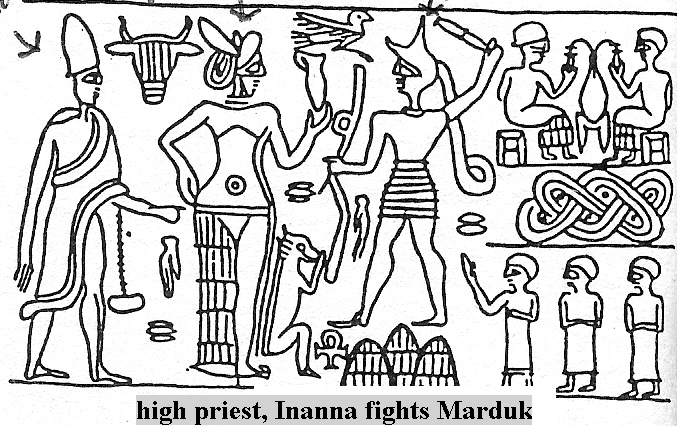
          3d - Marduk waging war on Inanna & cousins  (Marduk & son Nabu attack Inanna, Ninhursag warns against it)

  1.         It was Marduk who made him drop his weapon.

  2.         He …. the attack of my foe,

  3.         It was Marduk who……

    (Two fragmentary lines, then gap.

Insert here, perhaps, two lines known only from an ancient commentary)

   At the place of the river ordeal,

   where people´s fates are decided,

   I was struck on the forehead, my slavemarks removed

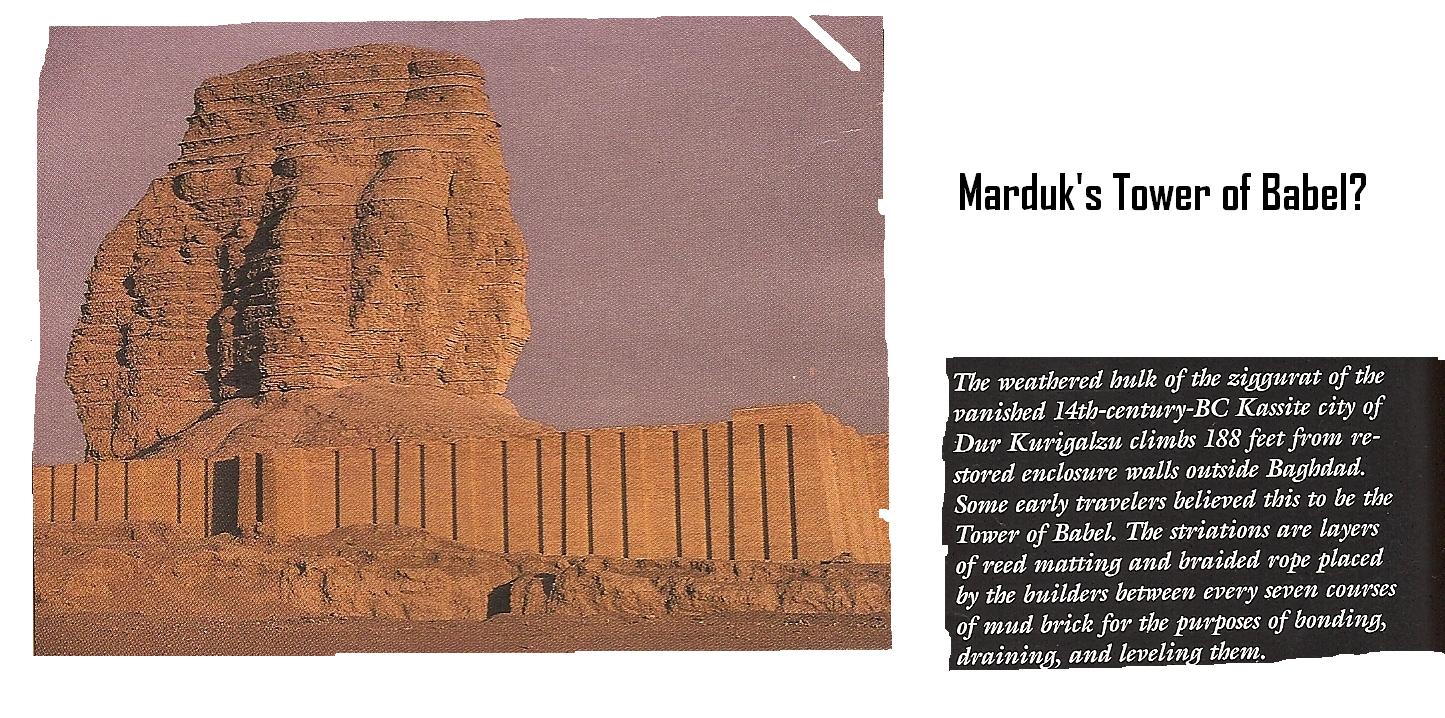
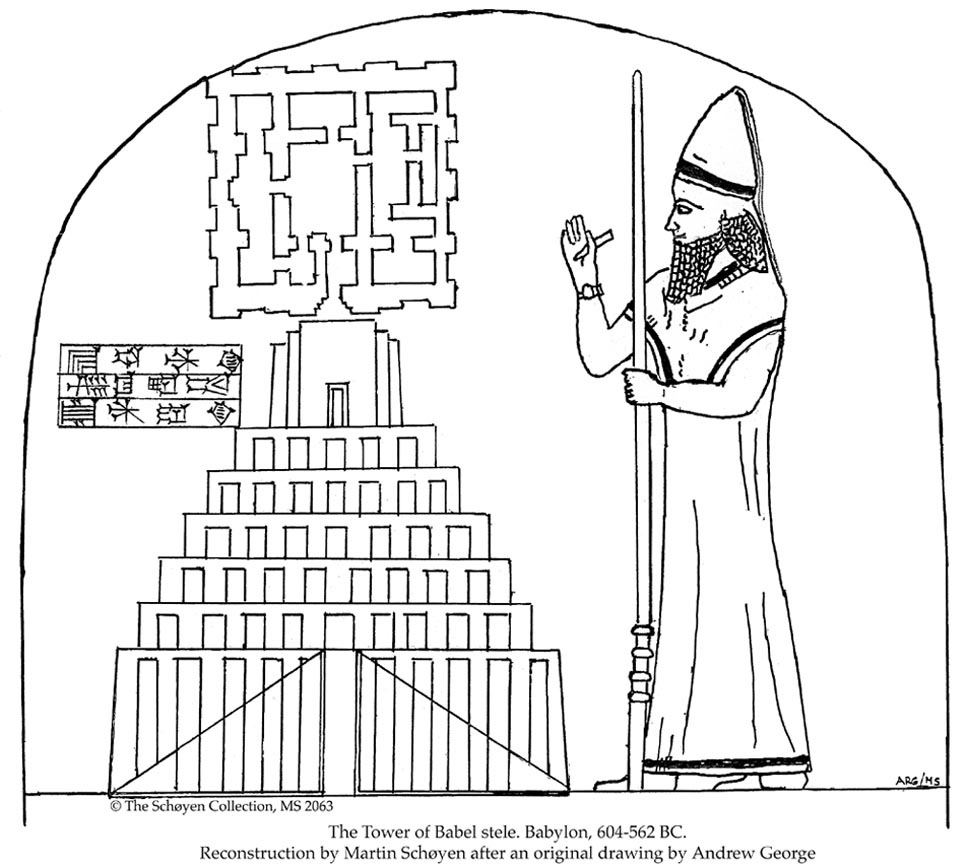
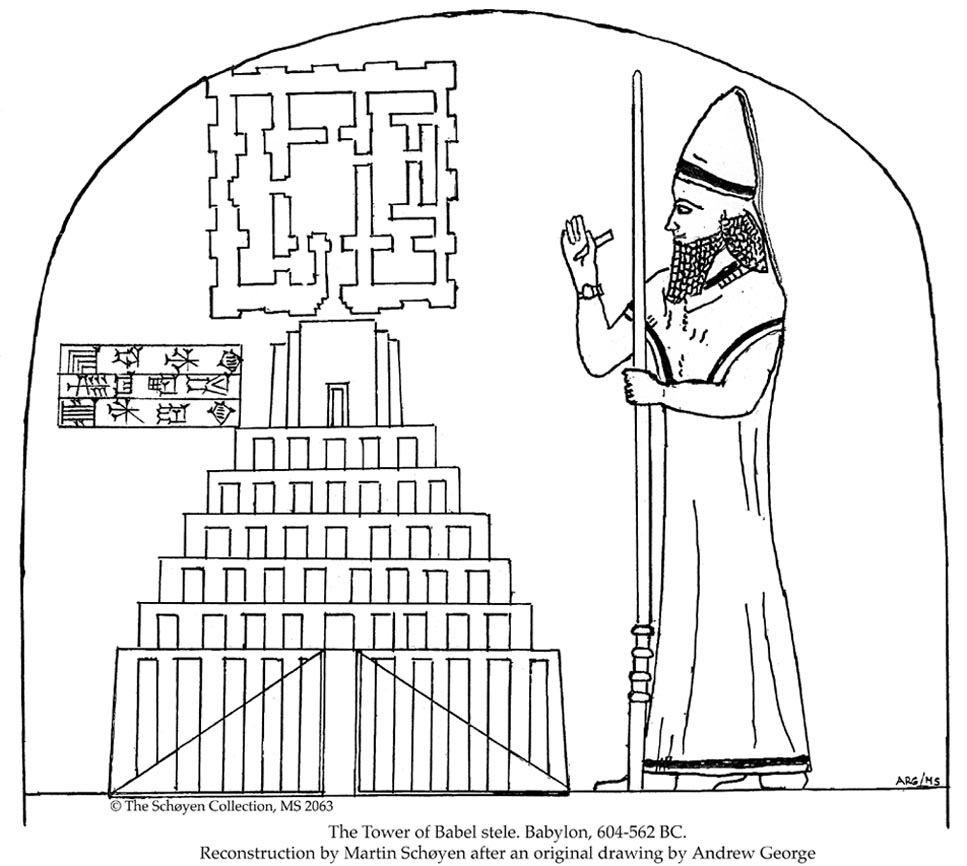
8c - Tower of Babel, Marduk's Unauthorized Spaceport (Marduk‘s mud brick-built landing site)

FRAGMENT B

  1.         [ ] which in my prayers….

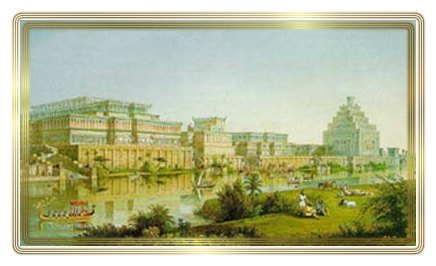
               3d - Babylon, Marduk's Home  (Babylon & Marduk‘s Temple ziggurat / residence)

  2.         With prostration and supplication [ ] to Esagila (Marduk‘s ziggurat residence in Babylon) [ ]

  3.         I who went down to the grave have returned to the Gate of Sunrise

  4.         In the Gate of Prosperity prosperity was given me

  5.         In the Gateway of the Guardian Spirit, a guardian spirit drew nigh to me,

  6.         In the Gate of Well-being I beheld well-being

  7.         In the Gate of Life I was granted life

  8.         In the Gate of Sunrise I was reckoned among the living

  9.         In the Gate of Splendid Wonderment my signs were plain to see.

  10.         In the Gate of Release from Guilt, I was released from my bond.

  11.         In the Gate of Petition my mouth made inquiry.

  12.         In the Gate of Release from Sighing my sighs were released.

  13.         In the Gate of Pure Water, I was sprinkled with purifying water.

  14.         In the Gate of Conciliation, I appeared with Marduk,

  15.         In the Gate of Joy I kissed the foot of Sarpanitum (Marduk‘s spouse),

  16.         I was assiduous in supplication and prayer before them,

  17.         I placed fragrant incense before them,

  18.         An offering, a gift, sundry donations I presented,

  19.         Many fatted oxen I slaughtered, butchered many… (to feed the giant gods)

  20.         Honey-sweet beer and pure wine I repeatedly libated, (beer, drink of the gods)

  21.         The protecting genius, the guardian spirit, divine attendants of the fabric of Esagila (Marduk‘s temple residence),

  22.         I made their feelings glow with libation,

  23.         I made them exultant with lavish meals.

  24.         To the threshold, the bolt socket, the bolt, the doors

  25.         I offered oil, butterfat, and choicest grain,

  26.         [ ] the rites of the temple

   (large gap)

Insert here four lines quoted in an ancient commentary

  1.         I proceeded along Kunush-kadru Street in a state of redemption,

  2.         He who has done wrong by Esagila, let him learn from me.

  3.         It was Marduk who put a muzzle on the mouth of the lion that was devouring me.

  4.         Marduk took away the sling of my pursuer and deflected slingstone.

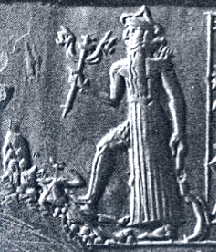
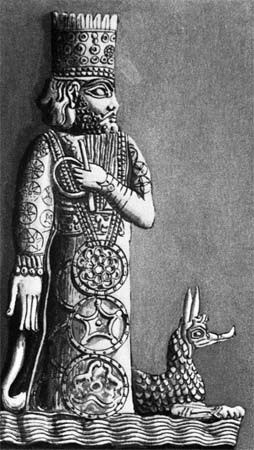
3 - Marduk & his symbol (Marduk & his dragon symbol, alien advanced technologies, rocket atop temple in background)

  FRAGMENT C

  1.         [ ] golden grain

  2.         He anointed himself with sweet cedar perfume upon him,

  3.         A feast for the Babylonians ……………..

  4.         His tomb he had made was set up for a feast!

  5.         The Babylonians saw how Marduk can restore to life,

  6.         And all mouths proclaimed his greatness,

  7.         “Who would have said he would see his sun?

  8.         “Who would have imagined that we would pass through his street?

  9.         “Who but Marduk revived him as he was dying?

  10.         “Besides Sarpanitum, which goddess bestowed his breath of life?

  11.         “Marduk can restore to life from the grave,

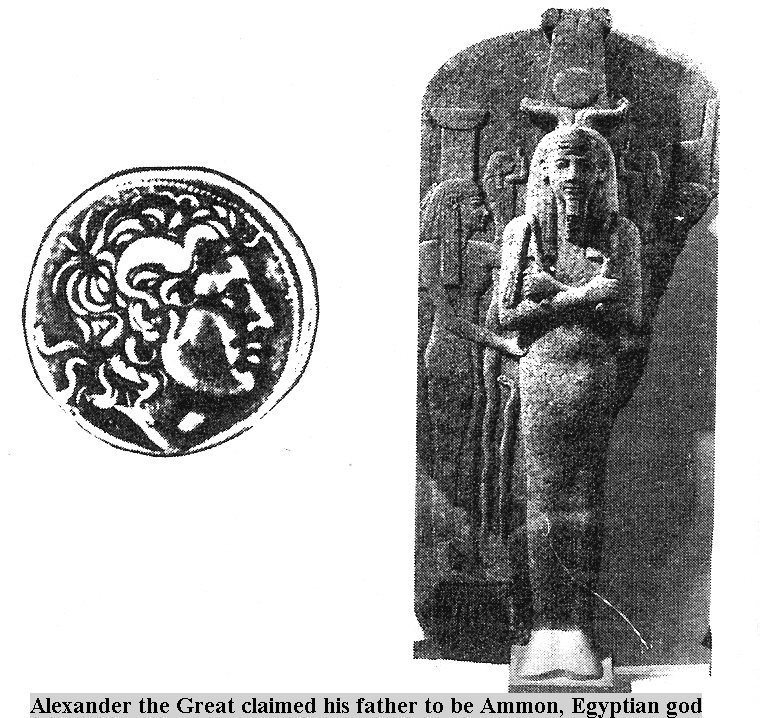
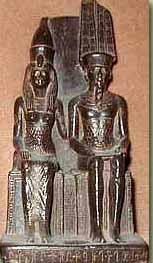
           8e - Alexander the Great & his father Ammon Ra 13b - Mut & Amun Ra

              (Alexander “the Great” & his proclaimed father Marduk; Sarpanitum & Marduk)

  1.         “Sarpanitum (Marduk‘s spouse) knows how to rescue from annihilation,

  2.         “Wherever earth is founded, heavens are stretched wide,

  3.         “Wherever sun shines, fire ablazes,

  4.         “Wherever water runs, wind blows,

                4 - Ninhursag in her Lab, holding the molded Adapa

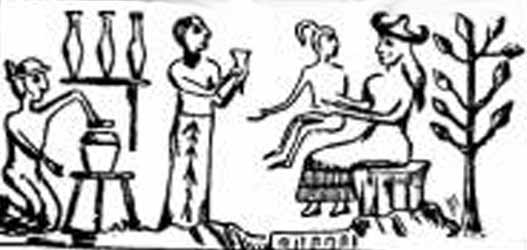
(clay mixing vessels, lab assistants, newly fashioned “modern man” / baby Biblical Adam, DNA specialist Ninhursag, & “Tree of Life“)           

  1.         “Those whose bits of clay Aruru (Ninhursag) pinched off to form them,

  2.         “Those endowed with life, who walk upright,

  3.         “Teeming mankind as many they be, give praise to Marduk!

  4.         “[…] those who can speak

  5.         “[…] may he rule all the peoples

  6.         “[…] shepherd of all habitations

  7.         “[…] floods from the deep..

  8.         “[…] the gods [ ]

  9.         “[…] the extent of heaven and netherworld

  10.         “[…………………………………………….]

  11.         “[…] was getting darker and darker for him”.

A Hymn to Marduk for a King: translation

The Electronic Text Corpus of Sumerian Literature

(Texts: All Artifacts, Color Coding, & Writings in Bold Type With Italics Inside Parenthesis, are Added by Editor R. Brown, not the Authors, Translators, or Publishers!)

(gods in blue)


                          (Hymn to Marduk;                   eldest son to Enki, eldest grandson to King Anu)

             1-13 May Marduk grant life!

          May he make your …… full!

          May Marduk decree life for you!

          May he prolong your life, and may he let you keep it for everlasting days!

          May you live, and may you have peace!

          May it last forever!

          May life be your lot, and may a life of contentment be your share!

          When you lie down to sleep, may your dreams be propitious, and when you rise, may your omens be favorable!

          Wherever you walk, may you be established in peace!

             14-29 May the life of my king be pleasant in the eyes of An (Anu), father of the gods (“who came down”)!

          3b - Anu of planet Nibiru (alien Anunnaki King Anu,” father of the gods” ruling Earth Colony)

          May he let you wear your royal …… in the Land!

          May your …… throne be …… until distant days!

          ……, may it last forever, and may life be your lot!

          May Aya (Utu‘s spouse)…… life, …… your strength!

          1 line unclear

          May it be your lot to be a god, eating food and …… peaceful water (1 ms. has instead: drinking water …… ) of long life!

          May a divine command bestow life on you!

          May you live, and may you have peace!

          May it last forever and may life be your lot!

          May a life of contentment be your share!

          When you lie down to sleep, may your dreams be propitious, and when you rise, may your omens be favorable!

          Wherever you walk, may you be established in peace!

          May you live for everlasting days ……!

A Hymn to Asarluḫi (Asarluḫi A)

The Electronic Text Corpus of Sumerian Literature

(Texts: All Artifacts, Color Coding, & Writings in Bold Type With Italics Inside Parenthesis, are Added by Editor R. Brown, not the Authors, Translators, or Publishers!)

(gods in blue)

          1-11. 5 lines missing
           …… new ……. …… august words.

            2a - Enki keeper of the MUs-knowledge disks (Enki, eldest & wisest alien giant on Earth, 1st to arrive on Earth with crew of 50)

          Enki has named you with the name Id-lu-rugu

          (i.e. River of the ordeal, an epithet of Asarluḫi (Enki‘s son Marduk)), the sublime course .….

          You cleanse the just man like gold, and you hand over the wicked to extinction.

          12-19. Nourished on the good milk of intelligence, advice and reason, his voice resounds loudly.

          August sage, firstborn son of Enki (Marduk), he gives …… to all who are born.

          Profoundly intelligent, as wise as his father, possessed of understanding,

             2b - Marduk, son & heir to Enki  (Asarluhi / Marduk, patron god of Babylon, then of Egypt)

          Asarluḫi penetrates everything.

          Nothing …… him.

          Lordly son of the abzu, endowed with holy wisdom, he is Marduk, the bringer of counsel.

          Tall in stature, he can survey all the divine powers (alien technologies) of heaven and earth.

          20-28. Son endowed with a broad understanding,

          whose movement is that of an animal with large horns in the split reeds;

2e - giant Marduk, father to Seth, Ashur, & Nabu (mixed-breed high-priest & or king stands before giant god Marduk)

          Asarluḫi, mighty deluge determining great fates, unleashed and knowing no course whatsoever!

              7 - Anu meets 1st earthling hybrids Adapa & Titi  (King Anu meets son Enki‘s newly fashioned advanced earthlings, replacement workers for gods) 

          When great An (Anu) shared out the divine powers for heaven and earth, incantations fell to your lot.

          Scanning all mankind with a glance, god of benign features, with an attractive physique;

          most skilled metalworker, creating masterpieces; counselor and judge,

          whose word in the august sanctuary is unalterable and whose character is sublime:

          I shall exalt him in song and glorify his name.

               3a - Marduk & his reptilian symbol  (Marduk, son Nabu, & mixed-breed king with dinner offering)

          29-36. Eloquent one of the abzu, great minister of Eridug (Eridu, Enki‘s city), lordly Asarluḫi!

          The enkum and ninkum priests, the abgal and abrig priests,

          the …… priestesses and the …… all pay attention when you open your holy mouth.

          Daily as they go forth, they circumambulate (?) you.

          Cleansing the purification rites with pure hands and pure tread,

          holy in every respect, you are the supervisor of the purification priests of E-abzu.

          37-41. Kuara, the beloved city which you have chosen in your heart, lives in joy because of you.

          The generous-hearted Prince (Enki) named you with the name Asarluḫi.

          2 lines unclear or fragmentary

          up to 5 lines missing

Nebuchadnezzar and Marduk

Unidentified web source

(Texts: All Artifacts, Color Coding, & Writings in Bold Type With Italics Inside Parenthesis, are Added by Editor R. Brown, not the Authors, Translators, or Publishers!)

(gods in blue)

:

When Nebuchadnezzar [the king] dwelt in Babylon,

He would roar like a lion, would rum[ble] like thunder,

His illustrious great men would roar like lions.

2c - Marduk relief, flowing waters of Babylon (Marduk, supreme lord over Babylon)

[His] prayers went up to Marduk, lord of Babylon,

“Have mercy on me, in despair and pros[trate],*

“Have mercy on my land, which weeps and mourns,

“Have mercy on my people, who wail and weep!

“How long, O lord of Babylon,

Will you dwell in the land of the enemy?

“May beautiful Babylon pass through your heart,

“Turn your face towards Esagila (Marduk‘s ziggurat temple residence) which you love!”


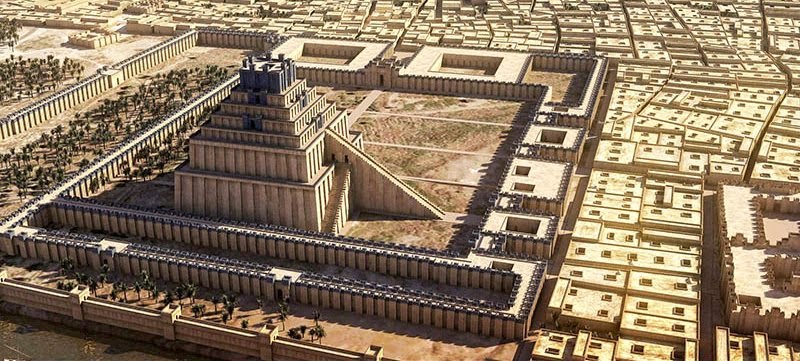
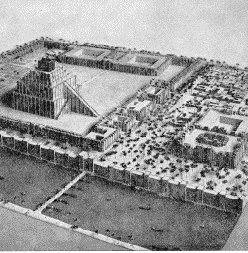
3i - Marduk's 7 story ziggourat  (Nebuchadnezzar & Marduk’s temple residence)

[The lord of Babylon] heeded Nebuchadnezzar [‘s prayer],

[ ] befell him from heaven,

“I command you with my own lips,

“[A word of] good fortune do I send you:

 (alien technologies used by gods for Nebuchadnezzar II)

“[With] my [help?] you will attack the Westland.

“Heed your instructions, [ ]

“Take me [from El]am to Babylon.

I, [lord of Bab]ylon, will surely give you Elam,

“[I will exalt] your [kingship] everywhere.”

[ ] the land of [ ] and seized [ ] of? his gods

The Inscription of Shalmaneser III on the Gates of Balawat

Records of the Past, 2nd Series, Vol. IV , ed. by A.H. Sayce, [1890], at sacred-texts.com

(Texts: All Artifacts, Color Coding, & Writings in Bold Type With Italics Inside Parenthesis, are Added by Editor R. Brown, not the Authors, Translators, or Publishers!)

(gods in bluemixed-breed demigods in teal…)

          COLUMN I
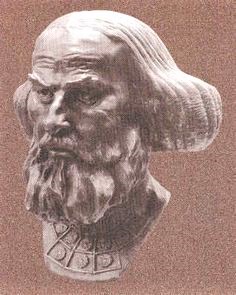
             (semi-divine Assyrian King Shalmaneser III, who walked with gods)

1. Shalmaneser, the great king, the powerful king, the king of hosts, [the king of Assyria] …

2. the pitiless one, who subjugates the rebellious … [who a rival]

3. has not. The great, the incomparable, the heroic one, … [clothed]

4. with splendor, who fears not opposition; [who from the rising of the sun]

         5. to the setting of the sun commands …
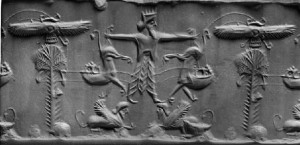
            2d - Marduk & flying discs

(Marduk with winged sky-disc battles animal symbols for his cousins)

6. is powerful. In those days, through the great lord, Merodach (Marduk)

COLUMN II

          1. … [After that the gods] had placed in my hands the insignia of mankind,
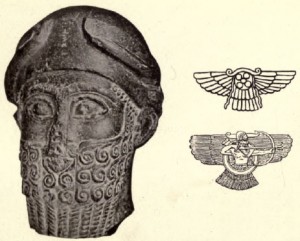
2a - Ashur, son to Marduk (Ashur, warrior son to Marduk)

         with the help of Assur (Osiris), the great lord, my lord, and of the god

         who loves my priesthood, [I trod] the summits of all mountain- ranges

2. to the extremities of them all, [as far as] the sea of Nairi and the sea of Zamua- sa-Bittani1 and the great sea of Syria. The country of the Hittites, to its very extremities, like a mound
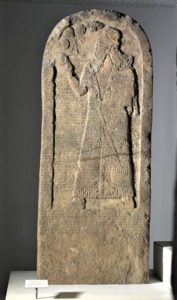
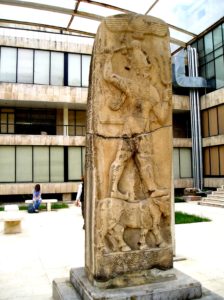
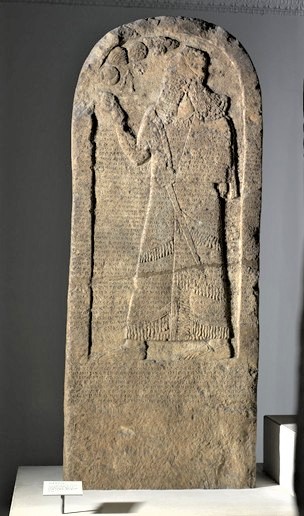
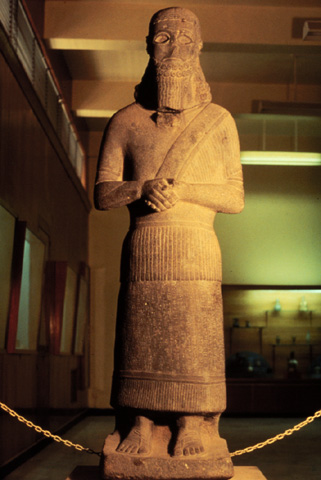
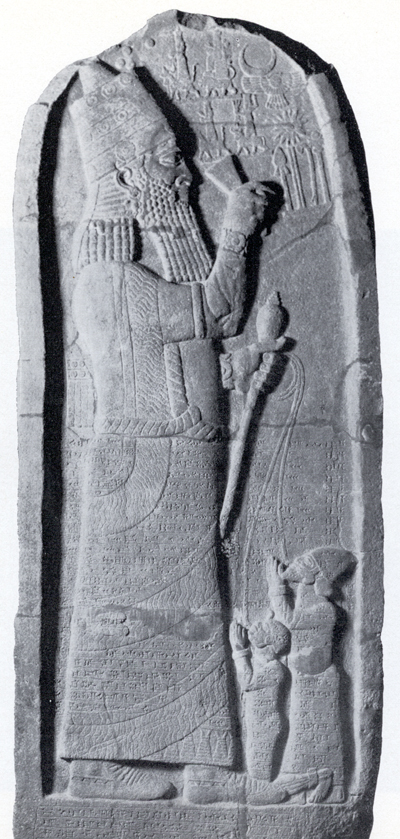
             (stele of semi-divine giant king Shalmaneser III)

3. swept by the wind, I ravaged … I spread over the country of the Hittites the [terror] of the glory of my sovereignty. In my passage from the sea2 I erected a great image of my majesty, (and) set (it) up along with that of Assur-irbe.1

4. … I marched [to] the great [sea]; I purified my weapons in the waters; I offered sacrifices to my gods; I received the tribute of all the kings of the shores of the sea.

5. … I erected [an image of my majesty beside] the sea; I wrote upon it; I set it up overlooking the sea. From the country of Enzite to the country of Dayaeni, from the country of Dayaeni to

6. [the country of] … I possessed myself [of Arzashkun, the royal city of Ara]me, of the land of Ararat, I threw (it) down, dug (it) up and burnt (it) with fire. While I was staying in Arzashkun, Arame, of the country of Ararat, to the multitude of his forces

COLUMN III

1. trusted and gathered all his troops; to give combat and battle he came against me. I utterly defeated him; I cut his fighting-men to pieces. I slew with weapons 3000 of his soldiers. With the bodies of his warriors

2. I filled the broad plain; I took from him his engines of war, his royal treasures (and) numerous war-material. To save his life he ascended an inaccessible
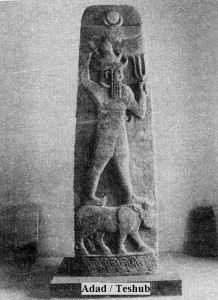
2c - Adad, fork & hammer (Adad, the Thunder God of many cultures, due to his alien weaponry)

mountain. Like Hadad (Adad)2 I overthrew the widespread land of Qute.3 From the city of Arzashkun to the country of Guzan,
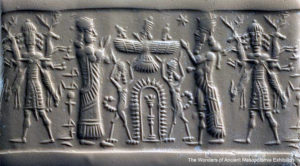
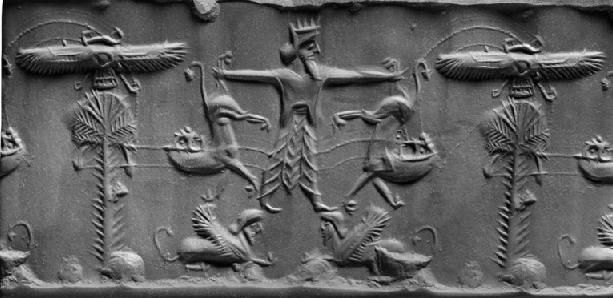
              (giant semi-divine king with 2 antelope below air gods in stormy sky-disc  

3. from the country of Guzan to the country of Khupushkia, like the stormy Air- god (thunder god Adad, Air-god Enlil) I roared upon them. I displayed over the country of Ararat the splendor of my sovereignty. Akhuni the son of Adini, who, with the permission of the kings my fathers, power and strength

4. had acquired, (whom) at the beginning of my reign I had shut up in his city, whose crops I had gathered, whose plantations I had cut down, to save (his) life had crossed the Euphrates (and) the city of Shitamrat, a mountain-peak which hangs from the sky like a cloud, for

5. his stronghold had taken. For the second time1 I pursued after him; the mountain-peak I besieged. My soldiers swooped upon them like birds of prey.2 I captured 17,500 of his troops. Akhuni with his troops, his gods, his chariots

6. (and) his horses, I caused to be brought before me; I carried (them) to my city of Assur (named after alien god Ashur) [and settled them among the people of my own land.]

COLUMN IV

1. In the eponymy of Samas-bel-utsur,3 in the time of Merodachsum-iddin the king of Babylonia,4 Merodach-bel-usâte his brother revolted against him. They divided the country into (two) factions. Merodach-sum-iddin to ask help to Shalmaneser sent

2. his ambassador. Shalmaneser, the impetuous chief, whose trust is Adar,5 took the road; he gave the order to march against Akkad 6 I approached the city of Zaban;7 victims before Hadad (Adad / Ishkur)8 my lord

3. I sacrificed. I departed from Zaban; to the city of Mê-Turnat I approached;9 the city I besieged, I captured; his fighting-men I slew; his spoil Icarried away. From the city of Mê-Turnat I departed; to the city of Gannanate1

4. I approached. Merodach-bel-usâte, the lame king, ignorant how to conduct himself, came forth against me to offer combat and battle. I utterly defeated him; his fighting-men I slew; in his city I shut him up. His crops

5. I gathered in; his plantations I cut; his river I dammed up. In a second expedition, in the eponymy of Bel-bunâya,2 on the 10th day of the month Nisan, I departed from Nineveh. The Upper Zab

6. and the Lower (Zab) I crossed. To the city of Lakhiru I approached. The city I besieged, I captured. Its fighting-men I slew, its spoil I carried away. From the city of Lakhiru

COLUMN V

1. I departed. To the city of Gan[na]nate I approached. Merodach-bel-usâte came forth like a fox from his hole; towards the mountains of Yasubi he set his face. The city of Arman

2. he took for his stronghold. The city of Gannanate I captured; its fighting-men I slew, its spoil I carried away. I ascended the mountains after him. In the city of Arman I shut him up; the city I besieged, I took. His fighting-men

3. I slew, his spoil I carried away. I put Merodach-bel-usâte to death with weapons. Of the miserable soldiers who (were) with him not one did I leave. When Merodach-sum-iddin had conquered his enemies, [and] Shalmaneser

4. the powerful king had fulfilled the desire of his heart, he exalted thee, O great

 2a - Marduk, Enki's 1st son, god of Babylon (Marduk with 2 left hands, & his animal symbol Mushhushshu)

lord Merodach (Marduk)! Shalmaneser the king of Assyria ordered the march to Babylon; he arrived at Kutha,3 the city of the warrior of the gods4

5. the exalted ones, (the city) of the Sun-god (Utu) of the south. At the gate of the temple he prostrated himself humbly, and presented his sacrifice; he made offerings. He entered also into Babylon, the bond of heaven to earth (rivaling Enlil’s Nippur Command), the seat of life;1
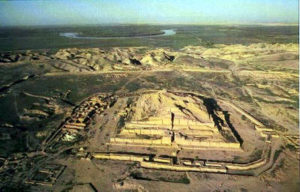
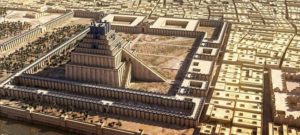
              (E-Sagil, Marduk’s ziggurat temple residence in Babylon)

6. he ascended also to Ê-Sagil (Marduk‘s temple residence in Babylon), the palace2 of his gods as many as there are; before Bel (Enlil, or Marduk) and Beltis (spouse Ninlil, or Sarpinat) he was seen to pass and he directed their path. Their propitiatory sacrifices (and) pure offerings on Ê-Sagil

COLUMN VI

I. he lavished. He visited all the shrines3 in Ê-Sagil and Babylon: he presented his pure sacrifice. He took also the road to
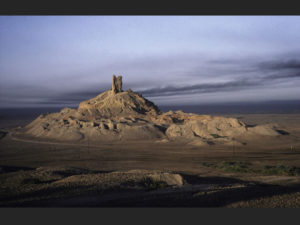
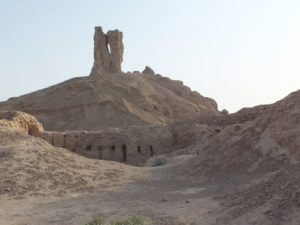
             (E-Zida,Nabu’s ziggurat residence & Tower of Babel in Borsippa)

2. Borsippa,4 the city of the warrior of the [god]s,5 the angel (?) supreme. He entered also into Ê-Zida (Nabu’s temple residence in Borsippa)6 … he prostrated himself before the temple of his immutable oracle, and in the presence of Nebo (Nabu) and Nana (Nanaya)

3. the gods his lords he directed reverently his path. Strong oxen (and) fat sheep he gave in abundance. He visited all the shrines3 in Borsippa and Ê-Zida; each time

4. he offered libations (?). For the men of Babylon and Borsippa, the vassals of the great gods, he made a feast, and gave them food (and) wine; with embroidered robes he clothed (them); with presents

5. he endowed them. After that the great gods had favorably regarded Shalmaneser, the powerful king, the king of Assyria, had directed his face, had granted the desire (?) of his heart and strength, (and) had heard his prayers, I departed from Babylon; [to] the country of Chaldæa1

6. I descended. To the city of Baqâni, a fortress of Adini the son of Dakuri I approached. The city I besieged, I captured. His numerous soldiers I slew; their rich spoil, their oxen (and) their sheep, I carried away. The city I threw down, dug up (and) burned with fire. From the city of Baqani I departed; the Euphrates hard by it I crossed. The city of Enzudi,
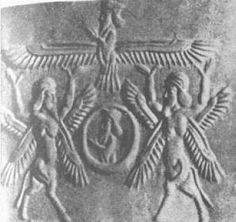
               (the overwhelming terror of Marduk from the air) 

7. the royal city of the aforesaid Adini, I approached. As for Adini the son of Dakuri, the terror of the glory of Merodach the great lord overwhelmed him, and I received from him … silver, gold, copper, lead, iron, muskanna wood, ivory, (and) elephants’ skin. While I was staying [on the shores] of the sea,2 the tribute of Yakin the king of the maritime country

8. and of Musallim-Merodach the son of Amukkani, silver, gold, lead, copper, [iron], muskanna wood, [ivory, and] elephants’ skin, I received.

Footnotes

74:1 See Records of the Past, new series, p. 149, note 6.

74:2 Lake Van.

75:1 See Monolith Inscription, II. 10 (above, p. 61).

75:2 [Rather Nerra the demon of pestilence. See my Lectures on the Religion of the Babylonians, pp. 195, 311–314.—Ed.]

75:3 [Also called Gutium. It was the district which lay to the east of Assyria, and in early Chaldean geography included Assyria itself. Here, however, the term is extended so as to include not only Kurdistan, but also the district between Assyria and Lake Van.—Ed.]

76:1 Literally, “year.”

76:2 [More exactly “vultures.” The zu or “vulture” was the symbol of the god of “the storm-cloud” who was believed to have stolen the laws and attributes of Bel (“older” Bel is Enlil) for the benefit of mankind, and to have been punished for the theft by transformation into a vulture. See my Lectures on the Religion of the Babylonians, pp. 293–299.—Ed.]

76:3 B.C. 852.

76:4 Kar-Dunias.

76:5 Uras.

76:6 Northern Babylonia.

76:7 On the southern bank of the Lower Zab.

76:8 Rimmon (Adad).

76:9 “The waters of the Turnat” or Tornadotos, the modern Diyaleh.

77:1 “The garden of Anat (Inanna).”

77:2 B.C. 851.

77:3 Fow Tel Ibrahim. Men from Kutha were brought to Samaria by Sargon, 2 Kings xvii. 24, 30.

77:4 [Nergal.—Ed.]

78:1 [This is a play on the Accadian names of the two cities which constituted the later Babylon, Ka-Dimirra, “the gate of God,” sometimes misinterpreted “the gate of the gods,” and Din-Tir, which by a false etymology was mistranslated “seat of life.”—Ed.]

78:2 Compare Is. vi. 1, where the heavens are called a “palace” filled by the train of the Lord.

78:3 Bit-ili or “Beth-els.”

78:4 Here written Dur-’Siabba “the fort of ’Siabba.”

78:5 Nebo (Nabu).

78:6 [Ê-Zida, “the immutable house,” was the name of the sanctuary of Nebo at Borsippa, as E-Sagil, “the house of the high head,” was that of the sanctuary of Merodach (Marduk) at Babylon. Both names had come down from the pre-Semitic age.—Ed.]

79:1 Kaldi, in the south of Babylonia.

79:2 The Persian Gulf.
A Hymn to Marduk for Abi-Eshuh (Abi-Eshuh A): translation

The Electronic Text Corpus of Sumerian Literature

(Texts: All Artifacts, Color Coding, & Writings in Bold Type With Italics Inside Parenthesis, are Added by Editor R. Brown, not the Authors, Translators, or Publishers!)

(gods in bluemixed-breed demigods in teal...)

          1-6 King who gathers up the divine powers (alien technologies) of heaven and earth,

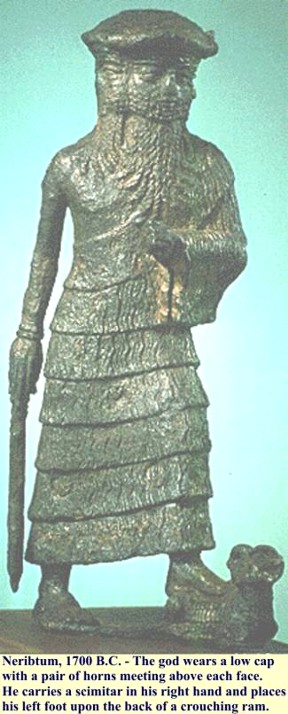
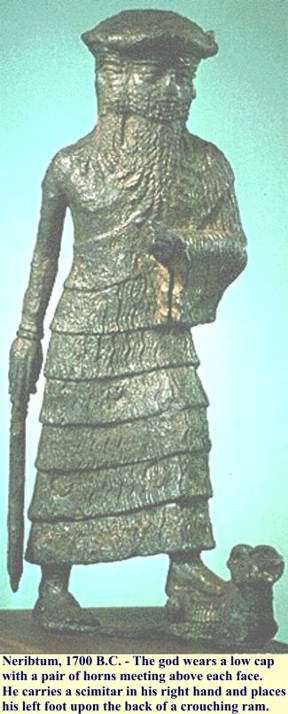
             2 - Marduk upon a ram (Marduk, patron god of Babylon with foot upon his zodiac symbol of Aires the Ram)

          foremost son of Enki, Marduk, mighty lord, perfect hero, foremost of the Great Princes (a name for the Igigi gods) ,

          strong one of the Anuna (Anunnaki), the great gods who have given him justice and judgment!

             3a - Anu in flight (Marduk‘s grandfather Anunnaki King Anu in his winged sky-disc)

          Great prince, descendant of holy An (Anu), lord who decides destinies,

          who has everything in his grasp (?), wise, august knower of hearts,

          whose divinity is manifest, who shows concern for all that he looks upon!

          Your ancestor An, king of the gods (god the father in heaven to the “sons of god” who “came down” & colonized the Earth),

          has made your lordship effective against the armies of heaven and earth.

             7-10 He has given you the supervision of great august commands of heaven and earth,

          he has bound to your hand the shepherd’s crook that curbs the foreign lands, he has made you excel among the great gods,

          and in addition has given you, to control them, the royal scepter and the ritual ordinances of the gods.

          Enlil has fixed as your destiny kingship over the totality of heaven and earth and has relieved you of any rivals;

          he has made you eminent among the Anuna (Anunnaki), and has bestowed on you the exercise of domination.

             11 1st kirugu.

          12 Marduk, in all quarters of the heavens they have made shine forth like Utu the lordship of prince Abi-Ecuh,

          the beloved son of your heart, and have relieved him of any rivals.

             13 Jicgijal.

             14 The lordship of the hero standing in all his strength upon this august pedestal is indeed eminent in heaven and earth.

          2c - Marduk relief, flowing waters of Babylon (Marduk, patron god of Babylon & then Egypt)

          The lordship of Marduk standing in all his strength upon this august pedestal, is indeed eminent in heaven and earth.

Marduk’s Ordeal (Imprisonment)

http://www.gatewaystobabylon.com/myths/texts/classic/mardor.htm

A hard-to-get text concerning Marduk (Nibiru), of Assyrian origin. We know that some Assyrian versions of the Enuma Elish have Ashur instead of Marduk as the protagonist. Here, Ashur is the protagonist, and Ishtar (Inanna) of Nineveh is explained as Tiamat. The Assyrians regarded Ashur as another name for Anshar, Tiamat‘s grandson, thus closer to Tiamat and worthier of worship than Marduk.

H. Zimmern saw in the text an account of death and resurrection of Marduk (Lishtar´s Note: which took actually place during the Akitu, or New Year´s Festival). Von Soden, another scholar, pointed out that the events in the text were to be associated with the destruction of Babylon in 689 B.C., and the deportation of the statue or symbol of Marduk to Assyria.

(Texts: All Artifacts, Color Coding, & Writings in Bold Type With Italics Inside Parenthesis, are Added by Editor R. Brown, not the Authors, Translators, or Publishers!)

(gods in blue)

2f - Nabu-Nebo Assyrian  (Nabu, 3rd son to Marduk, helped Marduk with many battles against their cousins)

        1. Nabu,who comes from Borsippa. He comes to greet his father (Marduk), who has been taken captive.

          2. Nabu, who turns back and goes to Borsippa, and sprinkles here and there stamens of the date palms there. That is the rebellion ……

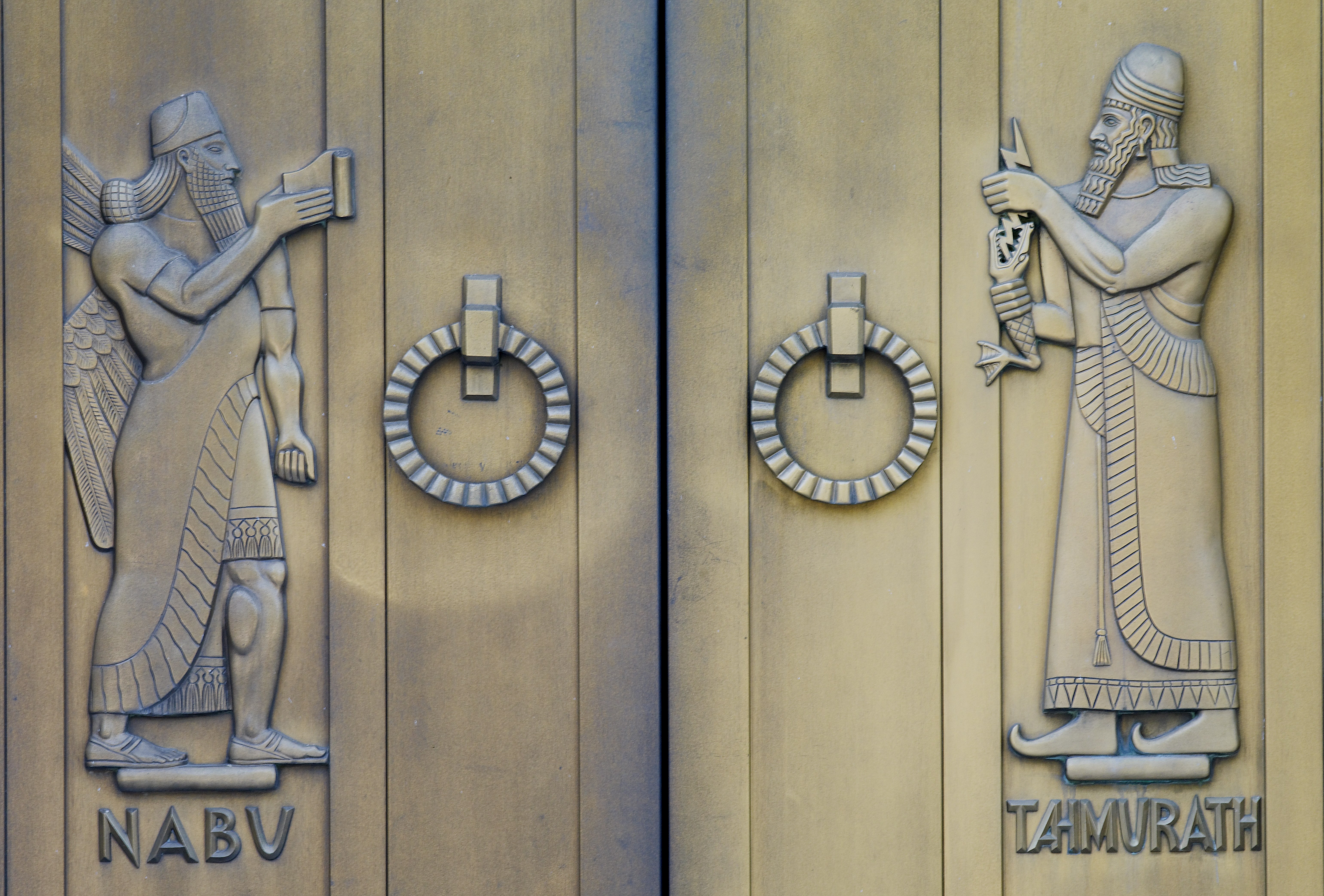
          2a - Nabu & Tahmurath, Library of Congress, John Adams Bldg (winged Nabu & unidentified on Library of Congress door)

        3. The pig reeds in the path of Nabu. When he comes from Borsippa and blesses.

        4. Nabu, who comes, stands over, and watches. : He is the criminal who is with Bel ….. Because he is with Bel (Marduk)

        2 - Nanaya being presented to the daughter of the king (Nabu‘s spouse, Tashmetu / Nanaya, giant Anunnaki goddess, & smaller king with spouse)

        5. Tashmetu (“lady who listens”, Nabu‘s spouse), who bows down with him. She has come to greet him.

        6. The Lady of Babylon, who does not go to the Akitu temple. She is the governess of the temple …… “You know the temple. Guard the temple! I hold you responsible for it.”

        7. She is the governess of the temple. They ask her, “Who is the criminal?”

        8. The Lady of Babylon on whose back is black wool, and on her front multicolored wool…….: ….. on her front is the blood of the heart which was shed …….

        9. Sakkukutu (unidentified), who goes round the city. : She is his wailing woman, and goes round the city.

        10. ……. is the criminal who was present with Bel. : They Ashshur …..

       3b - Anu of planet Nibiru   (Anu, alien father of the gods; Anu in his winged sky-disc)

        11. ……. they have killed the daughter of Anu ……

        12. …… because of the god … encircles, they demonstrate.

        13. ….. the ….. of the districts ……

        14. The exorcists, who go in front of him reciting an incantation. They are his people, and go in front of him calling out.

        15. The ecstatic, who goes in front of the Lady of Babylon (Sarpanit). He is a bringer of news and weeps on her breast.

        16. The athletes, who stand at the gate of Esagil. : They are his guards, are appointed over him and guard him.

         17. … in the battle …..

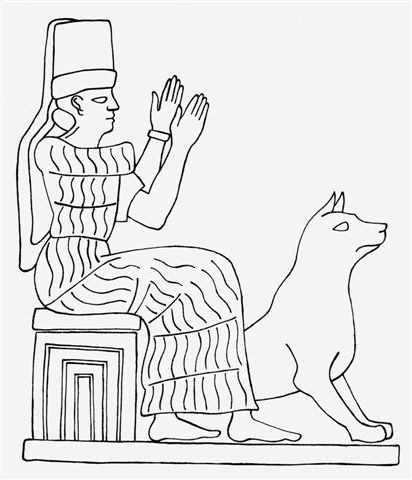
          2c - Bau-Gula, goddess of medicine, & dog 1c - Gula, Anu's daughter, Ninurta's spouse (Bau / Gula on her throne with her guard dog; Bau)
       18. The dog, which crosses Esabad. He is a messenger.
Gula (Bau) sends (to inquire) about him.

        19. Enuma Elish (SEE TEXT ON MARDUK‘S PAGE), which is recited and which they chant in front of Bel in Nisan. : That concerns the prisoner.

        20. …. they sing ……

        21. He says prayers and makes supplications to them. He recites that before Shamash (Utu): They were favors for Ashshur (Ashur). I did them. What is my crime?”

         3a - Utu in the mountains with weapons of brilliance2ee - Utu, Shamash

               (Utu cuts launch pads with launch towers into the mountains; mixed-breed king stands before Utu, the alien giant & Sun god
       22. ….. which in the rays of
Shamash (Utu the Sun god)….

        23. …. who scans the heavens. She is praying to Ashshur (Ashur), Anu, Sin (Nannar), Shamash (Utu), and Adad (Ishkur): “Keep me alive!”

        24. …. who scans the ground on which his place of river ordeal has been put down. : Concerning the one who comes from the place of the river ordeal.

        25. They carry him to the place of the river ordeal. She gives chase: “My brother, my brother!” ……

          2a - Nabu, Canaanite god (Marduk, Enki‘s eldest son, patron god of Babylon, standing upon his zodiac symbol Aires the ram)
       26. …
Bel went to the place of the river ordeal. : The city has revolted against him and done battle inside. “What is his crime?”

        27. ….. who rides. : He goes to the place of the river ordeal.

         3a - Marduk's House in Babylon  (Marduk‘s ziggurat residence & his patron city of Babylon way below him)

        28. ….. who goes. : That is the temple. They question him about it at the edge of the place of the river ordeal.

        29. …. who carry. : The criminal …..

        30. ….. it is the place on …..

        31. …. his … to the place of the river ordeal …

        32. .. .. who does not go with him. “I am not a criminal! I will not be made to swear!” With him, on behalf of Ashshur they opened lawsuits before him. The lawsuits ….

        33. …. “It is just.”

          3b - Ashur the god of Assyria (Ashshur / Ashur / etc., Marduk‘s son in his weaponized winged sky-disc)
       34. … who does not go with him. He is a
son of
Ashshur and is a guard. He is appointed over him, and guards the citadel because of him.

        35. ….. placed to guard …. goes in front of him.

        36. ….. his guard wearing a crown….

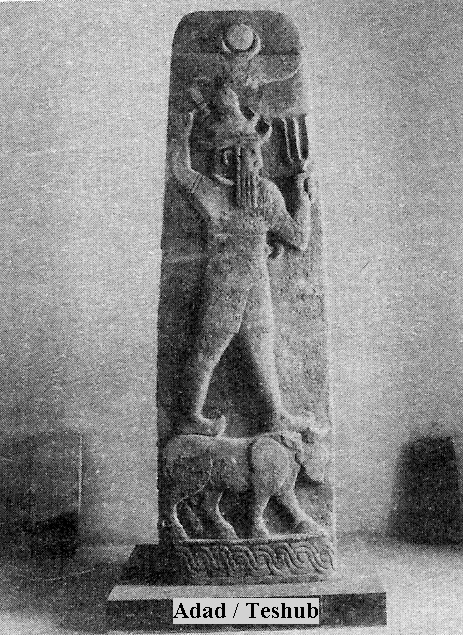
        2a - Utu, Shamash, twin to Inanna 1b - Ishkur, Adad, Teshub 2ba - King Esarhaddon stele  (Shamash / Utu; Adad; & Ashur with mixed-breeds)

        37. ….. Shamash and Adad that is. From the temple of the prisoner …

        38. … he is held fast.

        39. …. it concerns the one who is held fast..

        40. That which they do on the ziggurat. : Because the god imprisoned him he disappeared and was held inside.

        41. … which they place, responsibility … in the ladles.

        42. …. there is not. He is present. Responsibility …..

        GP-1999-356-R1, 2/22/12, 10:46 AM, 8C, 4700x9322 (16.0/400.0), 100%, straight 6 sto, 1/15 s, R60.4, G32.4, B27.9  (alien giant gods in combat with each other)

        43. …. she makes carry to him, to the temple of his imprisonment …..

        44. …. because it is not old …. as his name.

        45. …. who does not go out with Bel to the Akitu temple. He holds the fetter of the prisoner … with him.

        46. …. to the place of the river ordeal he goes. In the Akitu temple……

        47. The man who on the 7th day of the month….

        48. …. who slaughters a pig in front of her on the 8th of Nisan.

        49. It is said in Enuma Elish (SEE TEXTS ON MARDUK‘S PAGE): When heaven and earth were not created, Anshar came into being. When city and temple came into being, Anshar had come into being. The water which over Anshar …..

50. All the speech which is recited among the lamentation priests. It concerns the robbery and desecration which they commit against him. They are the gods, his fathers ……

3i - Marduk's 7 story ziggourat (Esagil, Marduk‘s “holy of holies” within his ziggurat residence / house in Babylon)

51. His silver, gold, or gems which they take out of Esagil to other temples. : It is his temple ……

52. ……. whom they make superior ….

53. ….. it is ……. it is plundered …..

54. They make poured offerings from ladles and beakers.

55. ….. who goes. Because her vessel was lifted and he completes

……..: It is in fear. He quickly thirsts for water….

56. ….. is libated ………….

         57. …. which he libates and pours. : That is turbid water ……

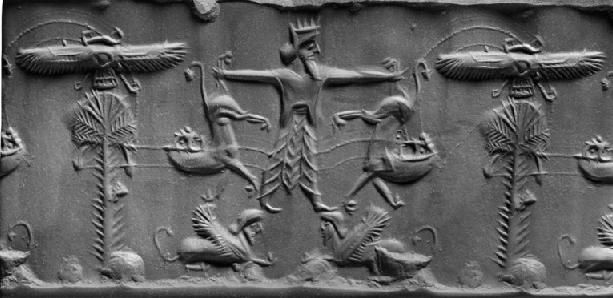
2d - Marduk & flying discs (Marduk between 2 winged sky-discs)

58. ….. who roams the streets. : He is looking for Marduk. “Where is the prisoner?”

4l - Utu, Inanna, & Nannar  (Utu, twin sister Inanna, father Nannar, & brother Papsukal damaged)

59. The Lady of Babylon, whose hands are stretched out. : She is praying to Sin and Shamash: “Keep Bel (Marduk) alive!”

60. …….s who goes, That is the gate of graves. She goes and looks for him.

61. …… who weep …… who do not weep. It is concerning Marduk ….

62. ….. Keep alive! Do not kill! …..

63. ….. is put down. Let me bear and bury …

64. ….. who goes and puts down.

65. ….. the messenger saves. They send him down from inside.

66. ….. who opens, the urn ….

67. …… whom Ashshur will kill …

        68. That is the day of his crime. It is gathered in the chamber. Without water. He is clothed. Chamber……

6f - Ninurta shoots down Anzu

 (Ninurta in his winged “storm bird” shoots down winged Anzu, in his failed coup attempt, here portrayed as a demon bird)

69. The race which is in Kislimu, and in which they go round in front of Bel and in all the cult places. : When Ashshur sent Ninurta to defeat Anzu. Nergal …. spoke before Ashshur, “Anzu is defeated”. Ashshur said to the god ….. “Go to all the gods and give the news.” He gives the news to them and they in ….. they rejoiced.

70. …. he the cult places …..

71. …. she comes round from the city …..

72. ….. He is a messenger …. He goes round the city.

73. … he makes him go out….. not the messenger of his lords. Who makes him go out? ….. who goes, who makes him go out.

74. Grain, which is extremely plentiful in Nisan. : It is grain of when he was taken prisoner.

2l - Ishtar - Inanna2d - Inanna Wars Against Marduk (Ishtar / Inanna, Goddess of Love & War)

75. The milk, which they draw in front of Ishtar (Inanna) of Nineveh. : Because she brought him up and showed compassion to him.

76. The moistened roasted flesh which they place in front of Marduk.: It is of the darkness (?)

77. It is of the darkness (?) …..

78. ….. who cuts, darkness (?) ….

79. The water for (washing) the hands which they bring near. : It is because he wept. His tears inside….

80. The garment which is on him. : What they say, that is water, those are drops.

81. The garment in which he is clad. : He is in the chamber.

82. ….. It is his mattress ….

83. The shoe which they take to the temple of the Lady of Babylon. It is a standard. He sends it to her because they will not release him and he cannot go out.

84. His clothing, which they send to the Lady of Uruk (Inanna). They are his cloaks. They carried them off.
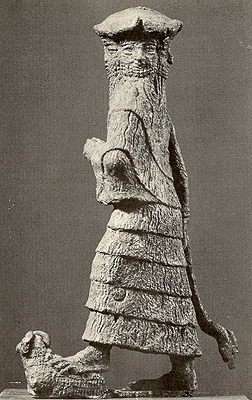
85. …. concerning the dead one …. the saddle beneath him (and) the multi-colored wool with which he is clad. They are the blows which were struck. They are dyed in his blood.
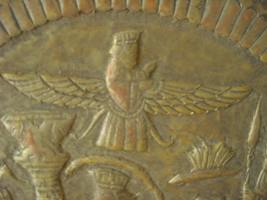
86. …. all which the cloak …. …… the temple …

87. …. does not go. They …. his garments. He has disrobed ….

88. … which hangs from the beam of the Lady of Babylon. That is the head of a criminal who was present with him and whom they killed. They have hung his head on the neck of the Lady of Babylon.

89. The lattice door. : As they say, the gods have taken him captive and he has entered the temple and locked the door behind him. They bored holes in the door and did battle.

90. The chariot, which goes to the Akitu temple. It goes with no driver. Without a driver, it rocks about.

91. ….. he ….. not in honor of them.

92. ….. oil ……. lasting……

(end of extant text)