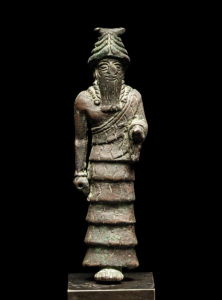
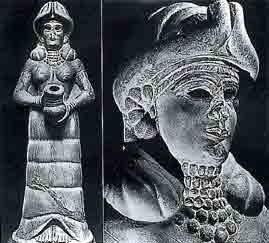
Author Archives: nibirudb

The Name of Ra

Published: Pleyte and Rossi, Papyrus de Turin, pls. 31, 77, 131-138.

Translated: Wiedemann, Religion of the Ancient Egyptians, p. 54.

This tale is found in a hieratic papyrus of the xxth dynasty (about 1200-1100 B.C.). It is written on both sides; the handwriting on one side differs from the handwriting on the other, showing that it is the work of two scribes. The writing is in black ink with occasional sentences in red. Hieratic is the running hand, derived from the hieroglyphs; the earliest example occurs in the first dynasty; it was superseded by demotic in the latest period of Egyptian history.

This papyrus is not quite complete, but the part containing the legend is fortunately uninjured. The text consists of magical formula against the bites of serpents. In healing by magic, the magician recited an event in the career of some deity in which the god suffered from the same malady as the human patient then seeking relief. The words which cured the divine patient would also cure the human invalid. The same idea prevails in the legend of the Scorpions of Isis.

(Texts: All Artifacts, Color Coding, & Writings in Bold Type With Italics Inside Parenthesis, are Added by Editor R. Brown, not the Authors, Translators, or Publishers!)

(gods in blue)
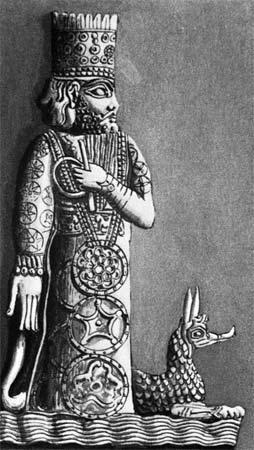
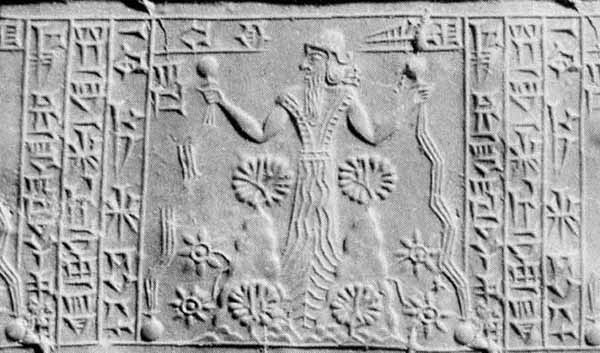
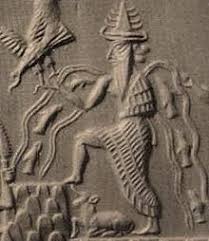
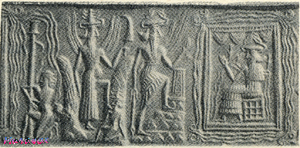
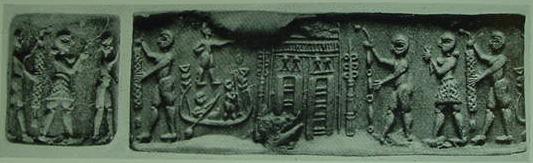
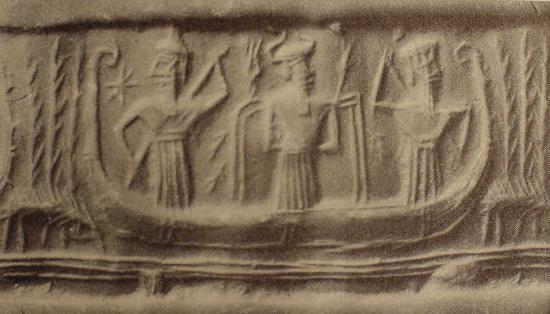
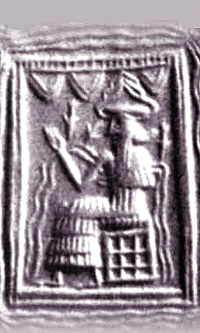
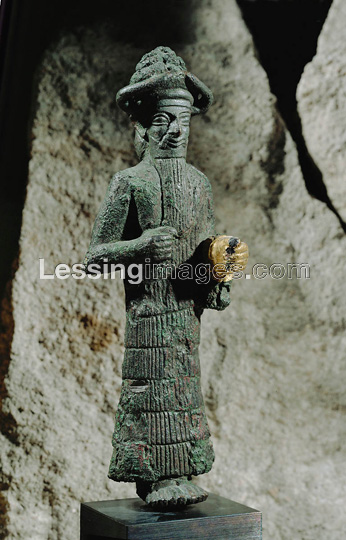
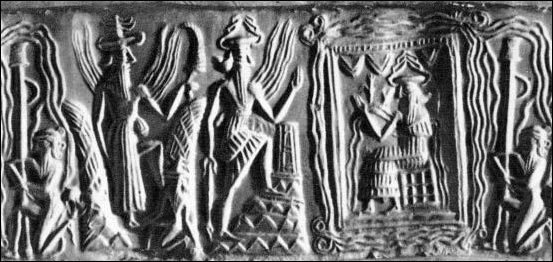
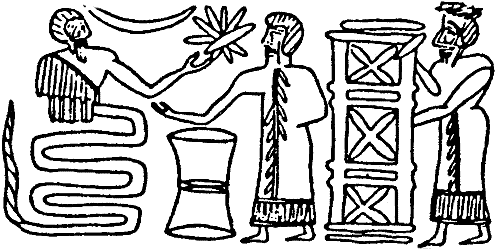
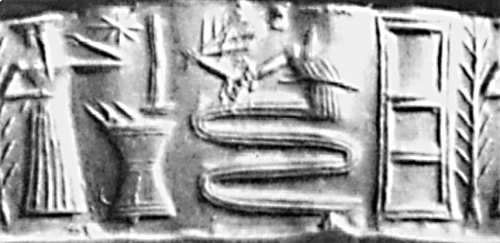
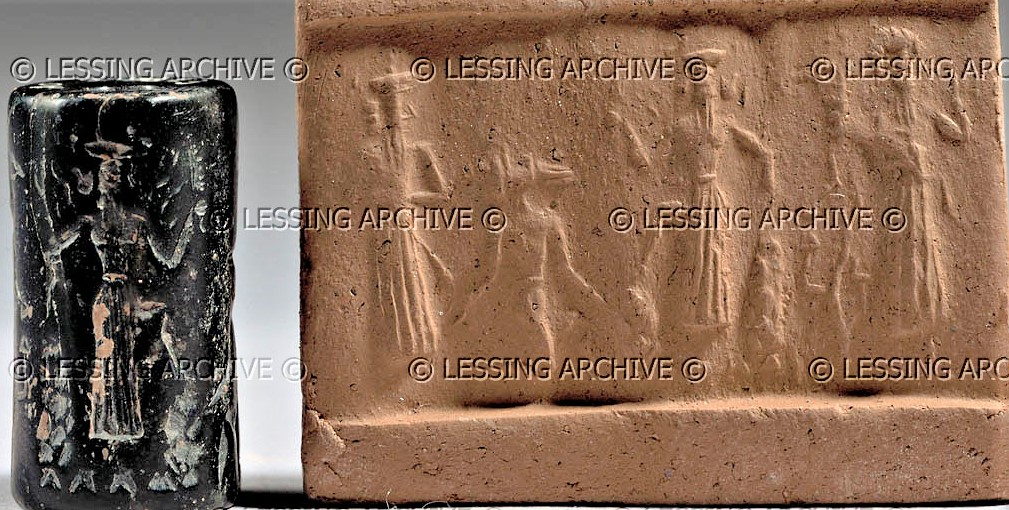
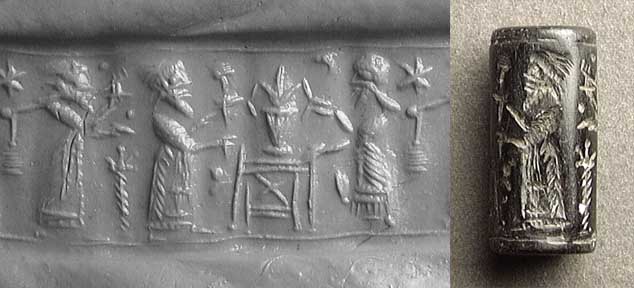
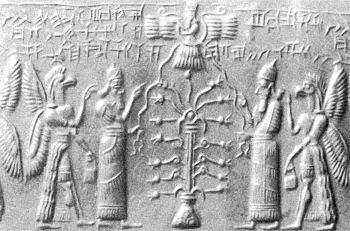
2aa - Marduk, older brother to many siblings babylonian_cylinder_seal (Marduk, Enki‘s eldest son, angrily believed enlil usurped enki‘s birth-rite of kingship, leaving marduk‘s birth-rite forgotten)

Now the Majesty of Ra (Marduk) was the creator of heaven and earth,

of gods, men, and cattle, of fire, and the breath of life; and he ruled over gods and men.

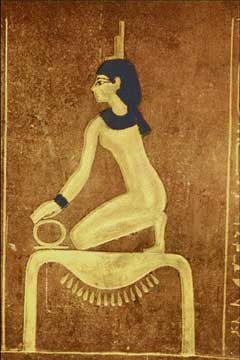
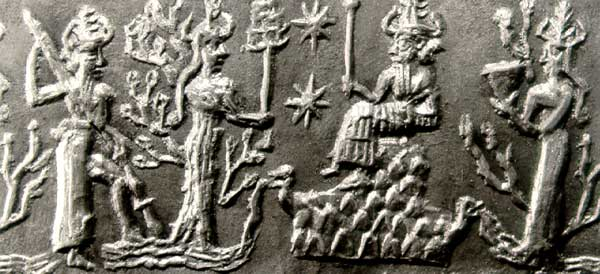
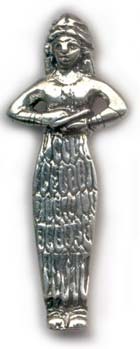
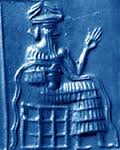
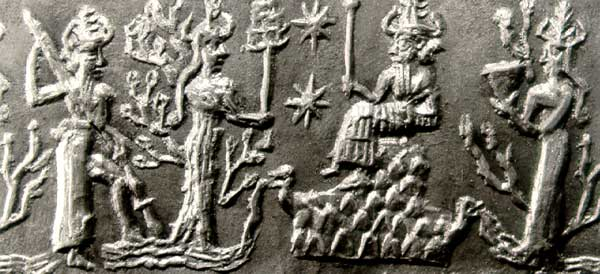
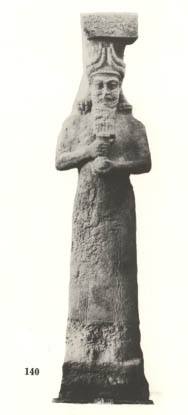
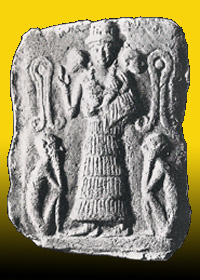
7e - Isis on the throne (Isis, spouse to Ashur / Asar / Osiris)

And Isis (Marduk‘s daughter-in-law) saw his might, the might that reached over heaven and earth,

before which all gods and men bowed; and she longed in her heart for that power,

that thereby she should be greater than the gods and have dominion over men.

There was but one way to obtain that power.

By the knowledge of his own name did Ra (Marduk) rule, and none but himself knew that secret name.

Whosoever could learn the secret, to that one—god or man—would belong the dominion over all the world,

and even Ra himself must be in subjection.

Jealously did Ra guard his secret, and kept it ever in his breast,

lest it should be taken from him, and his power diminished.

Every morning Ra (Sun disc symbol) came forth in his glory at the head of his train from the horizon of the East,

journeying across the sky, and in the evening they came to the horizon of the West,

and the Majesty of Ra sank in his glory to lighten the thick darkness of the Duat.

Many, many times had Ra made the journey, so many times that now he had waxed old.

Very aged was Ra, and the saliva ran down from his mouth and fell upon the earth.

Then Isis took earth and mixed it with the saliva,

and she kneaded the clay and molded it, and formed it into the shape of a snake,

the shape of the great hooded snake that is the emblem of all goddesses,

the royal serpent which is upon the brow of the Kings of Egypt.

No charms or magic spells did she use, for in the snake was the divine substance of Ra himself.

She took the snake and laid it hidden in the path of Ra,

the path on which he traveled in journeying from the eastern to the western horizon of heaven.

In the morning came Ra and his train in their glory journeying to the western horizon of heaven,

where they enter the Duat and lighten the thick darkness.

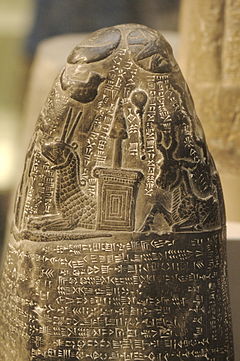
6g - Marduk's symbol (boundary stone with symbols of gods, giving protection by the gods)

And the serpent shot out its pointed head which was shaped like a dart, and its fangs sank into the flesh of Ra,

and the fire of its poison entered into the God, for the divine substance was in the serpent.

Ra cried aloud, and his cry rang through the heavens from the eastern to the western horizon;

across the earth it rang, and gods and men alike heard the cry of Ra.

And the gods who follow in his train said to him, “What aileth thee? What aileth thee?”

But Ra answered never a word, he trembled in all his limbs, and his teeth chattered, and naught did he say,

for the poison spread over his body as Hapi spreads over the land,

when the waters rise above their banks at the time of the overflowing of the river.

When he had become calm, he called to those who followed him and said,

“Come to me, ye whom I created. I am hurt by a grievous thing.

I feel it, though I see it not, neither is it the creation of my hands, and I know not who has made it.

Never, never have I felt pain like this, never, never has there been an injury worse than this.

Who can hurt me? For none know my secret name, that name which was spoken by my father and by my mother,

and hidden in me that none might work witchcraft upon me.

I came forth to look upon the world which I had made,

I passed across the Two Lands when something—I know not what—struck me.

Is it fire? Is it water? I burn, I shiver, I tremble in all my limbs.

Call to me the children of the gods, they who have skill in healing,

they who have knowledge of magic, they whose power reaches to heaven.”

Then came all the gods with weeping and mourning and lamentations;

their power was of no avail against the serpent, for in it the divine substance was incorporated.

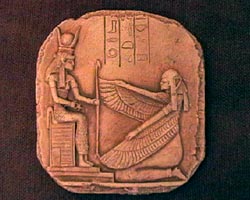
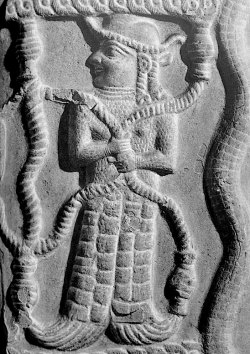
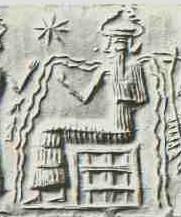
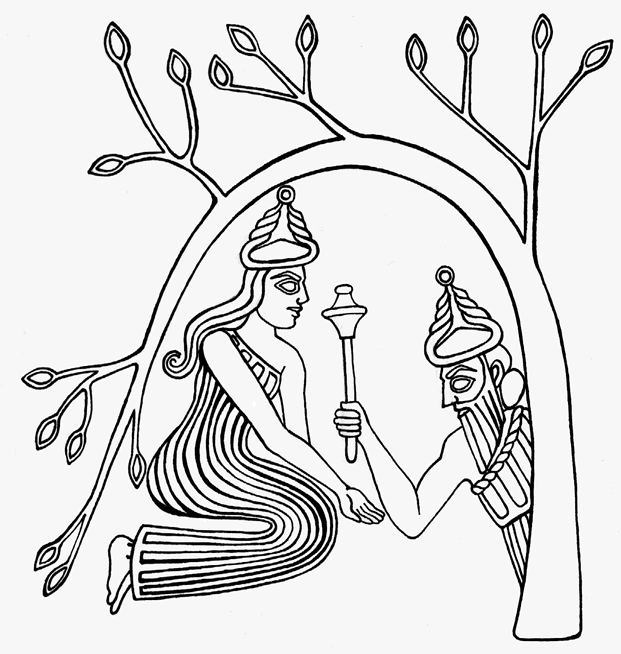
8d - Iisis-Kneeling (Isis, spouse to Marduk‘s son Ashur / Osiris, goddess of Egypt)

With them came Isis the Healer, the Mistress of Magic, in whose mouth is the Breath of Life,

whose words destroy disease and awake the dead.

She spoke to the Majesty of Ra and said.

“What is this, O divine Father? what is this? Has a snake brought pain to thee?

Has the creation of thy hand lifted up its head against thee?

Lo, it shall be overthrown by the might of my magic, I will drive it out by means of thy glory.”

Then the Majesty of Ra answered, “I passed along the appointed path,

I crossed over the Two Lands, when a serpent that I saw not struck me with its fangs.

Was it fire? Was it water? I am colder than water, I am hotter than fire, I tremble in all my limbs,

and the sweat runs down my face as down the faces of men in the fierce heat of summer.”

And Isis spoke again, and her voice was low and soothing,

“Tell me thy Name, O divine Father, thy true Name, thy secret Name, for he only can live who is called by his name.”

Then the Majesty of Ra answered, “I am the Maker of heaven and earth, I am the Establisher of the mountains,

I am the Creator of the waters, I am the Maker of the secrets of the two Horizons,

I am Light and I am Darkness, I am the Maker of Hours, the Creator of Days,

I am the Opener of Festivals, I am the Maker of running streams, I am the Creator of living flame.

I am Khepera in the morning, Ra at noontide, and Atmu in the evening.”

But Isis held her peace; never a word did she speak, for she knew that Ra had told her the names that all men know;

his true Name, his secret Name, was still hidden in his breast.

And the power of the poison increased, and ran through his veins like burning flame.

After a silence she spoke again.

“Thy Name, thy true Name, thy secret Name, was not among those.

Tell me thy Name that the poison may be driven out,

for only he whose name I know can be healed by the might of my magic.”

And the power of the poison increased, and the pain was as the pain of living fire.

Then the Majesty of Ra cried out and said,

“Let Isis come with me, and let my Name pass from my breast to her breast.”

And he hid himself from the gods that followed in his train.

Empty was the Boat of the Sun (Marduk‘s sky-disc), empty was the great throne of the God,

for Ra had hidden himself from his Followers and from the creations of his hands.

When the Name came forth from the heart of Ra to pass to the heart of Isis, the goddess spoke to Ra and said,

“Bind thyself with an oath, O Ra, that thou wilt give thy two eyes unto Horus.”

Now the two Eyes of Ra are the sun and the moon, and men call them the Eyes of Horus to this day.

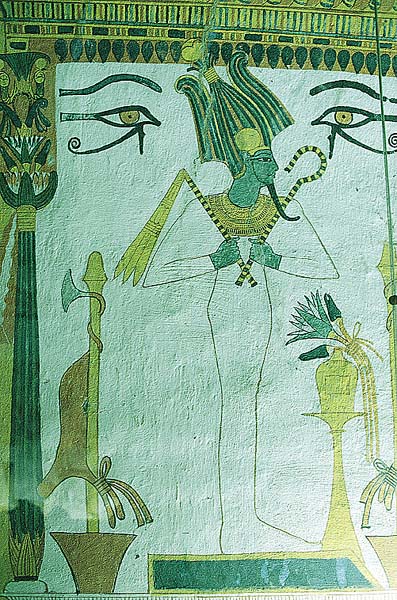
7g - Osiris flanked by Eyes of Horus (Ashur / Osiris with eyes of Horus in Egypt)

Thus was the Name of Ra taken from him and given to Isis, and she, the great Enchantress,

cried aloud the Word of Power, and the poison obeyed, and Ra was healed by the might of his Name.

And Isis, the great One, Mistress of the Gods, Mistress of magic, she is the skilful Healer,

in her mouth is the Breath of Life, by her words she destroys pain, and by her power she awakes the dead.

XI

THE REGIONS OF NIGHT AND THICK DARKNESS

When the world came into being, there were two rivers, the river of Egypt and the river of the sky.

Great is the Nile, the river of Egypt, rising in his two caverns in the South beyond the cataract,

flooding the land of Egypt and bringing joy and good harvests to Ta-mery.

Great and mighty is the river of the sky, flowing across the heavens and through the Duat,

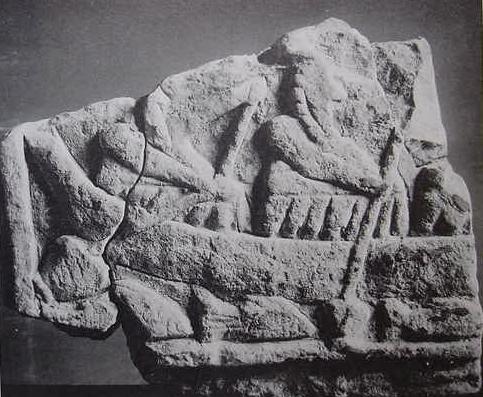
the world of night and of thick darkness, and on that river floats the Boat of Ra (alien sky-disc).

Boat of Millions of Years is its name, but men call it the Manzet Boat in the dawn,

when Ra rises in splendor on the eastern horizon of heaven; the Mesektet Boat is it called in the evening,

when Ra enters in glory within the portals of the Duat, where the mountain of Manu lifts its peaks to the western sky.

On the western horizon is the mountain of Manu. and on the eastern horizon the mountain of Bakhu;

vast and huge are they, raising their crests above the earth, and the sky rests upon their summits.

And on the topmost peak of the mountain of Bakhu dwells a serpent;

thirty cubits in length is he, and his scales are of flint and of glittering metal.

He guards the mountain and the Great Green Waters, and none can pass by him save Ra in his Boat.

In the evening Ra descends in majesty to the Western horizon of heaven, to the portals of the Duat at the Gap of Abydos.

Splendid is the Mesektet Boat, glorious its trappings,

and its colors are of amethyst and emerald, jasper and turquoise, lazuli and the luster of gold.

At the Gap of Abydos waits a company of gods to prepare the Boat for the journey through the Duat,

the land of night and of thick darkness.

Stripped is the Boat of its splendor, bare and without glory is it when it passes through the portals of the Duat,

and in it is the body of Ra, lifeless and dead.

Then the gods take the great towing-ropes; slowly the Boat moves along the river.

The portals of the Duat are flung wide, and the twelve goddesses of the night

take their place upon the Boat to guide it through the gloom and perils of the Duat;

pilots of the river are they, and without them not Ra himself could pass through unscathed.

“Watercourse of Ra” is the name of the first country of the Duat.

Sombre is this land, yet not wholly dark; for on either side the river are six serpents,

coiled and with heads erect, and the breath of their mouths is a flame of fire.

In the cabin of the Boat is Ra, dead and lifeless;

in the prow are Up-uaut, the Opener of the Ways, and Sa, and the goddess of the hour.

Round about the cabin are a company of gods;

these are they who guard Ra from all perils and dangers, and from the attack of the abominable Apep.

Slowly goes the Boat of Ra, passing through the Duat, to regions of thick darkness,

of horror and dismay, where the dead have their habitations, and Apep lies in wait for the coming of Ra.

Thus passes the first hour of the night, and the second hour is at hand.

At the entrance of every country of the Duat is a gate; tall are the walls, and narrow is the passage;

upon the walls are spearheads, sharp and pointed, that no man may climb over.

The door of the gate is of wood, turning on a pivot, and a monstrous snake guards the door.

None may pass by him save those only to whom his name is known.

At the turn of the passage are two great hooded snakes, the one above, the other below.

The breath of their mouths is fire and poison mingled;

through the narrow portal on every side they send forth streams of flame and venom.

At either end of the passage stands a warder, keeping watch.

Then the goddess of the first hour makes way for the goddess of the second hour,

and she calls aloud the name of the Guardian of the gate.

Flung wide are the portals, the fire and poison cease, and the Boat of Ra passes through.

“Ur-nes” do we name this second country of the Duat,

but the Hanebu and those who inhabit the isles of the Great Green Waters call it Ouranos.

The river is wide and bears on its dark waters four shallops;

no oars have they, neither masts nor rudders, but float upon the stream and are carried by the current.

Mysterious and strange are they, and the shadowy shapes which fill them have forms like the forms of men.

In this country Ra is Lord and King, and those who live here are in peace,

for none can pass the great hooded snakes who guard the gates, whose breath is mingled flame and venom.

Happy are those who inhabit this land, for here dwell the spirits of the corn, Besa and Nepra and Tepu-yn.

These are they who make the wheat and barley to flourish and cause the fruits of the earth to increase.

Slowly goes the Boat of Ra, passing through the Duat, through regions of thick darkness, of horror and dismay,

where the dead have their habitation, and Apep lies in wait for the coming of Ra.

Thus passes the second hour of the night, and the third hour is at hand.

Then the goddess of the second hour makes way for the goddess of the third hour,

and she calls aloud the name of the Guardian of the gate.

Flung wide are the portals, and the Boat of Ra passes through.

“Watercourse of the only God” is the name of the third country of the Duat,

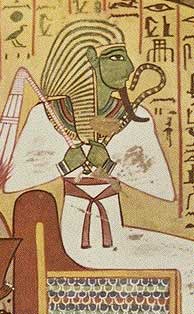
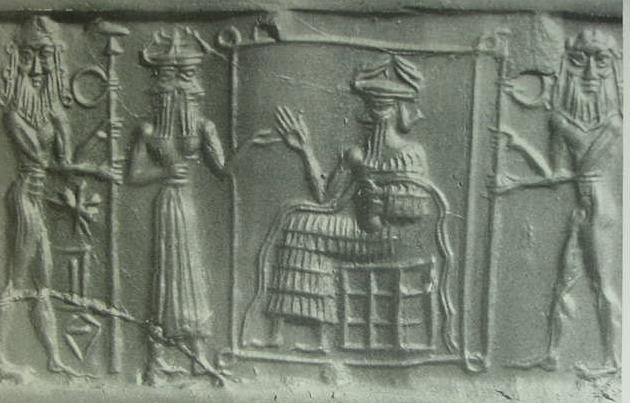
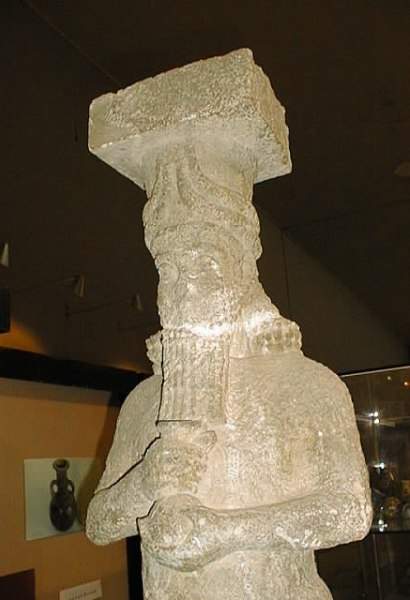
7d - Egyptian Osiris (Marduk‘s eldest son Ashur / Asar / Osiris, gods of Mesopotamian, & then Egypt)

and here in the beautiful Amentet is the Kingdom of Osiris (Ashur).

On either side the river are the great shapes of the gods surrounding the form of Osiris himself.

Enthroned is he, appearing in splendor as king,

with the White Crown of the South Land and the Red Crown of the North Land upon his head.

Great is Osiris, god of the dead, for all who die come before him for judgment,

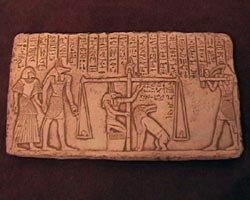
and their hearts are weighed in the balance against the feather of Truth.

His throne is set upon a running stream, clear and deep,

and from the waters rises a single lotus-blossom, the color of the sky at morning.

Upon the blossom stand the four Children of Horus,

they who assist Osiris at the Judgment, who protect the bodies of the dead.

To them belong the South and the North, the West and the East, and the four great goddesses are their protectors.

They stand upon the lotus-blossom and their faces are towards Osiris;

the first has the face of a man, the second the face of an ape,

the third the face of a jackal, and the fourth the face of a bird of prey.

This is the hour which evil-doers fear; by their own actions are they judged, and naught can avail them.

Heavy is the heart of the evil-doer and drags down the scale;

lower and lower it sinks till it reaches the jaws of Amemt, the Devourer of Hearts.

Then is the evil-doer driven forth into the thick darkness of the Duat,

to dwell with the abominable Apep and to fall at last into the Pits of Fire.

But some there are who have wrought righteousness upon earth; who have hurt no man by fraud or violence;

who have succored the widow, the orphan, and the shipwrecked mariner;

who have given food to the hungry and clothes to the naked;

who have not stirred up strife, nor caused the shedding of tears.

When these come to the Judgment of Osiris, and their hearts are put in the balance,

then is the feather of Truth the heavier.

The scale with the feather sinks down, and the scale with the heart rises up.

             7 - Thoth & Egyptian Scales of Justice (scales of righteousness)

Then does Thoth, the twice-great, take the heart and place it again in the breast of the man,

and Horus takes him by the hand and leads him to the foot of the throne of Osiris

that he may dwell in the kingdom of Osiris for ever and for evermore.

And now only can he see the most pure and truly holy Osiris,

for “the souls of men are not able to participate of the divine nature

whilst they are encompassed about with bodies and passions…

When they are freed from these impediments and remove into those purer and unseen regions…

tis then that this God becomes their Leader and King; upon him they wholly depend, still beholding without satiety,

and still ardently longing after that beauty, which ’tis not possible for man to express or think.

Slowly goes the Boat of Ra, passing through the Duat, to regions of thick darkness, of horror and dismay,

where the abominable Apep lies in wait for the coming of Ra, and where the Pits of Fire are prepared for the wicked.

Thus passes the third hour of the night, and the fourth hour is at hand.

Then the goddess of the third hour makes way for the goddess of the fourth hour,

and she calls aloud the name of the Guardian of the gate.

Flung wide are the portals, and the Boat of Ra passes through.

“Living one of forms” is the name of the fourth country of the Duat, and Sokar has dominion in this land.

Dreary is the waste of sand, limitless the desert, gloomy and sombre the landscape.

No blade of grass is seen, no tree, no herbage; naught grows, naught lives,

save monstrous many-headed serpents, gliding along the ground or creeping upon legs.

Terrible are they of aspect as they writhe and turn and hiss and roar;

they raise their hideous crests on high and hold their dusky wings outspread.

But their anger is not towards Ra, and he passes safely through their midst.

Engulfed is the great river and lost beneath the shifting sands, and where it ran is now a deep ravine.

The walls of rock rise high and steep, and ever the way winds and turns between the rocks.

Men call this place Re-stau, the Mouth of the Tomb.

Even in this gloomy desert Osiris has dominion;

Lord of Re-stau is he called, therefore none need fear when traversing the narrow path.

And now the Boat of Ra can no longer float upon the water,

but is changed into a great and mighty serpent with glittering scales.

At the prow is a serpent’s head with eyes watchful and fierce,

at the stern is a serpent’s head with poison-fangs prepared.

Over the sand it glides as a boat glides over the water.

Slowly goes the Boat of Ra, passing through the Duat, through regions of thick darkness, of horror and dismay,

to the place where Apep lies in wait for the coming of Ra.

Thus passes the fourth hour of the night, and the fifth hour is at hand.

Then the goddess of the fourth hour makes way for the goddess of the fifth hour,

and she calls aloud the name of the Guardian of the gate.

Flung wide are the portals, and the Boat of Ra passes through.

“Hidden” is the name of the fifth country of the Duat,

and in this dark and gloomy region dwells Sokar, its Lord and King, god of those who are buried.

Beside a turn of the winding way is his dwelling deep below the ground; above it rises a high mountain of sand.

Guarding it on either side are two sphinxes; lions are they in their bodies, with the faces of men;

and their claws are outstretched like the talons of a beast of prey.

In the midst lies a serpent with three heads, and between his wings stands Sokar

in the form of a man with the head of a hawk.

Savage and fierce as a hawk is Sokar, and terrible is the punishment he metes out to those who rebel against him.

Hard by his dwelling is a lake where the water boils and bubbles with heat as water boils in a pot.

Into the boiling lake are cast the rebels, and they cry to Ra for help, but Ra lies cold and lifeless,

waiting for the coming of Khepera, and their cries are unheeded while the Boat passes on its way.

On the farther wall of the ravine is a high and vaulted building, the home of Night and Darkness.

Two birds cling on either side, and round about it glides a two-headed serpent.

He lifts his savage heads, and his poison is ever ready to strike the rash intruder who should dare to try to pass.

Faithful is his watch, for in the home of Night and Darkness lives Khepera,

the great Soul of the universe, he whose emblem is the beetle, the god of resurrection.

In the form of a scarab he watches the coming of Ra,

and he flies upon the Boat and awaits there the time when he shall bring Life back to the god.

And now through the thick darkness along the narrow passage falls a gleam of light;

the Morning Star (Venus) stands by the gate to lead the Boat onwards;

for in the darkest of the night is a promise of the coming day.

Slowly goes the Boat of Ra, passing through the Duat, through regions of thick darkness, of terror and dismay,

to the place where the abominable Apep lies in wait for the coming of Ra.

Thus passes the fifth hour of the night, and the sixth hour is at hand.

Then the goddess of the fifth hour makes way for the goddess of the sixth hour,

and she calls aloud the name of the Guardian of the gate.

Flung wide are the portals, and the Boat of Ra passes through.

“Abyss of waters” is the name of the sixth country of the Duat, and Osiris has dominion over it,

Osiris, the great god, Lord of the city of Daddu, the living King,

Creator of men, of cattle, and of the green things which grow upon the earth,

Osiris, to whom all men bow in praise and adoration.

The river rises out of the sand again, and the Boat floats upon its waters,

and those who are in it rejoice, for the hours of the night are passing away.

On the banks of the river are the great shapes of the gods, mysterious and wonderful;

nine scepters of sovereignty stand there also, and a monstrous lion looms through the darkness,

faintly seen in the light which comes from the Boat of Ra.

Three shrines stand beside the river, and a serpent whose breath is flame guards each one.

Mystic and strange are the forms within the shrines, and to man it is not given to know the meaning of them;

in one is a human head, in another the wing of a bird, in the third the hind part of a lion.

Here also lives the great coiled serpent with five heads, and within his coils lies Khepera, god of resurrection.

On his head he places the scarab, beneath his feet is the sign of flesh;

thus does he send Life into the dead, and thus will he re-vivify Ra.

For this is the farthest point of the Duat, and beyond the gate lies the way to the sunrise.

Slowly goes the Boat of Ra, passing through the Duat, through regions of thick darkness, of horror and dismay,

where the abominable Apep lies in wait for the coming of Ra.

Thus passes the sixth hour of the night, and the seventh hour is at hand.

Then the goddess of the sixth hour makes way for the goddess of the seventh hour,

and she calls aloud the name of the Guardian of the gate.

Flung wide are the portals, and the Boat of Ra passes through.

“Secret cavern” is the name of the seventh country of the Duat.

Full of danger and peril is it, for the abominable Apep dwells in this land.

As a great and monstrous serpent does he appear and with wide-open mouth he swallows the waters of the river,

that the Boat may be wrecked and that Ra may perish.

Then would the earth belong to the powers of darkness, and evil and wickedness would overcome the gods.

But in the prow of the Boat stands Isis, the great enchantress, whose magic none can withstand;

Isis, the greatest of the goddesses, she who can raise the dead, and to whom all mankind pay love and reverence.

With arms outstretched, she recites the Words of Power; calling aloud across the dark river.

Over the body of Ra, the serpent Mehen casts his protecting coils, for now is the time of danger.

On a sandbank in the midst of the river lies the abominable Apep.

Four hundred and fifty cubits long is the sandbank;

the coils of Apep cover it so that naught can be seen but the river around him.

Loud does he hiss and roar, and the Duat is filled with the thunder of his voice,

yet Isis flinches not, nor does she cease her incantations and the magical movements of her hands.

Her spells prevail and the abominable Apep lies helpless on the sand.

Then Selk and Her-desuf leap from the Boat of Ra and bind him with cords,

and with sharp knives they pierce his flesh, hoping to destroy him.

But Apep is immortal, and every night will he await and attack the Boat of Ra.

Yet Selk and Her-desuf hold him fast while the Boat continues on its way,

past the great sandbanks, where he writhes and twists and struggles to get free,

but the cords are strong and the knives are sharp and his efforts are in vain.

Onward goes the Boat to the burial-places of the gods.

These stand beside the river; high mounds of sand are they, over each mound is a building,

and at each end the head of a man watches the passing of Ra.

Softly goes the Boat of Ra, passing through the Duat, moving through the darkness to the sunrise and the day.

Thus passes the seventh hour of the night, and the eighth hour is at hand.

Then the goddess of the seventh hour makes way for the goddess of the eighth hour,

and she calls aloud the name of the Guardian of the gate.

Flung wide are the portals, and the Boat of Ra passes through.

“Sarcophagus of the gods” is the name of the eighth country of the Duat, for here dwell the dead gods.

Dead and buried are they, embalmed and bandaged as men embalm and bandage the dead upon earth.

They cry aloud salutations to Ra as he passes, calling to him across the vast expanse,

but so far away are they that the sound of their voices is as the roaring of savage bulls,

as the cry of birds of prey, as the wail of mourners, as the murmur of bees.

Before the Boat go nine Followers of the Gods;

strange are their forms, mysterious and wonderful, like naught that is upon the earth.

In front of them march the four souls of Tatanen in the likeness of rams,

great and fierce, with horns wide-spreading and sharp-pointed.

The first is crowned with high upstanding plumes, the second with the Red crown of the North Land,

the third with the White crown of the South Land, the fourth with the glittering disk of the sun.

Ancient is Tatanen, dweller in Memphis, where the abode of Ptah (Enki) is on the south of the wall.

Softly goes the Boat of Ra, passing through the Duat, moving through the darkness to the sunrise and the day.

Thus passes the eighth hour of the night, and the ninth hour is at hand.

Then the goddess of the eighth hour makes way for the goddess of the ninth hour,

and she calls aloud the name of the Guardian of the gate.

Flung wide are the portals, and the Boat of Ra passes through.

“Procession of images” is the name of the ninth country of the Duat.

Full and strong runs the river, and the Boat is born forward upon the rushing stream.

Twelve star-gods guard the Boat, with paddles in their hands, ready to help the Boat in case of need.

Thick darkness broods not upon this land, for twelve great hooded snakes lie coiled upon the bank,

and the breath of their mouths is a flame of fire, gleaming upon the dark water and upon those who dwell in the Duat.

Three shallops float upon the sombre river; strange is the shape of these shallops, not like the boats of men;

and the shadowy forms within them are in the likeness of a cow, of a ram, and of the soul of a man.

From them the dwellers in this land receive the offerings which are made to them upon the earth.

Then the star-gods break into singing; and the twelve goddesses and the weaving gods

and the dwellers in this land chant the glory and honor of Ra,

praising the Lord of the Boat, the Maker of earth and of heaven.

With joy and singing they follow the appointed path.

Onward goes the Boat of Ra, passing through the Duat, traveling to the sunrise and the light of open day.

Thus passes the ninth hour of the night, and the tenth hour is at hand.

Then the goddess of the ninth hour makes way for the goddess of the tenth hour,

and she calls aloud the name of the Guardian of the gate.

Flung wide are the portals, and the Boat of Ra passes through.

“Abyss of waters, lofty of banks” is the name of the tenth country of the Duat, and the ruler is Ra.

The dwellers in this land come to meet their king as he passes by upon the swelling river.

Deep and full and strong runs the stream, and the Boat is born forward upon the rushing current.

Divine warriors armed with glittering weapons of war are a guard for their king;

light is on their faces like the light of the sun.

By the side of the river are four goddesses;

upon the darkness they cast beams of light, making bright the way of Ra upon the gloomy river.

Before the Boat of Ra moves the Star of Morning in the form of a double-headed serpent walking upon legs,

and upon his heads are the crowns of the South Land and the North Land;

between his coils is the great hawk of the sky;

Leader of Heaven is his name, for the stars of heaven follow him, but men call him Hesper and Lucifer also.

In a shallop on the stream is a snake, Life of the Earth is he called,

and he watches in the Duat against the enemies of Ra.

The greatest of all the countries of the Duat is this,

for in this realm of wonder and mystery Khepera joins himself to Ra, and Ra himself is created anew.

Yet the dead body of Ra remains in the Boat; but his soul is united to the soul of Khepera.

Onward goes the Boat of Ra, passing through the Duat, traveling to the sunrise and the light of open day.

Thus passes the tenth hour of the night and the eleventh hour is at hand.

Then the goddess of the tenth hour makes way for the goddess of the eleventh hour,

and she calls aloud the name of the Guardian of the gate.

Flung wide are the portals, and the Boat of Ra passes through.

“Mouth of the cavern” is the name of the eleventh country of the Duat,

and Ra is its ruler. Low has the river fallen and sluggishly it runs,

and the Boat is drawn onwards by the gods; not with cords do they tow it,

but with the body of the great serpent Mehen, the protector of Ra.

On the prow of the Boat is a fiery star, but its light is not redder than the strange and lurid glow

which fills this land; terrible and red is it and the sight of it is full of horror.

This is the region feared by evil-doers, for their punishment awaits them here.

Far and near are pits of fire; goddesses, whose breath is flame, guard the pits,

holding in their hands gleaming swords of fire.

With their knives do they torment the wicked and cast them into the pits of flame till they perish utterly.

Horus stands by and beholds their torments, for these are the enemies of Osiris and of Ra,

doers of evil upon the earth and blasphemers of the gods.

No help can come to them, no escape is possible; doomed are they by their own actions to the sword and fire.

And the smoke and flame of their torment rise up in the Duat.

On the far side of the river are the stars; Shedu is there in the fashion of a snake;

scarlet and crimson is he, and the stars which form his body are ten in number.

There also a shape is seen, mysterious and wonderful;

like a winged snake with legs does he appear, and between the wings is the shadowy likeness of a man.

Men call him Atmu, dweller in Heliopolis; ancient is Atmu, more ancient than Ra himself;

and he sends the sweet breezes of the North Wind upon the land of Egypt.

On either side of him the Eyes of Horus show dimly in the faint and lurid light.

And now springs up the breeze of morning; gentle is it and slight, but with it comes the promise of the day.

Onward goes the Boat of Ra, passing through the Duat, traveling to the sunrise and the light of open day.

Thus passes the eleventh hour, and the twelfth hour and the dawn are at hand

Then the goddess of the eleventh hour makes way for the goddess of the twelfth hour,

and she calls aloud the name of the Guardian of the gate.

Flung wide are the portals, and the Boat of Ra passes through.

“Darkness has fallen, and births shine forth” is the name of the twelfth country of the Duat.

On the prow of the Boat is the great scarab of Khepera,

ready to make the transformations of Ra where he reaches the end of the Duat.

Not like other lands is this twelfth region of the Duat, for it is enclosed in the body of a vast and monstrous serpent.

“Life of the Gods” is his name, and through this great and huge frame travels the Boat of Millions of Years.

Twelve of the worshipers of Ra seize the towing-ropes and drag the Boat onward,

and here in the body of the serpent is Ra transformed into Khepera and is alive again,

for now the journey through the Duat is near the end.

Standing by the mouth of the serpent are twelve goddesses;

to these the Worshipers of Ra yield the towing-ropes, and they draw the Boat to the eastern horizon of heaven.

And now the dead corpse of Ra is cast out of the Boat, as the husk is cast away when the grain is winnowed out,

for the soul and the life of Ra are in the scarab of Khepera, and the transformations of Ra are completed.

With shouting and singing, with joy and with gladness, the Boat of Ra passes out of the Duat.

Glorious is the Manzet Boat, speeding to the sunrise!

Wide, swing wide the portals, and usher in the day.

Between the sycamores of turquoise comes the Boat of Ra, and the mountain of Bakhu is flushed with light.

The serpent, guardian of the Great Green Waters,

beholds Ra in glory in the eastern horizon of heaven, and the rays glitter on his scales.

Glorious is the Manzet Boat, born upon the river, flashing in the splendor and the light of open day.

In the foam at the prow of the Boat sports the Abtu-fish, darting through the gleaming spray,

and the Ant-fish is seen in the whirlpool of turquoise.

From the earth rises up the sound of rejoicing, for all created things praise Ra at his rising.

Hail to thee, Ra, at thy rising; the night and the darkness are past.

At the dawn of the day thou shinest, the heavens are filled with thy light.

King of the Gods art thou, all glory and triumph are thine.

The Gods come as dogs to thy feet, rejoicing to greet thee at dawn.

Hail to thee Ra, at thy rising; at thy coming all men are glad.

In joy dost thou come in the morning, with glory thou rulest the world.

The stars of the heavens adore thee, the Gods of the earth exalt thee,

Lord of the Heavens art thou. Hail to thee, Ra, at thy rising!

None can express thy glory, Lord of all Wisdom and Truth.

The souls of the East attend thee, the souls of the West are thy servants, the North and the South adore thee.

Worshiped art thou, our Ruler, by those whom thou hast created,

Thou risest in heaven‘s horizon, thou causest mankind to rejoice.

Hail to thee, Ra, at thy rising; at thy rising in beauty,

O Ra.

Minor Gods Related to Marduk Quotes From Texts

(Texts: All Artifacts, Color Coding, & Writings in Bold Type With Italics Inside Parenthesis, are Added by Editor R. Brown, not the Authors, Translators, or Publishers!)

(gods in blue)
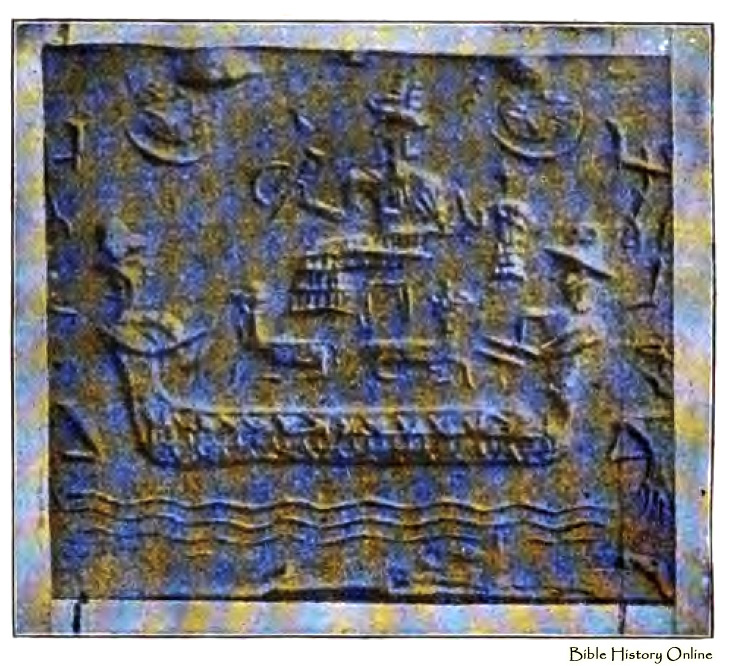
 

Sarpanit / Sarpanitum Quotes From Texts

Sarpanit / Sarpanitum = Marduk’s ½ sister-spouse

         “In the Gate of Conciliation, I appeared with Marduk,

        In the Gate of Joy I kissed the foot of Sarpanitum (Marduk’s spouse),

        I was assiduous in supplication and prayer before them,

        I placed fragrant incense before them, …”

        “Who but Marduk revived him as he was dying?

        Besides Sarpanitum, which goddess bestowed his breath of life?

        Marduk can restore to life from the grave,

        Sarpanitum knows how to rescue from annihilation, …”

         (Hammurabi speaking:)

         “When he reads the record, let him pray with full heart to Marduk, my lord,

         and Zarpanit (Marduk’s spouse), my lady;

         and then shall the protecting deities and the gods,

         who frequent E-Sagil, graciously grant the desires daily presented before Marduk,

         my lord, and Zarpanit, my lady. …”

Ninehama Quote From Text

Ninehama = Marduk’s spouse

         “On that day, the storm forced people to live in darkness.

         In order to destroy Kuara, it forced people to live in darkness.

         Ninehama in her fear wept bitter tears.

         ‘Alas the destroyed city, my destroyed house,’ she cried bitterly.

         Asarluhi (Marduk) put his robes on with haste and….. …”

Marduk Quotes From Zecharia Sitchin’s Books

SEE SITCHIN’S EARTH CHRONICLES, ETC.:

(Texts: All Artifacts, Color Coding, & Writings in Bold Type With Italics Inside Parenthesis, are Added by Editor R. Brown, not the Authors, Translators, or Publishers!)

(gods in blue mixed-breed demigods in teal…)


Marduk’s urgent message to his father, describing a near-calamity on the flight to Earth:

It has been created like a weapon;

It has charged forward like death…

The Anunnaki who are fifty it has smitten…

The flying, birdlike Supreme Orbiter it has smitten on the breast …”

In Marduk’s Babylonian re-written accounts of Sumerian history, he claimed that it was he who defeated Zu (Anzu) and regained the Tablets of Destinies instead of Ninurta:

         “I have crushed the skull of the god Zu. …”

The text reports a conversation between father and son…with a difficult question:

         “Enki answered his son Marduk:

         ‘My son, what is it you do not know?

         What more could I give to you?

         Marduk, what is it that you do not know?

         What could I give you in addition?

         Whatever I know, you know!’ …”

Ra as the engineer (“Extender of the Chord”) who built the “Protected Place” in the “Sacred Desert,” from which he could “ascend beautifully” and “traverse the skies”:

         “Thou extendest the chords for the plan, thou didst give form to the lands…

         Thou didst make secret the Lower World…

         Thou hast built for thee a place protected in the sacred desert, with hidden name.

         Thou risest by day opposite them…

         Thou art rising beautifully…

         Thou art crossing the sky with a good wind…

         Thou art traversing the sky in the celestial Barque…

         The sky is jubilating, the Earth is shouting joy.

         The crew of Ra do praising every day;

         He comes forth in triumph. …”


         “there did the boat-wrecking waters carry the espoused of Inanna…. …”

Having disapproved of the DumuziInanna love match from the beginning, Marduk no doubt was even more opposed to the union after the Pyramid Wars. The rape of Geshtinanna by Dumuzi—was thus an opportunity for Marduk to block the designs Inanna had on Egypt, by seizing and punishing Dumuzi.

As far as she (Inanna) was concerned, Marduk had caused her beloved’s death. And as the (Akkadian) text makes clear

         “What is in holy Inanna’s heart?

         To Kill!

         To kill the Lord Bilulu (Marduk)

Inanna armed herself with an array of weapons to attack the god in his hiding place…she confidently approached The Mountain, which she called E.BIH (Abode of Sorrowful Calling”). Haughtily she proclaimed:

         “Mountain, thou art so high, thou art elevated above all others…

         Thou touchest the sky with thy tip…

         Yet I shall destroy thee,

         To the ground I shall fell thee..

         Inside thine heart pain I shall cause. …”

As Inanna continued to challenge Marduk, now hiding inside the mighty structure (pyramid), her fury rose…

         “For the second time, infuriated by his pride,

         Inanna approached (the pyramid) again and proclaimed:

         ‘My grandfather Enlil has permitted me to enter inside The Mountain! …”

Flaunting her weapons, she haughtily announced:

         “Into the heart of the Mountain I shall penetrate…

         Inside the Mountain, my victory I shall establish! …”

She began to attack:

         “She seized not striking the sides of E-Bih and all its corners,

         even its multitude of raised stones.

         But inside…the Grest Serpent who had gone in his poison ceased not to spit …”

The record of the trial and sentencing of Marduk is available from a fragmentary text…begins where the gods had surrounded the pyramid. A god…a spokesman, addressed Marduk in his enclosure”;

         “the one who was evil he implored …”

Marduk was moved by the message:

         “Despite the anger of his heart, clear tears came into his eyes …”

The trial was held within sight of the pyramids, in a temple by the riverbank:

         “To the place of reverence, by the river,

         with him who was accused they stepped.

         In truth they made the enemies stand aside.

         Justice was performed …”

In sentencing Marduk the mystery of Dumuzi’s death posed a problem…Standing there, in sight of the pyramids, with Marduk fresh out of his hiding place, the solution dawned on Inanna, and she proceeded to address the gods:

         “On this day, the Lady herself,

         She who speaks truth,

         The accuser of Azag, the great princess,

         An awesome judgment uttered …”

There was a way to sentence Marduk to death without actually executing him, she said:

         “Let him be buried alive within the Great Pyramid!

         Let him be sealed there as in a gigantic envelope!

         In a great envelope that is sealed,

         With no one to offer him nourishment;

         Alone to suffer,

         The potable watersourse to be cut off. …”

The judging gods accepted her suggestion:

         “The mistress art thou…

         The fate thou decrreest: let it be so! …”

Assuming that Anu would go along with the verdict,

         “The gods then placed the command to Heaven and Earth …”

The E.KUR, the Great Pyramid, had become a prison; and one of the epithets of its mistress was, thereafter,

         “Mistress of the Prison …”

Marduk had air to breathe; but he had neither food nor water…doomed to die in agony.

The ancient “script” begins with an introduction of the actors. The first one

         “is Bel, who was confined in The Mountain …”

Then there is the messenger who brings the news of imprisonment to Marduk’s son NabuNabu hastens to The Mountain in his chariot. He arrives at a structure

         “that is the house on the edge of The Mountain

         wherein they questioned him …”

They are told that the agitated god is

        Nabu who from Borsippa comes.

         It is he who comes to seek

         after the warefare of his father, who is imprisoned …”

Actors then come out, and rush about…

         “they are the people who in the streets hasten;

         they seek Bel saying:

         Where is he held captive? …”

We learn from the text that:

         “after Bel had gone into The Mountain,

         the city fell into tumult …”


        “because of him fighting within it broke out …”

A goddess appears; she is Sarpanit, the sister-wife of Marduk. She is confronted by a messenger

         “who weeps before her, saying:

         ‘Unto The Mountain they have taken him.’ …”

He shows her the garments of Marduk (possibly bloodstained):

         “these are his raiment, which they took off him …”

Marduk

         “with a Garment-of-Sentence was clothed …”


         “That means: in a coffin he is …”

Sarpanit goes to a structure that symbolizes Marduk’s tomb. She sees a group of mourners. The script explains:

         “These are those who make lament

         after the gods had locked him up,

         separating him from among the living.

         Into the House of Captivity,

         away from the sun and light, they put him in prison …”

Sarpanit recites an appeal…

         “She prays to Sin and Shamish, saying:

         ‘Give life to Bel!’ …”

Offerings are made to Ishtar,

         “that she may show her mercy …”

The high priest appeals to the supreme god, to Sin, and to Shamash:

         “Restore Bel to life! …”

…who represents Marduk, clothed with shrouds which

         “with blood are dyed …”

speaks out:

         “’I am not a sinner!

         I shall not be smitten!’ …”

He announces that the supreme god has reviewed his case and found him not guilty.

The attention is diverted to a doorpost;

         “it is the doorpost of Sarpanit in Babylon …”

         “That is the head of the evil doer,

         whom they shall smite and slay …”

Nabu

         “comes back from Borsippa;

         he comes and stands over the evildoer and regards him …”

         “The one whose sin it was …”

is carried away in a coffin. The murderer of Dumuzi has paid with his life. Sarpanit reappears…

         “It is water for hand-washing

         which they bring after The Evildoer has been carried away …”


In all the sacred places of Bel torches are lit….The supremacy of Ninurta…is reasserted…the divine messenger Nusku (did)

         announce the (good) tidings to all the gods …”

         “How can they let him free,

         the one who cannot come out? …”

Nusku, the divine messenger, tell her (Sarpanit) that Marduk shall pass through SA.BAD, the “chiseled upper opening.” He explains that it is

         “A doorway-shaft which the gods will bore;

         Its vortex they will lift off, his abode they shall reenter.

         The door which was barred before him

         At the vortex of the hollowing, into the sides,

         a doorway they shall twistingly bore;

         Getting near, into its midst they will break through. …”

The Anunnaki realized that the shortest and quickest way to reach the starved Marduk was to tunnel a connecting shaft…a tunneling of a mere thirty-two feet…

         “burst open by a tremendous force

         Getting near, into its midst they will break through …”

Having broken through into the Grand Gallery, the rescuers led Marduk back the way they came. The entry from the Descending Passage was sealed up again, to be (later) discovered by Al Mamoon’s men.

(Ra) went into exile…in Egypt Ra acquired the epithet Amen, “The Hidden One.” Circa 2000B.C., he reappeared to claim again supremacy; for that, mankind ended paying a most bitter price.

Sargon in his old age made a big mistake: He took away soil from Babylon and built upon the soil another Babylon beside Agade…

         “On account of the sacrilege Sargon thus committed,

         the great lord Marduk became enraged

         and destroyed his people by hunger.

         From the east to the west he alienated them from Sargon;

         and upon him he inflicted as punishment that he could not rest …

        The soil from the trenches of Babylon he removed,

         and the boundaries of Akkad he made like those of Babylon.

         But because of the evil which he had committed,

         the great lord Marduk was angry, and he destroyed his people by famine…. …”

one text states:

He dug up the dirt of the pit of Babylon and

made a counterpart of Babylon next to Agade.

Because the wrong he had done the great lord Marduk became angry

and wiped out his family by famine.

From east to west, the subjects rebelled against him

and Marduk afflicted him with insomnia. …”
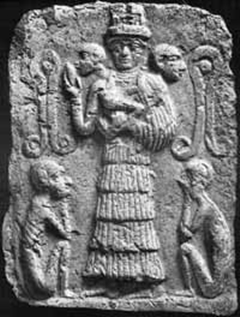
1,500 years later, the Weidner Chronicle (ABC 19) accounts for the Gutian period as follows:

        “NaramSin destroyed the people of Babylon,

         so twice Marduk summoned the forces of Gutium against him …”

Marduk gave his kingship to the Gutian force.
The Gutians were unhappy people unaware how to revere the gods,

ignorant of the right cultic practices … “

Utuhengal, the fisherman, caught a fish at the edge of the sea for an offering.

That fish should not be offered to another god

until it had been offered to Marduk,

but the Gutians took the boiled fish from his hand before it was offered,

so by his august command, Marduk removed the Gutian force

from the rule of his land and gave it to Utu-hengal …”

Unable or unwilling to remove Marduk by force, the Anunnaki turned to Marduk’s brother Nergal and asked him to

         “scare Marduk off the divine seat … (in Babylon).”

A text named by scholars The Erra Epos, for in it Nergal is called… ER.RA…a derogatory epithet,…The Servant of Ra.”...better called The Tale of the Sins of Nergal for it puts the blame on Nergal for a chain of events with a catastrophic ending…

         “into the Esagil (Marduk’s temple – residence in Babylon), temple of Heaven and Earth,

         he entered and stood before Marduk …”

Marduk explained that he had to take matters in his own hands:

         “In the aftermath of the Deluge,

         the decrees of Heaven and Earth had gone astray.

         The cities of the gods upon the wide Earth were changed around;

         They were not brought back to their locations…

         As I survey them again, of the evil I am disgusted;

         Without a return to their (original) places,

         Mankind’s existence is diminished…

         Rebuild I must my residence which in the Deluge was wiped away;

         Its name (I must) call again. …”

…failures on the part of Erra himself to account for certain divine artifacts–

         “the instrument of giving orders,

         the Oracle of the gods; the sign of kingship,

         the Holy Scepter which contributes brilliance to Lordship…

         Where is the Holy Radiating Stone which disintegrates all? …”

Marduk asked. If he were forced to leave,

         “on the day I step off my seat,

         the flooding shall from its well cease to work…

         the waters shall not rise…

         the bright day to darkness (shall return)

         confusion shall arise…

         the winds of drought shall howl…

         sickness shall spread. …”

After some more exchanges Erra offered to return to Marduk’s possession

         “the artifacts of Heaven and Earth …”

He assured Marduk there was nothing to worry about: he (Erra) would enter Marduk’s house only to

         erect the Bulls of Anu and Enlil at thy gate …”

statues of winged bulls as were actually found at temple sites…

        Marduk heard this;

         The promise, given by Erra, found his favor.

         So did he step down from his seat,

         and to the Land of Mines, abode of the Anunnaki, he set his direction …”

Marduk agreed to leave Babylon. But no sooner he had done that than Nergal broke his word. Nergal / Erra ventured into the Gigunu, the mysterious underground chamber…and there Erra caused its Brillianceto be removed…as Marduk had warned,

         “the day turned into darkness, flooding was disarrayed,

         the lands were laid to waste, the people were made to perish …”


         “With anger (at Erra) they were filled …”

Ea (Enki), Erra’s father, reproached him:

         “Now that the Prince Marduk had stepped off, what have you done? …”

         “Go away! …”

he ordered Erra.

         “Take off to where no gods ever go! …”

        Erra lost his voice …”

         “As to my warriors, they shall not go back. …”

The departure of Marduk from Babylon brought an end Ishtar’s conflict with him.; the rift between Marduk and Nergal…created an alliance between Ishtar and Nergal.

It was exactly when Abraham, accompanied by an elite military corps, left Harran,–the gateway to the Hittite lands—that the exiled and wondering Marduk appeared in Hatti lands.–...Marduk stayed there through the same twenty-four Fateful Years , the years that culminated with the Great Disaster…aging Marduk tells of his erstwhile wanderings and eventual return to Babylon:

           “O great gods, learn my secrets.

           As I girdle my belt, my memories remember:

           I am the divine Marduk, a great god.

           I was cast off for my sins,

           to the mountains I have gone.

           In many lands I have been a wanderer:

           From where the sun rises to where it sets I went.

           To the heights of Hatti-land I went.

           In Hatti-land I asked an oracle

           (about) my throne and my Lordship;

           In its midst (I asked):

           ‘Until when?’

           24 years, in its midst, I nested. …”

It was a place, we suggest, which the Bible called Kadesh-Barnea, and there Abraham stood with his elite troops, blocking the invaders’ advance to the Spaceport proper…it was intended to prevent the return of Marduk and thwart the efforts of Nabu to gain access to the Spaceport.

Marduk’s desire to make Babylon the heavenward naval in the four regions. It was to thwart this that the gods opposing Marduk ordered Khedorla’omar to seize and defile Babylon:

         “The gods…

         to Kudur-Laghamar, king of the land of Elam,

         they decreed: ‘Descend there!’

         That which to the city was bad he performed;

         In Babylon, the precious city of Marduk, kingship he overthrew;

         To herds of dogs its temple he made a den;

         Flying ravens, loud shrieking, their dung dropped there …”

After the bad deeds were done there, Utu / Shamash sought action against Nabu, who (he had said in accusation) had subverted the allegiance of a certain king to his father.

         “Before the gods the son of his father (came);

         On that day Shamash, the Bright One, against the lord of lords,

         Marduk (he said):

         ‘The faithfulness of his heart (the king) betrayed–

         in the time of the thirteen year a falling-out against my father (he had);

         to his faith-keeping the king ceased to attend;

         all this Nabu has caused to happen.’ …”

But at Dur-Mah-Ilani, according to the Babylonian text,

         “the son of a priest,

         whom the gods in their true counsel had anointed, …”

stood in the invaders’ way andthe despoiling prevented.”

Could the Babylonian text indeed refer to Abraham, the son of Terah the priest…?(high-priest of Ur)

2123 B.C. . Abraham was born in Nippur to his father Terah

2113 B.C. . Ur-Nammu (Ninsun’s mixed-breed son) enthroned in Ur, given guardianship in Nippur

Terah and his family move to Ur

2095 B.C. . Shulgi (Ninsun’s mixed-breed son) ascends throne after death of Ur-Nammu

Terah and his family leave Ur for Harran

2055 B.C. . Shulgi receives (uncle) Nannar’s oracles, sends Elamite troops to Canaan

2048 B.C. . Shulgi’s death ordered by Anu and Enlil

Abraham, seventy-five years old, ordered to leave Harran for Canaan

2047 B.C. . Amar-Sin (Shulgi’s son) (“Amarpal”) ascends the throne of Ur

Abraham leaves the Negev for Egypt

2042 B.C. . Canaanite kings switch allegiance to “other gods

Abraham returns from Egypt with elite corps

2041 B.C. . Amar-Sin launches the War of the Kings

2041 B.C., the year of the military expedition—also MU NE IB.RU.UM BA.HUL, “Year (in which) the Shepherding-abode of IB.RU.UM was attacked”`

Abraham protects the Spaceport in “The Kings’ War”

Ibbi-Sin (Shu-Sin’s mixed-breed son) put his trust again in Nannar and Inanna, installing himself in his second year as High Priest of Inanna’s temple in Uruk…In the fourth year of his reign he was told that

         “The Son in the west will arise…

         it is an omen for Ibbi-Sin: Ur shall be judged …”

In his fifth year, Ibbi-Sin sought further strength by becoming High Priest of Inanna at her shrine in Ur.. But that too was no help…As the sixth year began, the omens concerning destruction became more urgent and more specific.

         “When the sixth year comes,

         the inhabitants in Ur will be trapped, …”

Another omen said,

         “When for the second time, he who calls himself Supreme,

          like one whose chest has been anointed, shall come from the west. …”

That very year, as messages from the borders reveal,

         “hostile Westerners had entered the plain …”

of Mesopotamia; without resistance, they quickly

         “entered the interior of the country,

         taking one by one all the great fortresses …”

Marduk, as the omens had predicted, returned to Babylon for the second time.

         “In Hattiland I asked an oracle (about) my throne and my Lordship;

          In its midst (I asked); ‘Until when? …”

Then, in that twenty-fourth year, he received a favorable omen:

         “My days (of exile) were completed;

         To my city (I set my course);

         My temple (residence) Esagila as a mount (to raise / rebuild),

         My everlasting abode to (reestablish).

         I raised my heels (toward Babylon)

         Through…lands (I went) to my city

         her (future / well-being) to establish,

         A king in Babylon to (install)

         In the house of my covenant…

         In the mount-like Esagil

         By Anu created…

         Into the Esagil…

         A platform to raise…

         In my city…

         Joy. …”


         “chase away evil and bad luck…

         bring motherly love to Mankind. …”

It was then that the holy city was despoiled and its shrine, the Ekur (Enlil’s temple – residence in Nippur), desecrated. Ninurta accused the followers of Marduk of this evil deed; but it was not so; it was his ally Nergal / Era who had done it!

         “Erra , the pitiless one, entered the sacred precinct.

         He stationed himself in the sacred precinct, he beheld the Ekur.

         His mouth he opened, he said to his young men:

         ‘Carry off the spoil of Ekur, take away its valuables,

         destroy its foundation, break down the enclosure of the shrine!’ …”

When Enlil, loftily enthroned, heard that his temple had been destroyed, its shrine defiled, that in the holy of holies the veil was torn away”, he rushed back to Nippur.

         “Riding in front of him were gods clothed with radiance; …”

he himself,

         “set off brilliance like lightning as he came down from the skies;

         made the holy place shake …”

as he ascended to the sacred precinct. Enlil then addressed himself to his son, the prince Ninurta. to find out who defiled the sacred place. But instead of telling the truth, that it was Erra, his ally, Ninurta pointing the accusing finger at Marduk and his followers…

The Babylonian text asserts that Ninurta was acting without the required respect of meeting with his father:

           “not fearing for his life, he removed not his tiara …”

To Enlil

           “evil he spoke…

           there was no justice, destruction was conceived. …”


           “Enlil against Babylon caused evil to be planned …”

In addition to “evil deeds” against Marduk and Babylon, an attack against Nabu and his temple Ezida in Borsippa was also planned. But Nabu managed to escape westward

         “Fron Ezida…

         Nabu, to marshal all his cities set his step;

         Toward the great sea he set his course …”

…verses in the Babylonian text…have a direct parallel in the biblical tale of the destruction of Sodom and Gomorrah:

         “But when the son of Marduk in the land of the coast was,

         He-of-the-Evil-Wind (Erra) with heat the plain-land burnt …”


         “He (Nabu) the great sea entered,

         Sat upon a throne which was not his

         (Because) Ezida, the legitimate abode, was overrun …”

Enki stood by his firstborn son:

         “Now that Prince Marduk has arisen,

         now that the people for the second time have raised his image,

         why does Erra continue his opposition? …”

Finally, loosing his patience, Enki shouted at Nergal to get out of his presence. Leaving in a huff, Nergal returned to his domain. Consulting with himself,he decided to unleash the awesome weapons:

         “The lands I will destroy, to a deep dust-heap make them;

         the cities I will upheaval, to desolation turn them;

         the mountains I will flatten, their animals make disappear;

         the seas I will agitate, that which teems in them I will decimate;

         the people I will make vanish, their souls shall turn to vapor;

         none shall be spared. …”

We learn from a text…that it was Gibil, whose domain in Africa adjoined that of Nergal, who alerted Marduk to the destructive scheme hatched by Nergal…It was then that Gibil these words to Marduk did speakin regard to the

         “seven awesome weapons which Anu created..

         The wickedness of those seven against thee is being laid, …”

he informed Marduk. Marduk inquired of Gibil where the awesome weapons were kept. O Gibil,,” he said,those seven—where were they born, where were they created? To which Gibil revealed that they were hidden underground:

         “Those seven, in the mountain they abide,

         in a cavity inside the earth they dwell.

         From this place with a brilliance they will rush forth,

         From Earth to Heaven, clad with terror. …”

But where exactly is this place? Marduk asked again and again; and all Gibil could say was that even the wise gods, to them it is unknown.Now Marduk rushed to his father Enki with the frightening report.

         “To his father Enki’s house he (Marduk) entered …”

Enki was lying on the couch in the chamber to which he retired for the night. “My fatherMarduk said,

         “Gibil this word hath spoken to me:

         of the coming of the seven (weapons) he has found out. …”

Telling his father the bad news, he urged his all-knowing father:

         “Their place to search out, do hasten thou! …”

Enki spoke out strongly against the idea, urging steps to stop Nergal, for the use of the weapons, he pointed out,

         “the lands will make desolate, the people will make perish. …”

Nannar and Utu wavered as Enki spoke, but Enlil and Ninurta were for decisive action. And so with the Council of the Gods was in disarray, the decision was left to Anu.

Nergal had already ordered the priming of the seven awesome weaponswith theirpoisons.”,

         “Anu, lord of the gods, on the land had pity …”

It was then that Ninurta, attempting to dissuade Nergal from indiscriminate annihilation, used words identical to those attributed in the Bible to Abraham when he tried to have Sodom spared:

         “Valiant Era (Nergal),

         Will you the righteous destroy with the unrighteous?

         Will you destroy those who have against you sinned

         together with those who against you have not sinned? …”

The two gods argued back and forth on the extent of the destruction. More than Ninurta, Nergal was consumed by personal hatred:..he shouted

         “I shall annihilate the son (Nabu), and let the father (Marduk) bury him;

         then I shall kill the father, let no one bury him. …”

Ninurta finally swayed Nergal.

         “He heard the words spoken by Ishum (Ninurta);

          the words appealed to him as fine oil …”

Agreeing to leave alone the seas, to leave Mesopotamia out of the attack, he formulated a modified plan: the destruction will be selective..to destroy the cities where Nabu might be hiding…to deny Marduk the greatest prize—the Spaceport, the place from where the Great Ones ascend…. …”

         “From city to city an emissary I will send;

         The son, seed of his father, shall not escape;

         His mother shall cease her laughter…

         To the place of the gods, access he shall not have:

         The place from where the Great Ones ascend

         I shall upheaval. …”

Wasting no more time, Nergal then urged Ninurta that the two of them go at once into action:

        “Then did the hero Erra go ahead of Ishum, remembering his words;

         Ishum too went forth, in accordance with the word given,

         a squeezing in his heart …”

Their first target was the Spaceport, its command complex hidden in the Mount Most Supreme, its landing fields spread in the adjoining great plain:

         “Ishum to Mount Most Supreme set his course;

         The Awesome Seven, (weapons) without parallel, trailed behind him.

         At the Mount Most Supreme the hero arrived;

         He raised his hand–the mount was smashed;

         The plain by the Mount Most Supreme he then obliterated;

         in its forests not a tree-stem was left standing …”

So with one nuclear blow the Spaceport was obliterated…Now it was the turn of Nergal...Guiding himself through the Sinai peninsula to the Canaanite cities by folllowing the King’s Highway, Erra upheavaled them.

The words employed by the Erra Epic are almost identical to those used in the biblical tale of Sodom and Gomorrah:

        “Then, emulating Ishum, Erra the King’s Highway followed.

         The cities he finished off, to desolation he overturned them.

         In the mountains he caused starvation, their animals he made perish. …”

The verses that follow may well describe the creation of the new southern portion of the Dead Sea…:

         “He dug through the sea, its wholeness he divided.

         That which lives in it, even the crocodiles he made wither.

         As with fire he scorched the animals,

         banned its grains to become as dust …”

We find descriptions and recollections of the nuclear upheaval in other texts as well:

         “Lord, bearer of the Scorcher

         that burnt up the adversary;

         Who obliterated the disobedient land;

         Who withered the life of the Evil Word’s followers;

         Who raised stones and fire upon the adversaries …”

In a Babylonian text in which one king recalls the momentous events that had taken place in the reign of an earlier king.”

         “At that time, in the reign of a previous king, conditions changed.

         Good departed, suffering was regular.

         The Lord (of the gods) became enraged, he conceived wrath.

         He gave the command: the gods of that place abandoned it…

         The two, incited to commit the evil, made its guardians stand aside;

         its protectors went up to the dome of heaven …”

TheKhedorlaomer Text”, which identifies the two gods by their epithets as Nergal and Ninurta, tells it this way:

         “Enlil, who sat alone in loftiness, was consumed with anger.

         The devastators again suggested evil;

         He who scorches with fire (Ishum / Ninurta)

         and he of the evil wind (Erra / Nergal) together performed their evil.

         The two made the gods flee, made them flee the scorching …”

The target, from which they made the gods guarding it flee, was the Place of the Launching:

         “That which was raised towards Anu to launch they caused to wither;

         Its face they made fade away, its place they made desolate …”

Thus was the Spaceport, the prize of which so many Wars of the Gods had been fought, obliterated: the Mount within which the controlling equipment was placed was smashed; the launch platforms were made to fade off the face of the earth; and the plain whose hard soil the shuttle craft had used as runways was obliterated, and not even a tree left standing.

But the deed done by Nergal and Ninurta had not gone unrecorded, for it turned out to have a most profound effect on Sumer, its people, and its very existence…The nuclear explosion gave rise to an immense wind, a radioactive wind, which began as a whirlwind:

         “A storm, the Evil Wind, went around in the skies …”

The desolation caused by the catastrophe is then described vividly, by such verses as these:

         “Causing cities to be desolate, (causing) houses to become desolate;

         Causing stalls to be desolate, the sheepfolds to be emptied;

         That Sumer’s oxen no longer stand in their stalls,

         that its sheep no longer roam in its sheepfolds;

         That its rivers flow with water that is bitter,

         that its cultivated fields grow weeds, that its steeps grow withering plants …”

In the cities and the hamlets,

         “the mother cares not for her children,

         the father says not ‘O my wife’…

         the young child grows not sturdy on their knee,

         the nursemaid chants not a lullaby…

         kingship has been taken away from the land …”


        “On the Land (Sumer) fell a calamity, one unknown to man:

         One that had never been seen before, one which could not be withstood …”

It was an unseen death,

         “which roams the street, is let loose in the road;

         it stands beside a man–yet none can see it;

         when it enters a house, its appearance is unknown …”

There was no defense against this

         “evil which has assailed the land like a ghost:…

         The highest wall, the thickest walls, it passes as a flood,

         no door can shut it out, no bolt can turn it back;

         through the door like a snake it glides,

         through the hinge like a wind it blows in.

         Cough and phlegm weakened the chest,

         the mouth was filled with spittle and foam…

         dumbness and daze have come upon them,

         an unwholesome numbness…

         an evil curse, a headache…

         their spirit abandoned their bodies …”

it was a most gruesome death:

         “The people, terrified, could hardly breathe;

         the Evil Wind clutched them,

         does not grant them another day…

         Mouths were drenched in blood, heads wallowed in blood…

         The face was made pale by the Evil Wind …”


         “Covered the land as a cloak, spread over it like a sheet …”

Brownish in color, during the daytime

         “the sun in the horizon it obliterated with darkness

         (Girt with dread brilliance it filleth the broad earth) …”

it blocked out the moon:

         “the moon at its rising it extinguished …”

Moving from west to east, the deadly cloud–

         “enveloped in terror, casting fear everywhere

         a great wind which speeds high above,

an evil wind which overwhelms the land …”

It was

         “a great storm directed from Anu

         it hath come from the heart of Enlil.

         In a single spawning it was spawned…

         like the bitter venom of the gods; in the west it was spawned.

         Bearing gloom from city to city,

         carrying dense clouds that bring gloom from the sky …”

was the result of a

         “lightning flash, from the midst of the mountains

         it had descended upon the land,

         From the Plain of No Pity it hath come …”

Though the people were baffled, the gods knew the cause of the Evil Wind:

         “An evil blast heralded the baleful storm,

         An evil blast the forerunner of the baleful storm was;

         Mighty offspring, valiant sons were the heralds of the pestilence …”

As soon as the awesome weaponswere launched from the skies, there was an immense brilliance

         “they spread awesome rays towards the four points of the earth,

         scorching everything like fire …”


         “The storm, in a flash of lightning created, a dense cloud that brings gloom …”

followed by

         “rushing wind gusts…

          a tempest that furiously scorches the heavens …”

Several texts attest that the Evil Wind, bearing the cloud of death, was caused by gigantic explosions on a day to remember:

         “On that day

         When heaven was crushed and the Earth was smitten,

         its face obliterated by the maelstrom–

         When the skies were darkened and covered as with a shadow …”

Over Sumer, its passage lasting twenty-four hours—a day and a night…as in this…from Nippur:

         “On that day,, on that single day; on that night, on that single night…

          the storm, in a flash of lightning created, the people of Nippur left prostrate …”

The Uruk Lament

         “The great gods paled at its immensity,

         gigantic rays reach up to heaven (and) the earth tremble to its core …”

As the Evil Wind began to spread to the mountains as a net, the gods of Sumer began to flee their beloved cities...Thus

         “Ninhursag wept in bitter tears …”

as she escaped from Isin. Nanshe cried,

         “’O my devastated city…’

         her beloved dwelling place was given over to misfortune …”

Inanna hurriedly departed from Uruk, sailing off toward Africa in a submersible shipand complaining that she had to leave behind her jewelry and other possessions…Inanna / Ishtar bewailed the desolation of her city and her temple by the Evil Wind

         “which in an instant, in a blink of an eye

         was created against the midst of the mountains, …”

and against which there was no defense…As the

         “loyal citizens of Uruk were seized with terror …”


         “’Rise up! Hide in the steppe!’

         the deities ran off…

         they took unfamiliar paths …”


         “Thus all the gods evacuated Uruk;

         They kept away from it;

         They hid in the mountains,

         They escaped to the distant plains …”

In Uruk…

         “Mob panic was brought about in Uruk….

         its good sense was distorted …”

…as the people asked questions:

         “’Why did the gods benevolent eye look away?

         Who caused such worry and lamentation?’ …”

When the Evil Storm passed over,

         “the people were piled up in heaps…

         a hush settled over Uruk like a cloak …”

Ninki, we learn from The Eridu Lament”, flew away from her city to a safe haven in Africa:

         “Ninki, its great lady, flying like a bird, left her city …”

But Enki left Eridu only far enough to get out of the Evil Wind’s way, yet near enough to see its fate:

         “Its lord stayed outside the city…

         Father Enki stayed outside the city…

         for the fate of his harmed city he wept with bitter tears …”

They watched the storm put its hand on Eridu. After the

         “evil-bearing storm went out of the city,

         sweeping across the countryside, …”

Enki surveyed Eridu; he found the city

         “smothered with silence…

         its residents stacked up in heaps …”

Those who were saved addressed to him a lament:

         “O Enki, thy city has been cursed, made like an alien territory! …”

…and Enki

         “stayed out of his city as though it were an alien city …”

         “Forsaking the House of Eridu, …”

Enki then led

         “those who have been displaced from Eridu …”

to the desert, “towards an inimical land”; there he used his scientific powers to make the foul tree edible.

From Babylon, a worried Marduk sent his father, Enki, an urgent message as the cloud of death neared his city:

         “’What am I to do?’ …”

he asked Enki’s advice…and in line with the advice given by the two emissaries to Lot, the people fleeing Babylon were warned

         “neither to run nor to look back …”

They were also told not to take with them any food or beverage, for these might have been touched by the ghost.”

         “Get thee into a chamber below the earth, into a darkness, …”

until the Evil Wind was gone…In Lagash,

         “mother Bau wept bitterly for her holy temple, for her city …”

Though Ninurta was gone, his spouse could not force herself to leave. Lingering behind, O my city, O my city,she kept crying; the delay almost cost her her life:

         “On that day, the lady–the storm caught up with her;

         Bau, as if she were mortal–the storm caught up with her …”

In Ur we learn from the lamentations (one of which was composed by Ningal herself) that Nannar and Ningal refused to believe that the end of Ur was irrevocable. Nannar addressed a long and emotional appeal to his father…Enlil’s reply was to say

        “Ur was granted kingship–it was not granted an eternal reign.

         Since days of yore, when Sumer was founded,

         to the present, when people have multiplied–

         Who has ever seen a kingship of everlasting reign? …”

While the appeals were made, Ningal recalled in her long poem,

         “the storm was ever breaking forward,

         its howling overpowering all.

         Although of the day I still tremble,

         of that day’s foul smell we did not flee …”

As night came, “a bitter lament was raised in Ur, yet the god and goddess stayed on…and Ningal realized that Nannar

         “had been overtaken by the evil storm …”

…Only next day, when

         “the storm was carried off from the city Ningal, in order to go from her city…

         hastily put on a garment, …”

and together with the stricken Nannar departed from the city they so loved. As they were leaving they saw death and desolation:

         “the people, like potsherds, filled the city’s streets;

         in its lofty gates, where they were wont to promenade,

         dead bodies were laying about;

         in its boulevards, where the feasts were celebrated,

         scattered they lay; in all of its streets, where they were wont to promenade,

         dead bodies were laying about;

         in its places where the land’s festivities took place, the people lay in heaps.

         The dead bodies, like fat placed in the sun, of themselves melted away …”

Then did Ningal raise her lamentation for Ur…

         “O house of Sin in Ur, bitter is thy desolation…

         O Ningal whose land has perished, make thy heart like water!

         The city has become a strange city, how can one now exist?

         The house has become a house of tears, it makes my heart like water…

         Ur and its temples have been given over to the wind. …

         On the banks of the Tigris and Euphrates, only sickly plants grew…

         In the swamps grow sickly-headed reeds that rot in the stench…

         In the orchards and gardens there is no new growth, quickly they waste away…

         The cultivated fields are not hied, no seeds are planted in the soil,

         no songs resound in the fields …”

In the countryside the animals were also affected:

         “On the steppe, cattle large and small became scarce,

         all living creatures came to an end.

         The sheepfolds have been delivered to the wind…

         The hum of the turning churn resounds not in the sheepfold…

         The stalls provide not fat and cheese…

         Ninurta has emptied Sumer of milk…

         The storm crushed the land, wiped out everything;

         it roared like a great wind over the land, none could escape it;

         desolating the cities, desolating the houses…

         No one treads the highways, no one seeks out the roads …”

The desolation of Sumer was complete.

The Year of Doom (nuclear holocaust)–2024 B.C.–was the sixth year of reign of Ibbi-Sin, the last king of Ur...

Anu and Enlil finally accepted Marduk’s claim to supremacy at Babylon. Commemorating the fateful decision in the preamble to his law code, the Babylonian king Hammurabi put it in these words:

         “Lofty Anu, lord of themselves gods who from Heaven came to Earth,

         and Enlil, lord of Heaven and Earth who determines the destinies of the land,

         Determined for Marduk, the firstborn of Enki,

         the Enlilfunctions over all mankind;

         Made him great among the gods who watch and see,

         Called Babylon by name to be exalted,

         Made it supreme in the world;

         And established for Marduk, in its midst, an everlasting kingship. …”

Babylon, then Assyria rose to greatness. Sumer was no more…

Marduk Quotes From Texts

Marduk = Enki & Damkina‘s eldest son & heir


(Texts: All Artifacts, Color Coding, & Writings in Bold Type With Italics Inside Parenthesis, are Added by Editor R. Brown, not the Authors, Translators, or Publishers!)

(gods in bluemixed-breed demigods in teal…)


Marduk Speaking in the 1st Person:

        “[The lord of Babylon] heeded Nebuchadnezzar [‘s prayer], [ ] befell him from heaven,

        ‘I command you with my own lips,

        ‘[A word of] good fortune do I send you:

        ‘[With] my [help?] you will attack the Westland.

        ‘Heed your instructions, [ ] (…)

        ‘I, [lord of Bab]ylon, will surely give you Elam,

        ‘[I will exalt] your [kingshp] everywhere.'”


As Marduk:

         “MARDUK was created in the heart of the holy apsu.

         Ea (Enki) begot him and Damkina (Alalu‘s daughter, Enki‘s spouse) bore him, father and mother; …”


         “In the heart of Apsu was Marduk created,

In the heart of holy Apsu was Marduk created.

He who begot him was Ea (Enki), his father;

         She who conceived him was Damkina (Enki‘s spouse), his mother. …”


Anu, Enlil, and Ea each presented him with gifts.

[ ] Damkina his mother exclaimed with joy at him;

She made him beam [inside (?)] his fine (?) house.

He (Marduk) appointed Usmu (Isumud), who had brought his greetings present as good news,

          To be vizier of the Apsu, to take care of shrines …”


          Erra / Nergal speaking:

          “’Like the sun, I scan the circumference of the world,

          ‘I am the wild ram striding forth in the steppe,

          ‘I invade the range and take up my dwelling in the fold,

          ‘All the gods are afraid of a fight, so the black-headed folk are contemptuous!

          ‘As for me, since they did not fear my name, and I have disregarded Marduk´s command,

          so he may act according to his wishes I will make Marduk angry,

          stir him from his dwelling, and lay waste the people!’

          The warrior Erra set out for Babylon, city of the king of the gods.

          He entered Esagila, (Marduk’s temple / residence) palace of heaven and earth and stood before him.

          He made ready to speak, saying to the king of the gods:

          Why has your precious image, symbol of your lordship, lost its brilliance?

          ‘Your lordly diadem, which made the inner sanctum shine like the outside tower, why is it dimmed?

          The king of the gods made ready to speak, saying to Erra, these words,

          ‘O warrior Erra, concerning that deed you said you would do,

          ‘Once, long ago indeed I grew angry, indeed I left my dwelling and caused the deluge!

          ‘When I left my dwelling, the regulation of heaven and earth disintegrated:

          ‘The shaking of heaven meant: the positions of the heavenly bodies changed, nor did I restore them,

          ‘The quaking of netherworld meant: the yield of the furrow diminished, being thereafter difficult to exploit.

          ‘The regulations of heaven and earth disintegrating meant: underground water diminished, high water receded.

          When I looked again, it was struggle to get enough.

          ‘Productivity of living offspring declined, nor did I renew it,

          ‘Such that were I a plowman, I could hold all seed in my hand.

          ‘I built another house and settled therein

          ‘As to my precious image, which had been struck by the deluge that its appearance was sullied,

          ‘I commanded fire to make my features shine and cleanse my apparel.

          ‘When it had shined my precious image and completed the task, ‘I donned my lordly diadem and returned.

          ‘Haughty were my features, terrifying my glare!

          ‘The survivors of the deluge saw what was done,

          ‘Shall I raise my weapon and destroy the rest?

          ‘I sent those craftsmen down to the depths, I ordered them not to come up,

          ‘I removed the wood and gemstone and showed no one where,

          ‘Now then, warrior Erra, as concerns that deed you said you would do,

          ‘Where is the wood, flesh of the gods, suitable for the lord of the universe,

          ‘The sacred tree, splendid stripling, perfect for lordship,

          ‘Whose roots thrust down an hundred leagues through the waters of the vast ocean to the depths of hell,

          ‘Whose crown brushed Anu´s heaven on high?

          ‘Where is the clear gemstone that I reserved for [ ]?

          ‘Where is Ninildum (unidentified), great carpenter of my supreme divinity,

          ‘Wielder of the glittering hatchet, who knows that tool,

          ‘Who makes it shine like the day and puts it in subjection at my feet?

          ‘Where is Kunig-banda (unidentified), fashioner of god and man, whose hands are sacred?

          ‘Where is Ninagal, wielder of the upper and lower millstone

          ‘Who grinds up hard copper like hide and who forges tools?

          ‘Where are the choice stones, created by the vast sea, to ornament my diadem?

          ‘Where are the seven sages of the depths, those sacred fish,

          who, like Ea (Enki) their lord, are perfect in sublime wisdom, the ones who cleansed my person?

          The warrior Erra heard him….. [ ]

          He made ready to speak, saying to noble Marduk, ‘[ craftsmen ], ‘[ tree ],

          ‘Clear gemstone [from] its place will I bring up.’

          When Marduk heard this, he made ready to speak, saying to the warrior Erra:

          ‘(When) I rise from my dwelling, the regulation of heaven and earth will disintegrate,

          ‘The waters will rise and sweep over the land,

          ‘Bright day will turn to darkness, whirlwind will rise and the stars of heaven will be…

          ‘Ill winds will blow and the eyesight of living creatures will be darkened,

          ‘Demons will raise up and seize [ ],

          ‘They will …. the unarmed one who confronts them!

          ‘The gods of hell will rise up and smite down living creatures,

          ‘Who will keep them at bay till I gird on my weaponry once more?

          When Erra heard this, he made himself ready to speak, saying to noble Marduk:

          ‘O noble Marduk, while you enter the house, fire cleanses your apparel and you return to your palace,

          ‘For that time I will govern and keep strong the regulation of heaven and earth,

          ‘I will go up to heaven and issue instructions to the Igigi (Anunnaki for space transport of goods) gods,

          ‘I will go down to the depths and keep the Anunna gods in order.

          ‘I will dispatch the wild demons to the netherworld,

          ‘I will brandish my fierce weaponry against them,

          ‘I will truss the wings of the ill wind like a bird’s.

          ‘At that house you shall enter, O noble Marduk,

          ‘I will station Anu and Enlil to the right and left, like bulls.’

          Noble Marduk heard him, the words which Erra spoke pleased him. …”


         “Did noble Marduk give up, not at the appointed time?

He plotted to lay waste the lands and destroy their people!”


Ea the king considered and said these words,

‘Even now that noble Marduk has arisen from his dwelling, he did not command those craftsmen to come up.

‘How can images of them, which I made among mankind,

‘Approach his sublime divinity, where no god has access?

‘He himself gave those same human craftsmen great discretion and authority,

‘He gave them wisdom and perfect dexterity,

         ‘They have made his precious image radiant, even finer than before’, …”


         “Because they were angry with each other, and noble Marduk [ ] put [ ],

         ‘The star of Erra is shining bright and its radiant…. of warfare.

         ‘His awe-inspiring brilliance will….. and all people will perish.”


Marduk as Planet Nibiru Renamed by Marduk:

         “Ea (Neptune / Enki), his triumph over his enemies secured,

In his sacred chamber in profound sleep he rested.

He named it “Apsu” (Sun), for shrines he assigned (it).

In that same place his cult hut he founded.

Ea (Enki / Neptune) and Damkina, his wife, dwelled (there) in splendor.

In the chamber of fates, the abode of destinies,

A god was engendered, most potent and wisest of gods.

In the heart of Apsu (Sun) was Marduk (Nibiru) created,

In the heart of holy Apsu (Sun) was Marduk (Nibiru) created.

He who begot him was Ea (Neptune), his father;

         She who conceived him was Damkina, his mother …”


         “ in his holy palace Ea (Neptune) slept.

Over the abyss, the distance, he built his house and shrine

and there magnificently he lived with his (Enki‘s) wife Damkina .

          In that room, at the point of decision where what is to come is predetermined,

he was conceived, the most sagacious, the one from the first most absolute in action.

          In the deep abyss he was conceived,

          MARDUK was made …”


         “Bel (Marduk), cleverest of the clever, sage of the gods, was begotten.

And inside Apsu, Marduk was created;

Inside pure Apsu, Marduk was born.

Ea (Enki) his father created him, Damkina his mother bore him …”


Asarlui / Asarluhi / Asalluhi Quotes From Texts

Asarlui / Asarluhi / Asalluhi = Marduk, Enki‘s eldest son

“son of the abzu”, Enki‘s domain

Marduk As Asarlui:

        “prince Asarlui, the most precious one, is a warrior,

         born a noble prince, a leopard who seizes prey.

         He is like an onrushing storm battering the rebel land …”


        “Asar-alim-nuna, the son of the abzu, has erected a house in your precinct,

         O house Kuara, and taken his seat upon your dais… the house of Asarlui in Kuara …”


Marduk As Asalluhi:

        “by the wisdom of Ea (Enki) and Asalluhi, …”


Marduk As Asarluhi:

Asarluhi is named as “son of the abzu” and “eloquent one of the abzu.” The “abzu” is simply the Sumerian word for abyss. The most important temple in Eridu was known as the E-abzu, or “Temple of the Abyss”, which was the cult center of the god Enki.

        “Kuara, the beloved city which you have chosen in your heart, lives in joy because of you.

        The generous-hearted (Royal) Prince (Enki) named you with the name Asarluḫi …”


        “On that day, the storm forced people to live in darkness.

         In order to destroy Kuara, it forced people to live in darkness.

         Ninehama (Marduk’s spouse) in her fear wept bitter tears.

         ‘Alas the destroyed city, my destroyed house,’ she cried bitterly.

         Asarluhi put his robes on with haste and …….”


        “Just as when Enki, the wild bull of Eridug (Eridu), arrives;

        as when the mother of the E-maḫ, Damgalnuna (Ninki), arrives;

        as when Asarluḫi, the son of Eridug, arrives; …”


         “when I go to where Lord Enki is honored,

         when I go to where Damgalnuna …… is honored,

         when I go to where Asarluḫi …… is honored …”


Nimrod’s origins, and those of the god Marduk, can be traced back to the early dynasties of ancient Sumer and to the cult center of Eridu which was the original city of Babylon. After the fall of the Tower and after the division of the languages the memory of Nimrod was preserved in many different names. In the village of Kuara, very near to the city of Eridu, Nimrod was remembered as the god Asar-luhi. Here is a portion of a Sumerian “Hymn to Asarluhi“, in which the ‘Asar‘ figure is again equated with Marduk:

August sage, firstborn son of Enki, he gives …… to all who are born.

Profoundly intelligent, as wise as his father, possessed of understanding,

Asarluhi (Marduk) penetrates everything…

Lordly son of the abzu, endowed with holy wisdom, he is Marduk, the bringer of counsel.

Tall in stature, he can survey all the divine powers of heaven and earth.

         Son endowed with a broad understanding,

whose movement is that of an animal with large horns in the reed-beds;

Asarluhi, mighty deluge determining great fates, unleashed and knowing no course whatsoever!

When great An (Anu) shared out the divine powers (alien technologies)

for heaven and earth, incantations fell to your lot.

Scanning all mankind with a glance, god of benign features, with an attractive physique;

most skilled metalworker, creating masterpieces; counselor and judge,

whose word in the august sanctuary is unalterable and whose character is sublime:

I shall exalt him in song and glorify his name.

Eloquent one of the abzu, great minister of Eridug, lordly Asarluhi!

The enkum and ninkum priests, the abgal and abrig priests,

the …… priestesses and the …… all pay attention when you open your holy mouth.

Daily as they go forth, they circumambulate (?) you.

Cleansing the purification rites with pure hands and pure tread, holy in every respect,

you are the supervisor of the purification priests of E-abzu.

Kuara, the beloved city which you have chosen in your heart, lives in joy because of you.

The generous-hearted Prince (Enki) named you with the name Asarluhi …”


            “Asarluhi, mighty deluge determining great fates, unleashed and knowing no course whatsoever!”


Azag Quotes From Texts

Azag = Marduk, Enki‘s eldest son & heir

         “Ninurta: she has born him a warrior who knows no fear — the Asag (Marduk),

          a child who sucked the power of milk without ever staying with a wet-nurse, a foster-child,

O my master — knowing no father, a murderer from the Mountains, a youth who has come forth from ……,

          whose face knows no shame; impudent of eye, an arrogant male, …”


         “My master, this same creature has erected a throne dais: it is not lying idle.

Ninurta, Lord, it actually decides the Land’s lawsuits, just as you do.

Who can compass the Asag’s (Marduk) dread glory?

Who can counteract the severity of its frown?

People are terrified, fear makes the flesh creep; their eyes are fixed upon it.

          My master, the Mountains have taken their offerings to it. …”


         “Ninurta, it is confident that it can lay hands on the powers received by you in the abzu (Enki‘s domain).

Its face is deformed, its location is continually changing;

          day by day, the Asag (Enki‘s son Marduk) adds territories to its domain. …”


         “The besetting Asag is beyond all control, its weight is too heavy.

Rumors of its armies constantly arrive, before ever its soldiers are seen.

This thing’s strength is massive, no weapon has been able to overturn it.

Ninurta, neither the ax nor the all-powerful spear can penetrate its flesh,

          no warrior like it has ever been created against you …”


         “ The lights of the Mountains did not gleam in the distance any longer.

People gasped for breath (?); those people were ill, they hugged themselves, they cursed the Earth,

          they considered the day of the Asag’s birth a day of disaster …”


         “Someone from afar came to meet it, brought news for the tireless one,

         the one who never rests, whose wings bear the deluge, the Car-ur (terrible weapons).

What did it gather there …… for Lord Ninurta?

It reported the deliberations of the Mountains, it explained their intentions to Lord Ninurta,

it outlined (?) what people were saying about the Asag …”


         “Ninurta, Lord, full of fearsomeness, who will hurry towards the Mountains,

proud Hero without fellow, this time you will not equal the Asag!

          Ninurta, do not make your young men enter the Mountains …”


         “The Asag leapt up at the head of the battle.

For a club it uprooted the sky, took it in its hand; like a snake it slid its head along the ground.

It was a mad dog attacking to kill the helpless, dripping with sweat on its flanks.

Like a wall collapsing, the Asag fell on Ninurta the son of Enlil.

Like an accursed storm, it howled in a raucous voice; like a gigantic snake, it roared at the Land.

It dried up the waters of the Mountains, dragged away the tamarisks,

tore the flesh of the Earth and covered her with painful wounds.

It set fire to the reed-beds, bathed the sky in blood, turned it inside out; it dispersed the people there.

          At that moment, on that day, the fields became black potash,

across the whole extent of the horizon, reddish like purple dye — truly it was so!

(nuclear war, Ninurta & Nergal vrs. Marduk and Nabu) An (Anu) was overwhelmed, crouched, …”


          “Enlil has said:

‘As the Deluge i.e. Ninurta, before whom the venom has piled up, attacks the enemy,

let him take the Asag by the shoulder, let him pierce its liver, let my son enter with it into the E-kur.’ …”


          “Ninurta, Enlil‘s seal-bearer, go to it!

Do not tarry. My master: the Asag has constructed a wall of stakes on an earthen rampart;

the fortress is too high and cannot be reached, …… its fierceness does not diminish …”


         “The weapon covered the Mountains with dust, but did not shake the heart of the Asag …”


         “Like a bird of prey the Asag looked up angrily from the Mountains.

He commanded the rebel lands to be silent and …….

Ninurta approached the enemy and flattened him like a wave (?).

          The Asag’s terrifying splendor was contained, it began to fade, …”


          “Ninurta‘s splendor covered the Land, he pounded the Asag like roasted barley, …”

          “When he had brought the Asag which he had slain to the condition of a ship wrecked by a tidal wave, …”


          “From today forward, do not say Asag: its name shall be Stone …”


          Inanna speaking:

          “On this day, the Lady herself, She who speaks truth,

           The accuser of Azag, the great princess, An (Anu) awesome judgment uttered. …”


Overwhelmed by the merciless onslaught, Azag called on his followers to show no resistance:

          “The arisen Enemy to his wife and child called; against the lord Ninurta he raised not his arms.

          The weapons of Kur with soil were covered (hidden away); Azag them did not raise …”

By nonresistance tactics, Azag escaped defeat.

          “The scorpion of Kur Ninurta did not annihilate …”


Bel Quotes From Texts

Bel = sometimes Marduk, sometimes Enlil (as older Bel)

Marduk As Bel:

         “Cyrus held the hands of Bel (The Lord) Marduk


         “Nabu, who comes, stands over, and watches. :

         He is the criminal who is with Bel …..

         Because he is with Bel (Marduk).

         Tashmetu (Nabu‘s spouse), who bows down with him.

         She has come to greet him.

         The Lady of Babylon, who does not go to the Akitu temple.

         She is the governess of the temple …”


          “is the criminal who was present with Bel (Marduk).

          They Ashshur (Ashur) ………… they have killed the daughter of Anu …… …”


         “an eternal line of kingship, whose rule Bêl (Marduk) and Nabu love,

         whose kingship they desire for their hearts’ pleasure. …”


Enlil As Bel :

          “If it belongs really to Bêl (Enlil), it would have been marked with the spade …”


          “(O Ninip) is thy heart; a worshipper of Bel (Enlil) whose might upon thy great deity is founded, …”


Bilulu Quotes From Texts

Bilulu = Marduk sometimes, old lady sometimes

Marduk had caused her beloved’s (Dumuzi) death.

         “What is in holy Inanna‘s heart?

          To Kill! To kill the Lord Bilulu (Marduk). …”


         “How truly she proved the equal of Dumuzid, avenging him;

         by killing Bilulu, Inanna proved equal to him! …”


Merodach Quotes From Texts

Merodach = Marduk, eldest son & heir to Enki

Supreme god, sun god, son of Enki and Damgalnuna / Ninki

        “but in the mighty force of the great Merodach going before me

         I engaged in battle with them; I effected their overthrow; …”


         “in the service of Assur (Marduk’s son), the great god my Lord

         and the great Merodach going before me,

         by the powerful aid which the Lord Assur extended to my people, my servants and my soldiers …”


        “the great Merodach going before me (insuring victory), …”


Urac / Uras Quotes From Texts

Urac / Uras = sometimes Marduk, Enki‘s eldest son

                                sometimes Nammu, Anu‘s consort

                                sometimes Ninhursag, Anu‘s daughter

Marduk As Uras:

         “To Uras, the strong, the almighty, the supreme, the firstborn of the gods,

         the lusty warrior, the unique one, whose onset in battle is unrivaled,

         the eldest son, the crusher of opposition, the firstborn of Ea (Enki),

         the powerful warrior of the angels …” —–

(Igigi, those in orbit who transport from Earth to Mars to Nibiru, & back)


         “I (Ashurnasirpal) took the city of Calah (in hand) anew.

         The old mound I changed.

         I deepened (it) as far as the level of the waters.

         To a depth of 120 tikpi I consolidated (it).

         The temple of Uras my lord upon the middle of it I founded.

         At that time I made an image of the same Uras which did not previously exist in the inventiveness of my heart,

         even a colossus of his great divinity, with the best of mountain-stone and fine gold.

         I accounted him my great divinity in the city of Calah.

           His festivals I ordained in the months Sebat and Elul.

            His sanctuary which had not been built I designed.

         The holy of holies of Uras my lord I constructed firmly in the midst of it.

         The temple of Beltis (Ninlil), Sin (Nannar / Sin), and Gula (Bau),

         the image of Ea (Enki) the king (and) the image of Rimmon (Adad)

         the master of heaven and earth I erected …”


        “Uras, the hero, the destroyer of evil men and foes, who discloses all that is in the heart; …”


        Uras the warrior, the hero of the great gods,

         the king who in reliance upon Assur and Uras the gods …”


         “Uras the warrior-god (and) hero of the great gods, the avenger of his fathers, …”


        “Tiglath-pileser the valiant hero, the holder of the scepter unrivaled

         who completes the mission of the supreme (gods).

        Uras and Nergal have given their forceful weapons and their supreme bow

        to the hands of my lordship.

        Under the protection of Uras who loves me …”


        “elephants I brought to my city Asur.

        Under the protection of Uras who loves me …”

Marduk Overview

(gods in blue)

2c - Marduk relief, flowing waters of Babylon

Marduk, giant alien founder & patron god of Babylon & Egypt

. Marduk = Sumerian “Son of the Pure Mound”, & Babylonian

. Bel the younger = Babylonian Marduk, Bel the older = Enlil

. Merodach = Assyrian

. Asarlui / Asarluhi / Asarlluhi = Akkadian

. Uras / Urac = Assyrian (Uras / Urac also = Antu sometimes, & sometimes Ninhursag)

. Bilulu = Akkadian

. Ra = Ancient Egyptian “creator”, falcon headed Sun god

. Amen Ra = Newer Egyptian “the hidden one, “absent Ra

. born on Nibiru

. eldest son & heir to Enki & Damkina (Enki‘s official spouse)

. eldest son & heir to Egyptian god Ptah / Enki

. married to Sarpanit, his 1/2 sister-wife

. Ra’s symbol is the Sun Disc, or Winged Globe, also the Ram of Aries

          . Marduk’s residences:

          .E-temen-anki “temple of the foundation of heaven and earth”, (the ziggurat of Marduk in Babylon)

             . E-sag-il “temple that raises its head”, (the temple of Marduk in Babylon), & according to the “Enuma elish“, home to all the gods under the patronage of Marduk.

            . E-du-azaga “temple of the brilliant shrine”, to Marduk

. E-am-kur-kurra “temple of the lord of lands” to Bēl in Assur

. Marduk claimed he, not Enlil‘s son Ninurta, should inherit command of Earth Colony

. proclaimed himself national god of Sumer & Akkad (replacing Enlil‘s family)

. made himself king of the gods, (replacing Enlil as heir to their alien throne)

. Marduk claimed his time to rule as supreme god was during the Ram constellation of Aries

. caused nuclear war, waged by Ninurta & Nergal, evil winds ended the Sumerian civilization

In Babylon, when Marduk claimed supremacy on Earth, and declared himself as the one god, he did so by usurping the “Fifty Names”, representing the rule ranking number of Enlil, which was the # 50. He allowed the other gods to dwell within their own private temples inside the walls, when visiting Babylon. Marduk assumed all responsibilities previously held by Enlil & the other gods. Authority passed from the many deities to the one supreme deity, Marduk.

Enlil’s power and responsibilities – were changed to be known as:

         . Marduk of lordship and council.

. Ninurta’s were changed to be known as Marduk of the hoe

. Nergal’s were changed to be known as Marduk of the attack

         . Zababa’s were changed to be known as Marduk of the combat

         . Nabu’s were changed to be known as Marduk of numbers & counting

         . Sin’s were changed to be known as Marduk the illuminator of the night

         . Shamash’s – were changed to be known as Marduk of justice

         . Adad’s – were changed to be known as Marduk of rains

. Aires the ram was used as a Marduk symbol in Egypt, etc.

. Marduk / Ra was 1st to rule over Egypt, prior to earthling men

. Ra gave Lower Egypt (northern) to son Osiris, and Upper Egypt (southern) to son Seth

MARDUK’S SONS:

. Asar / Osiris / Ashur / Orieneldest son to Marduk & spouse Sarpanit, Osiris married Isis & had miracle son Horus

. Satu / Sethkilled his brother Osiris / Ashur, & was exiled for his crime


. Nabu – 3rd son born to Marduk, his new heir, Nabu‘s symbol is the six- pointed star

. grandfather to Horus, the miracle son of Osiris and Isis

Seth attempted to overthrow his brother Osiris. He drowned and dismembered his body. Isis, the sister / wife of Osiris, retrieved the body parts of Osiris and resurrected (reconstructed) him with the help of Ningishzidda / Thoth, and drained his semen. She then produced a son Horus, who succeeded his father Osiris to the throne.

Lament For Eridu

Source: Black, J. A., Cunningham, G., Robson, E. and Zólyomu, G. The Electronic Text Corpus of Sumerian Literature ,

Oxford University, 1998 – © All rights reserved to authors. Text reproduced here for aid in research and study purposes

(Texts: All Artifacts, Color Coding, & Writings in Bold Type With Italics Inside Parenthesis, are Added by Editor R. Brown, not the Authors, Translators, or Publishers!)

(gods in blue)

SEGMENT A

(beginning of 1st kirugu)

1-10 4 lines missing

The roaring storm covered it like a cloak, was spread over it like a sheet.

4a - Eridu, buried by Noah's Flood (Eridu, Enki‘s discovered ziggurat E-enguru & city)

It covered Eridug (Eridu) like a cloak, was spread over it like a sheet.

In the city, the furious storm resounded …….

In Eridug, the furious storm resounded …….

Its voice was smothered with silence as by a sandstorm.

Its people …….

Eridug was smothered with silence as by a sandstorm.

Its people …….

11-18 Its king stayed outside his city as if it were an alien city.

He wept bitter tears.

 (Enki, patron god of Eridu, early city established on Earth Colony)

Father Enki stayed outside his city (Eridu) as if it were an alien city.

He wept bitter tears.

For the sake of his harmed city, he wept bitter tears.

Its lady, like a flying bird, left her city.

The mother of E-mah, holy Damgalnuna (Damkina / Ninki, OR Ninhursag, Enki‘s spouse), left her city.

The divine powers (alien technologies) of the city of holiest divine powers were overturned.

The divine powers of the rites of the greatest divine powers (held by Enki) were altered.

In Eridug everything was reduced to ruin, was wrought with confusion.

19-26 The evil-bearing storm went out from the city.

It swept across the Land — a storm which possesses neither kindness nor malice,

does not distinguish between good and evil.

Subir (fire & brimstone) came down like rain. It struck hard.

In the city where bright daylight used to shine forth, the day darkened.

In Eridug where bright daylight used to shine forth, the day darkened.

As if the sun had set below the horizon, it turned into twilight.

     (Enlil, Inanna, alien King Anu,-father in heaven to his royal descendants, those who came down to Earth, & Ninhursag)

As if An (Anu) had cursed the city, alone he destroyed it.

As if Enlil had frowned upon it, Eridug, Ec-abzu, bowed low.

27 1st kirugu.

28 It cried out bitterly: “O the destruction of the city! The destruction of the house!”

29 Its jicgijal.

30-37 A second time the storm destroyed the city — its song was plaintive.

…… was breached (?). …… intensified the lament.

It cut the lock from its main gate.

The storm dislodged its door. ……

It stacked the people up in heaps. …… on its own destroyed it.

It turned …… into tears. …… defiled ……

1 line missing

39-47 …… It distorted its appearance. …… It distorted its appearance.

It circled its …… wall. It overturned its foundations.

Throughout his city, the pure, radiant (?) place, the foundations were filled with dust.

It cast down its ziggurat, the shrine which reaches up to heaven, into a heap of debris.

The loftiness of its awe-inspiring door-ornament, befitting a house, collapsed.

It cut down the gate,

4e - Eridu, Enki's city (one of many mud-brick-built ziggurat / houses of the gods)

its Great-Ziggurat-of-Heaven-and-Earth-Covered-with-Terrible-Awesomeness,

its shining door, and it broke through its bolt.

It ripped out its doorframe. The house was defaced.

48 2nd kirugu.

49 The destruction of Eridug! Its destruction was grievous.

50 Its jicgijal.

51-57 At its lion-faced gate, the place where fates are determined,

it mutilated the copse (?) forming the architrave of the house …….

Ka-hejala (unidentified?) and Igi-hejala (unidentified?), the doorkeepers of the house, …….

Prematurely they destroyed it utterly.

They completely altered …….

At the gate of the fattening-shed, the animal-fattener …… the great offerings.

Its birds and fish were neglected there.

Destruction …….

Throughout his house, radiant (?) in silver and lapis lazuli, tears …….

58-65 The hired man and the governor …….

The festivals …… grandly …….

Holy songs, songs of all kinds …….

The cem drum and ala drum …….

The great divine powers, all the divine powers (alien technologies) …….

The place of the gods of heaven and earth …….

The judgment by the king, the holy scepter at his right side, …….

The en priestess, lumah priest and nindijir priestess …….

7g - Enki & Isumud in Eridu

  (earthling worker, Isimud,               Enki,                          earthling worker)

66-73 The minister Isimud (Enki‘s 2-faced vizier) …….

Strangers to the house …… its side.

Eridug, Ec-abzu, …… silently.

The enemy …… the cleansed tugmah robe.

…… a man …… the people …….

Along with the fluids spilled from his guts, his blood spilled forth.

The ……, which like the azure sky was embellished forever, …… grasped …….

74 3rd kirugu.

75-7 2 lines fragmentary

77 Its jicgijal. distressed and anxious …… like a pigeon …….

            1 line fragmentary

            78 The birds of the destroyed city …… a nest.

            The ukuku bird, bird of heart’s sorrow, …… the place.

            Pain …….

            The area became entangled in wild thornbushes.

            It …… wild thornbushes.

            The Cimackians and Elamites, the destroyers, looked at the holy kettles which no one may look at.

                 (NisabaEnlil‘s mother-in-law’s residence E-jectug, Goddess of Scribes, record-keeping, & grains)

            In the E-jectugNisaba, (Nisaba’s residence) the house of wisdom, …… covered over …….

            The divine powers (alien technologies) which embellish the abzu …….

            When the holy treasures stored in the treasury were put ……, when, like a mist lying heavily on the earth,

            ……, they went like small birds shooed from their hiding places.

            7 lines fragmentary

            unknown no. of lines missing

   SEGMENT B

   (continuation of 4th kirugu)

   1 Father Enki uttered a lament for himself …….

   2 4th kirugu.

    (Utu & Ninurta enter Enki‘s ziggurat residence in Eridu)

3 Bitterly Father Enki uttered a lament for himself.

4 Its jicgijal.

5-9 Because of this, Enki, king of the Abzu, stayed outside his city as if it were an alien city.

It bowed its neck down to the ground.

Eridu‘s lady, holy Damgalnuna (Damkina, or Ninhursag, Enki‘s spouse), the faithful cow,

the compassionate one, clawed at her breast, clawed at her eyes.

She uttered a frenzied cry.

She held a dagger and a sword in her two hands — they clashed together.

10-15 She tore out her hair like rushes, uttering a bitter lament:

“You, my city whose woman does not dwell there, whose charms do not satisfy her —

where is a lament uttered bitterly for you?

Eridug! You, my city whose woman does not dwell there, whose charms do not satisfy her —

where are tears wept for you?

I fall like a bull in your lofty …… falls ……. I am …….

My heart …… queen …….”

unknown no. of lines missing

(incorporating end of 5th kirugu)

SEGMENT C

(continuation of 6th kirugu)

1-18 1 line fragmentary

          …… far away …… the great gods.

The lord Enlil, king of the lands, looked maliciously at Sumer.

He demolished it.

3a - nippur ziggurat, Enlil's home on Earth (E-kur, Enlil‘s ziggurat residence in Nippur, his Earth Colony “Command Central”)

He destroyed the Ki-ur, the great place.

He razed with the pickaxe all of the shining E-kur (Enlil‘s temple residence in Nippur).

He destroyed it but did not abandon it — at the lunches, in his great dining-hall, they call his name.

2e - Ninhursag & DNA experiments (Ninhursag, sister to Enki, 1/2 sister to Enlil)

19-20 Aruru (Ninhursag), the sister of Enlil, destroyed her city Irisajrig.

In Kec (Kish), the creation place (of Adapa’s fashioning) of the Land,

the people saw inside its holy sanctuary where daylight had been unknown.

She destroyed it but did not abandon it — at the lunches, in her great dining-hall, they call her name.

2a - Nannar statue 2,000 B.C.  (Nannar / Suen / Sin / Acimbabbar, son to Enlil & Ninlil, & patron god of Ur)

The lord Nanna (Nannar), the lord, destroyed his city Urim (Ur).

He decimated the Land with famine.

He committed a sacrilege against the E-kic-nu-jal (temple).

He struck at its heart.

He destroyed it but did not abandon it — at the lunches, in his great dining-hall, they call his name.

1aa - Inanna, equipted to fly (Inanna, daughter to Nannar & Ningal, & Goddess of Love & War)

21-25 Inanna, the queen of heaven and earth, destroyed her city Unug (Uruk).

Fleeing from the E-ana (Anu‘s & Inanna‘s temple residence in Uruk),

the house of seven corners (7 is symbol of Enlil Earth) and seven fires……,

she destroyed it but did not abandon it — at the lunches, in her great dining-hall, they call her name.

26 (Damgalnuna (Damkina, Enki‘s spouse) speaks:)

“My beloved, who has ever seen such a destruction as that of your city Eridug!”

27 6th kirugu.

28 “My beloved, for how long was it built? For how long is it destroyed? …… adornment of the Abzu.”

29 Its jicgijal.

30-36 “Lord Enki, who has ever seen such a destruction as that of your city Eridug?

Who has ever seen such a misfortune as that of Ec-abzu, your house?”

No one goes up to his offering terrace.

At the lunches, in his great dining-hall, they do not call his name.

Enki, king of the Abzu, felt distressed, felt anxious.

At the words of his spouse, he himself began to wail.

He lay down and fasted.

37-44 My king, you must not be distressed, you must not be anxious.

3b - Enki image (Enki & descendants struggle to follow along with Enlil‘s descendants’ decisions)

Father Enki, you must not be distressed, you must not be anxious.

Son of An, return your heart to your Ki-ur and your attention to your city.

Living in an alien city is miserable — return your attention to your city.

Living in an alien house is miserable — return your attention to your house.

What can anyone compare with this city? —

Return your attention to your city.

What can anyone compare with this house? —

Return your attention to your house.

Eridug‘s day is long. Its night is over.

45-52 May your throne say to you “Sit down”.

May your bed say to you “Lie down”.

May your house say to you “Be rested”.

May your holy dais also say joyfully to you “Sit down”.

May your father An, the king of the gods, satisfy your heart.

A person, a humble man, brings you a lament over your wife’s faithful house.

When he sings it before you, may that person soothe your heart.

When he recites a prayer, look kindly upon him.

53 7th kirugu.

54 It destroyed your …… and struck against your house.

55 Its jicgijal.

56-59 …… and may he restore it for you.

2 lines fragmentary

Do not hide like a criminal …….

A VERSION FROM UR

(UET 6 142)

SEGMENT A

1-5 House of princely powers, standing in mighty water (marshes)the waters have receded from it …….

One can walk on its wide swamp.

Within it grow wild thornbushes.

The delightful boat Antelope of the abzu — the waters have receded from it; …… its sheepfold …… the wharf.

They were Sirsir (unidentified?), the tutelary deity, and the man who rides the boat.


                                       (boats dock at Enki’s ziggurat residence in Eridu)

At the prow …… was hurled down in front of them.

Evildoers destroyed the house, and its rites were disturbed.

6-7 At the giguna shrine, the sacred house, evildoers …….

The E-unir — the shrine raises its head as high as heaven.

Its shadow …….

8-14 At the great gate, the lion-faced gate, the place where fates are determined, evildoers …….

They set fire to its door.

Ka-hejala (unidentified?) and Igi-hejala (unidentified?), the doorkeepers of the house, …….

…… Enki, at the …… place, …… its people.

…… the destroyed place, the abzu …… the powers of the Anuna (Anunnaki) gods.

3 lines fragmentary

unknown no. of lines missing (continuation of 3rd kirugu)

SEGMENT B

1-6 Eridug ……. City in the reed-beds …….

In Eridug, bull and cow …….

Without being a marsh boar …….

Eridug, like a bull …….

The lady of the city cried, “My city ……!”

7 3rd kirugu.

2a - Enki keeper of the MUs-knowledge disks (Enki, eldest son to King Anu, wisest of the giant aliens on Earth)

8 Father Enki! O your house, o your city, o your people …… the mountains.

9 Its jicgijal.

Enki Builds E-Engurra

Fonte: Kramer, Samuel Noah (1988) Sumerian Mythology, University of Pennsylvania Press, West Port, Connecticut

Myth that tells how Enki built a house (temple) for himself in Eridu, the oldest city in Sumer according to tradition, the first of five cities founded before the Great Flood.

The temple, decorated with silver, lapis lazuli, carnelian and gold, was established on the bank of a river, where its foundations reached deep into the underground sweet, fertilizing waters, called the Apsu.

The temple had magical qualities: the brickwork gave Enki advice, while the surrounding reed fences roared like a bull. The roof-beam was shaped like the bull of heaven, and a lion gripping a man formed the gateway. The overall effect was described as a lusty bull.

The bustle of activity there was compared to the drama of a river rising during a flood, Enki filled the building with lyres, drums and every other kind of musical instruments.

Surrounding the temple was a delightful garden full of fruit trees, with birds singing all around and frolicking carp playing among the reeds in the streams.

After finishing the construction of the E-engurra, the temple, Enki called up the beat of the ala and the uh drums and set out by barge to Nippur, in order to receive the other gods’ blessings.

The fish danced before him on the way to Nippur, and Enki slaughtered several oxen and sheep for the feast to come.

Once in Nippur, Enki started preparing the feast.
5 - Anu is well received on Earth5 - Anu is well received on Earth

          5 - Anu is well received on Earth5 - Anu is well received on Earth (King Anu lands on Earth, celebrations begin)

Paying attention to protocol, Anu was at the head of the group, with Enlil beside him and the goddess Nintu (Ninhursag) in a seat of honor nearby. In the happy celebration that followed, all the great gods pronounced blessings on Enki‘s new home, and Anu stated: My son Enki (Anu‘s first-born male) has made his temple (residence)…. grow from the ground like a mountain” (mud brick ziggurat).

2ba - Enki's Temple-Ziggourat in Eridu 2e - Eridu temple reconstruction  (Enki‘s ziggurat home & city ruins)


(Texts: All Artifacts, Color Coding, & Writings in Bold Type With Italics Inside Parenthesis, are Added by Editor R. Brown, not the Authors, Translators, or Publishers!)

(gods in blue)

After the water of creation had been decreed,

After the name hegal (abundance) born in heaven,

Like plant and herb had clothed the land,

5 - Enki lived in the abzu marshes of Eridu (Enki in the Abzu, marshlands of Persian Gulf)

The lord of the abyss, the king Enki,

Enki the Lord who decrees the fates,

Built his house of silver and lapis lazuli (blue-hued gem stone);

Its silver and lapis lazuli, like sparkling light,

The father fashioned fittingly in the abyss.

The creatures of bright countenances and wise, coming forth from the abyss,

Stood all about the lord Nudimmud (Enki‘s pet name);

4b - Eridu excavation (excavations of mud-brick-built Eridu, Enki’s 1st home on Earth Colony)

The pure house he built

He ornamented it greatly with gold,

  (Enki 1st splash-landed in Persian Gulf, & set up home in Eridu)

In Eridu he built the house of water-bank,

Its brickwork, word-uttering, advice-giving,

Its… like an ox roaring,

The house of Enki, the oracles uttering.

7a - Enki & Isimud, his vizier, Roman Janus = January2d-enki-dna-experimentations (Enki & vizier Isimud in the Abzu, Eridu)

Follows a long passage in which Isimud, Enki‘s counselor/prime minister, sings the praises of the sea-house. Then Enki raises the city of Eridu from the abyss and makes it float over the water like a lofty mountain. Its green fruit-bearing gardens he fills with birds; fishes too he makes abundant.

Then Enki raises the city of Eridu from the abyss and makes it float over the water like a lofty mountain.

Its green fruit-bearing gardens he fills with birds; fishes too he makes abundant.

Enki is now ready to proceed by boat to Nippur, where he will obtain Enlil‘s blessings or his newly built city and temple (residence). He therefore rises from the abyss:)

           3l - Enki & modern man 3c - Enki in the Abzu (Enki raises the fishes)

When Enki rises, the fish…. rise,

The abyss stands in wonder,

In the sea joy enters,

Fear comes over the deep,

Terror holds the exalted river,

The Euphrates, the South Wind lifts it in waves.

Enki seats himself in his boat and first arrives in Eridu itself. In Eridu, he slaughters many oxen and sheep before proceeding to Nippur. Upon his arrival, a feast is prepared for all gods and Enlil in special:

             (Enki & Enlil drinking at the ziggurat dining hall in Nippur)

Enki in the shrine Nippur,

Gives his brother Enlil bread to eat,

In the first place he seated Anu (the Skyfather),

6-anu-above-enlil-enki

   (Apkulla / pilot, Enki, father & King, Skyfather Anu in his winged sky-disc, Anu‘s son & heir Enlil, & winged eagle-headed Apkulla / pilot)

Next to Anu he seated Enlil,

Nintu (Ninhursag) he seated at the big side,

The Anunnaki seated themselves one after the other.

          Enlil says to the Anunnaki:

            1h-procession-lg  (King Anu‘s descendants in a parade on Earth Colony)

“Ye great gods who are standing about,

My brother has built a house, the king Enki;

Eridu, like a mountain, he has raised up from the earth,

         In a good place he has built it.

Eridu, the clean place, where none may enter,

The house built of silver, adorned with lapis lazuli,

The house directed by the seven lyre-songs given over to incantation,

With pure songs….

"God with a golden hand", initially completely gilded. The god wears a long "kaunakes" which leaves one shoulder free,typical of all divinities since Akkadian periods. From Susa, early 2nd mill.BCE. Copper and gold, H: 17,5 cm AO 28232aa - Enki, found in Sin's temple at Khorsabad (Enki in Eridu, God of Waters)

The abyss, the shrine of the goodness of Enki, befitting the divine decrees,

Eridu, the pure house having been built,

O Enki, praise!

Enki’s (House in Eridu) -Temple Hymn

The Electronic Text Corpus of Sumerian Literature

(Texts: All Artifacts, Color Coding, & Writings in Bold Type With Italics Inside Parenthesis, are Added by Editor R. Brown, not the Authors, Translators, or Publishers!)

(gods in blue)

            E-Unir

               1-7. O E-unir (House which is a ziqqurat), grown together with heaven and earth,

               4e - Eridu, Enki's city (ziggurat image, home of giant alien gods)

               foundation of heaven and earth, great banqueting hall of Eridug (Eridu)!

               Abzu, shrine erected for its prince, E-du-kug (House which is the holy mound) where pure food is eaten,

               watered by the prince’s pure canal, mountain, pure place cleansed with the potash plant,

               Abzu, your tigi drums belong to the divine powers (alien technologies).

               8-15. Your great …… wall is in good repair.

               Light does not enter your meeting-place where the god dwells, the great ……, the beautiful place.

               Your tightly constructed house is sacred and has no equal.

               Your prince, the great prince, has fixed firmly a holy crown for you in your precinct —

               O Eridug with a crown placed on your head, bringing forth thriving thornbushes, pure thornbushes for the susbu priests (?),

               O shrine Abzu, your place, your great place!

               16-23. At your place of calling upon Utu, at your oven bringing bread to eat,

               2e - Eridu temple reconstruction

                    (Enki‘s mud-brick-built ziggurat, reconstructed image: Utu climbs Enki’s ziggurat)

               on your ziqqurat, a magnificent shrine stretching toward heaven, at your great oven rivaling the great banqueting hall,

               your prince, the prince of heaven and earth …… can never be changed, the ……, the creator, the ……, the wise one, the ……,

                2a - Enki keeper of the MUs-knowledge disks (this artifact of Enki has been shamefully destroyed by Radical Islam)

               lord Nudimmud (Enki), has erected a house in your precinct,

               O E-engura (House of the subterranean waters), and taken his seat upon your dais.

               2ba - Enki's Temple-Ziggourat in Eridu (Eridu ruins of Enki‘s house & patron city)

               23 lines: the house of Enki in Eridug (Eridu).

Eridu Quotes From Texts

Eridu, Enki’s Patron City “Home of the Faraway”


(Texts: All Artifacts, Color Coding, & Writings in Bold Type With Italics Inside Parenthesis, are Added by Editor R. Brown, not the Authors, Translators, or Publishers!)

(gods in bluemixed-breed demigods in teal…)


Eridu – . 1st city on Earth, Enki’s city


. Eridu, “Place of the Waters”, “Home of the Faraway”

. Enki’s temple was built there; it was re-built many times in history.

. It was approximately 3,800 B.C. when man’s first civilization, after the flood, began in Eridu.


Kingship in Eridu

When kingship was first handed down from Heaven (the concept of kingship),

the city of Eridu was chosen as the seat of kingship.

In Eridu, Alulim (mixed-breed) ruled for 28,800 years as king and Alalgar ruled for 36,000 years.

The two kings ruled a total of 64,800 years and then kingship was removed to Bad-tibira. …”


         “My son had for himself a House built;

         The lord Enki Eridu like the mountain on Earth he raised;

         His House, in a beautiful place he built.

         To the place, Eridu, no one uninvited can enter

         In it’s sanctuary, from the Abzu the Divine Formulas (disc knowledge on all things) Enki has deposited …”


Ninki, we learn from The Eridu Lament”, flew away from her city to a safe haven in Africa:

        “Ninki, its great lady, flying like a bird, left her city …”

But Enki left Eridu only far enough to get out of the Evil Wind’s way, yet near enough to see its fate:

        “Its lord stayed outside the city…

         Father Enki stayed outside the city…

         for the fate of his harmed city he wept with bitter tears …”


They watched the storm “put its hand” on Eridu. After the

         “evil-bearing storm went out of the city, sweeping across the countryside ,…”


Enki surveyed Eridu; he found the city

         “smothered with silence…its residents stacked up in heaps …”

Those who were saved addressed to him a lament:

         “O Enki, thy city has been cursed, made like an alien territory! …”

…and Enki

         “stayed out of his city as though it were an alien city …”

         “Forsaking the House of Eridu, …”


Enki then led

         “those who have been displaced from Eridu …”

to the desert, “towards an inimical land”; there he used his scientific powers to make the “foul tree” edible.

The Eridu Genesis

THE ERIDU GENESIS

From “The Harps That Once…: Sumerian Poetry in Translation” by Thorkild Jacobsen.

Yale University Press, Publishers; Copyright 1987.

(Texts: All Artifacts, Color Coding, & Writings in Bold Type With Italics Inside Parenthesis, are Added by Editor R. Brown, not the Authors, Translators, or Publishers!)

(gods in bluemixed-breed demigods in teal…)

        Nintur (Ninhursag) was paying attention:

        Let me bethink myself of my humankind, all forgotten as they are;

          2b - Ninhursag, Chief Medical Officer (Ninhursag / Nintur with her early attempts to fashion workers for the gods)

        and mindful of mine, Nintur‘s creatures let me bring them back

        let me lead the people back from their trails.

        May they come and build cities and cult places, that I may cool myself in their shade;

        may they lay the bricks for the cult cities in pure spots

        and may they found places for divination in pure spots!

        She gave directions for purification and cries for elemency,

        the things that cool divine wrath, perfected the divine service and the august offices,

        said to the surrounding regions: “Let me institute peace there!”

        When An, Enlil, Enki and Ninhursaga (Ninhursag) fashioned the dark-headed people (modern man)

           6 - Anu above, Enlil, & Enki Hathorix capital. Limestone, bas-relief from Paphos, Cyprus 80 x 44 x 24 cm AM 2755  (Apkulla / pilot, Enki, Anu above in sky-disc, Enlil, Apkulla / pilot, & “Tree of Life” DNA manipulations to fashion replacement workers; Ninhursag, Chief Medical Scientist on Earth Colony, taking 50,000 years to complete the fashioning of “Modern Man”)

        they had made the small animals that come up from out of the earth,

        come from the earth in abundance and had let there be, as it befits it,

        gazelles, wild donkeys, and four-footed beasts in the desert.

        …and let me have him advise; let me have him oversee their labour,

        and let him teach the nation to follow along unerringly like cattle!

        When the royal sceptre was coming down from heaven,

        the august crown and the royal throne being already down from heaven,

        he (the king) regularly performed to perfection the august divine services and offices,

        laid the bricks of those cities in pure spots.

            (Biblical “Eden”, the land of the gods “between the rivers” Euphrates & Tigris)

        They were named by name and allotted half-bushel baskets.

        The firstling of those cities, Eridu, she gave to the leader Nudimmud (Enki),

           2ba - Enki's Temple-Ziggourat in Eridu3b - Enki image (Enki‘s patron city Eridu in ruins; Enki)

          1a - Bad-tibira, Iraq   (Bad-tibira ruins; Dumuzi & Inanna)

        the second, Bad-Tibira, she gave to the prince (Dumuzi) and the sacred one (Inanna),

             (Ninurta, Enlil‘s warrior son, & heir to throne of planet Nibiru after Anu & Enlil)

        the third, Larak, she gave to Pabilsag (Ninurta),

           2 - Utu's Temple destroyed by Noah's Flood2a - Utu, Shamash, twin to Inanna  (Sippar ruins & Utu)

        the fourth, Sippar, she gave to the gallant Utu.

         3b - Shuruppak, Ninlil's city south of Nippur

                                    (Ninlil‘s patron city ruins of Shuruppak, Enlil & his equal spouse Ninlil)

        The fifth, Shuruppak, she gave to Ansud (Ninlil).

        These cities, which had been named by names, and had been allotted half-bushel baskets,

        dredged the canals, which were blocked with purplish wind-borne clay, and they carried water.

        Their cleaning of the smaller canals established abundant growth.”

[lost account of the antediluvian rulers, and how human noise vexed the chief god Enlil so much that he persuaded the divine assembly to vote the destruction of man by the deluge] …

         2bb - Ninhursag & lab DNA experiments   (Ninhursag‘s early failures to produce a worker-race)

                (50,000 years of DNA manipulations to produce adequate replacement workers for the alien gods)

          “That day Nintur (Ninhursag) wept over her creatures and holy Inanna was full of grief over their people;

        but Enki took counsel with his own heart.

        An, Enlil, Enki, and Ninhursaga had the gods of heaven and earth swear by the names of An and Enlil.

        At that time, Ziusudra (Noah) was king and lustration priest.

        He fashioned, being a seer, the god of giddiness and stood in awe beside it, wording his wishes humbly.

            7e - Noah & Enki behind reed wall  (Noah overhears Enki‘s warnings of a coming flood)

         As he stood there regularly day after day something that was not a dream was appearing:

         conversation a swearing of oaths by heaven and earth,

         a touching of throats and the gods bringing their thwarts up to Kiur.

        And as Ziusudra stood there beside it, he went on hearing:

         “Step up to the wall (reed wall hiding Enki & Ningishzidda) to my left and listen!

          (Noah overhears Enki‘s warnings of a coming flood through a reed wall)

        Let me speak a word to you at the wall and may you grasp what I say, may you heed my advice!

        By our hand a flood will sweep over the cities of the half-bushel baskets, and the country;

        the decision, that mankind is to be destroyed has been made.

        A verdict, a command of the assembly cannot be revoked,

        an order of An and Enlil is not known ever to have been countermanded,

        their kingship, their term, has been uprooted they must bethink themselves of that.

        Now…What I have to say to you…”

[lost account of Enki‘s advice to build a boat and load it with pairs of living things, and Ziusudra‘s (Noah‘s) compliance]

         “All the evil winds, all stormy winds gathered into one and with them, then,

        the flood was sweeping over the cities of the half-bushel baskets for seven days and seven nights.

        After the flood had swept over the country,

          7i - Utnapishtim in the Ark  (Noah & family survive in the Ark)

        after the evil wind had tossed the big boat about on the great waters,

        the sun came out spreading light over heaven and earth.

        Ziusudra then drilled an opening in the big (submergeable) boat.

        And the gallant Utu (Sun god) sent his light into the interior of the big boat.

        Ziusudra, being (mixed-breed offspring of Enki,) king,

        stepped up before Utu kissing the ground before him.

        The king was butchering oxen, was being lavish with the sheep

        Barley cakes, crescents together with…

        …he was crumbling for him juniper, the pure plant of the mountains,

        he filled on the fire and with a …clasped to the breast he…”

           (Enlil smells Noah‘s Bar-B-Que, & discovers Noah alive by help of Enki)

[lost account of Enlil‘s wrath at finding survivor’s and his mollification by Enki]

          “You here have sworn by the life’s breath of heaven

        the life’s breath of earth that he verily is allied with yourself;

        you there, An and Enlil, have sworn by the life’s breath of heaven,

        the life’s breath of earth. that he is allied with all of you.

        He will disembark the small animals that come up from the earth!

        Ziusudra, being king, stepped up before An and Enlil kissing the ground.

        And An and Enlil after honoring him were granting him life like a god’s,

        were making lasting breath of life, like a god’s, descend into him.

          7aa - Shuruppak king Ziusudra - Noah & spouse (Noah‘s spouse & Noah made immortal by Enlil‘s decree)

        That day they made Ziusudra, preserver, as king,

        of the name of the small animals and the seed of mankind,

           2 - Dilmun location 

         (Dilmun, pristine lands given by Enki to his daughter Ninsikila; Noah‘s spouse, Noah, & Plant of Life)

        live toward the east over the mountains in mount Dilmun.